Friday, January 20, 2012

Alan Taylor

Born and raised in Maine, Alan Taylor teaches American and Canadian history at the University of California, Davis. His books include The Divided Ground, Writing Early American History, American Colonies, and William Cooper’s Town, which won the Bancroft and Pulitzer prizes for American history.

From a Q & A at his publisher's website about his latest book, The Civil War of 1812: American Citizens, British Subjects, Irish Rebels, & Indian Allies:

Q: Why did you decide to use the phrase “civil war” in the title of your new book? Most people think of the War of 1812 as a fight between the United States and England, not as a civil conflict.

A: I came to see the War of 1812 as a civil war between kindred peoples, recently and incompletely divided by the revolution. To call the War of 1812 a “civil war,” now seems jarring because hindsight distorts our perspective on the past. We underestimate the fluid uncertainty of the post-revolutionary generation, when the new republic was so precarious and so embattled. We imagine that the revolution effected a clean break between Americans and Britons as distinct peoples. In fact, the republic and the empire competed for the allegiance of the peoples in North America: native, settler, and immigrant. On both sides, the people thought of the war as continuing the revolutionary struggle between Loyalists and rebels. And the war divided the British Empire as Irish refugees fought for the United States but faced trial for treason if captured."

Q: In your opinion, why has the War of 1812 become a relatively forgotten piece of U.S. history (aside from inspiring the “Star Spangled Banner”)?

A: The War of 1812 looms small in American memory: forgotten as insignificant because it apparently ended as a draw that changed no boundary and no policy. At best, Americans barely recall the war as a handful of patriotic symbols: for inspiring the national anthem; for the victories of the warship dubbed “Old Ironsides”; for the British perfidy in burning the White House and the Capitol; and for the pay-back taken by Andrew Jackson’s Tennessee riflemen at the Battle of New Orleans. This highly selective memory recasts the war as a defense of the United States against British attacks—and screens out the many defeats suffered by American invaders in Canada.

Q: Would it be fair to say that Canadian memory of the conflict is much sharper?

A: The war...[read on]
Read Taylor's list of five books about America at war in 1812.

--Marshal Zeringue

Thursday, January 19, 2012

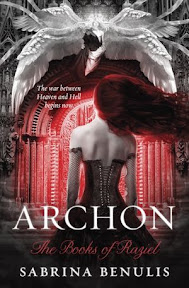
Sabrina Benulis

Sabrina Benulis graduated with a master’s in writing popular fiction from Seton Hill University. She currently resides in the Pocono Mountains of Pennsylvania with her husband, Mike, and her spoiled cockatiel, Caesar.

Last year's Archon is her debut novel.

From her Q & A with Jessica Strider:

What drew you to writing about angels?

I always wanted to write a story that was more about angels and demons as they are truly portrayed in history and religion: powerful, otherwordly beings, that are in very many ways both similar to humans and utterly beyond us. It was that mix of beauty and ambiguous morality that attracted me. Many people do not think of angels as aliens, but in their strictest definition, they very much are.

What's special / different about your angels?

My angels are sexy, seductive, creepy and terrifying all at the same time. 'Terrible beauty' is what immediately comes to mind. The Books of Raziel really shows just how awesomely dangerous the supernatural can be. Yet at the same time, these angels can be very human. Their morality is not ours, but they can be so human--damaged, emotional, with a very mortal kind of love as the driving force behind their most sublime or terrible actions.

What made you want to be a writer?

I wanted to be a writer merely so I could share the visions of the worlds I create. For me, that's what it's all about.

Who is you favourite character in the book and why?

My favorite character in the novel is probably Troy. Sadly, she does not have a ton of 'screen time' in ARCHON, but her role expands very much in the following books. Troy is a character who comes off as typical demon--at first. Eventually...[read on]
Visit Sabrina Benulis's website, blog, and Facebook page.

My Book, The Movie: Archon.

Writers Read: Sabrina Benulis.

--Marshal Zeringue

Wednesday, January 18, 2012

Jennifer Egan

Jennifer Egan's books include The Invisible Circus, which was released as a feature film by Fine Line in 2001, Emerald City and Other Stories, Look at Me, which was nominated for the National Book Award in 2001, The Keep, and A Visit From the Goon Squad, a national bestseller, won the 2011 Pulitzer Prize, the National Book Critics Circle Award for Fiction, and the LA Times Book Prize.

From her interview by Killian Fox for the Observer:

[A Visit From the Goon Squad] ranges backwards and forwards in time, between San Francisco in the 70s and a futuristic New York, and has a big cast tangentially connected to one another. Did it require meticulous planning?

No: the opposite, I write totally spontaneously. I actually write fiction by hand – that always seems to startle people. I think the reason I do that is to bypass the thinking part of me and get to the more unconscious part, which is where all the good ideas seem to be. I've tried working on a word processor because I would love to be faster but it just doesn't seem to work. Goon Squad took about three years to write and that's the short end. My second novel, Look at Me, took six years.

Most of the characters in the book are linked to the music industry. How much time have you spent in that world?

Not as much as you might think. People who read this book tend to think I'm a music geek – but I never really write about my own life. I did once get a journalistic assignment to write about a pair of identical-twin female rappers called Dyme, but it came to nothing – although there's a bit of their DNA in the Stop/Go sisters in the book: they also lived in Mount Vernon, and had an orange shag carpet in the recording studio that their dad built them, so I got something out of it.

But the rest came from your imagination?

I did do a fair amount of...[read on]
Look at Me and A Visit from the Goon Squad appear among Julie Christie's seven favorite books.

--Marshal Zeringue

Tuesday, January 17, 2012

Jodi Kantor

Jodi Kantor is a Washington correspondent at the New York Times. From a Q & A about her new book, The Obamas, with Elizabeth Day at the Observer:

One of the most interesting chapters in your book deals with the discomfort faced by the Obamas when they realised most of the staff in the White House are of African-American descent. Has their tenure improved race relations in the US?

It's way too early to tell. When I wrote the book, I felt that that question was still beyond our grasp. The question I focused on was: what is the day-to-day experience of being the first African-American president and first lady? For example, when the invitation came for Michelle Obama to appear on the cover of Vogue, her advisers were split by race. The African-American advisers really wanted her to do the cover because not that many African-American role models had done so. On the other hand, the white advisers were far more cautious because the country was in terrible economic straits and Vogue is a pure luxury magazine – the newsstand price alone is something like $5. In fact, she chose to do the cover and there was very little criticism. To me, that is one tiny look into the real mosaic of what's going on.

Have the Obamas read the book?

I don't know. I haven't heard back.

You say in your acknowledgements that you became a political reporter for the New York Times at the same time as you became a mother, did you ever find it hard to balance the two?

At one point during the 2008 campaign I got called up and screamed at by an Obama aide. It was 7pm and I'd just got home. My daughter was about two and she was sitting on my lap and she took control of the cell phone and began singing the Barney song down the phone: "I love you, you love me. We're as happy as can be." It was just surreal and kind of amazing on her part. In a way, it was the best thing to say to an over-agitated campaign aide.

Your book makes it clear the Obamas have distinct personalities – you say he's more cerebral, finds it difficult to connect with the public, whereas she's warmer and more feisty. Do you think it's the differences rather than the similarities that make their marriage work?

Absolutely. I don't think he would be president without Michelle Obama because she's the one who connects him with other people.

Can a marriage ever truly be one of equals when one partner is the leader of the free world?

The answer to that is...[read on]
--Marshal Zeringue

Monday, January 16, 2012

Krys Lee

Krys Lee was born in Seoul, South Korea, raised in California and Washington, and studied in the United States and England. She was a finalist for Best New American Voices in 2006, and her work has appeared in The Kenyon Review, Narrative Magazine, California Quarterly, Pacific Ties, The Korea Times, and Asia Weekly.

Viking will release her debut short story collection Drifting House in early February.

From a Q & A at the author's website:

DRIFTING HOUSE is a beautiful collection of short stories that portray life in South Korea, North Korea, and as a Korean-American in the US. They depict a fractured world. Where did the stories come from: personal experience, observations, or something else?

The stories arose from personal experiences as well as my observations and reactions toward the societies around me. Fractured is an interesting, important word for me; being animmigrant in the United States with parents who were afraid of America lends itself to a kind of fracturing. Our house was a Little Korea, and I was fascinated by the homes of American friends that I’d visit because their way of being was so culturally different. There were other, more violent and painful fractures that influenced my life and inevitably, my stories. But my sense of story is usually more Jamesian; the autobiographical impulse is buried in character and thematic obsessions rather than in the plot.

The world around me was also a large influence. When I wrote “The Salaryman’, for instance, I was in a relationship with a Korean man who was diminishing as a personality while working inhuman hours at a Korean conglomerate. “Drifting House’ was written after I became friends with activists and North Korean defectors. I cried many times, hearing and reading stories about people I knew, before this sadness changed into anger at a regime that destroys its own people. “The Goose Father’ was also written after people I knew personally began departing South Korea, leaving their husbands behind to fund their family’s flight to an overseas education for their children. Though all sacrifice in this situation, my sympathies were with...[read on]
--Marshal Zeringue

Sunday, January 15, 2012

David Vann

David Vann's latest novel is Caribou Island.

From his 2010 interview by Matt Scheiner:

WSJ: How did your own life experiences help to shape the narrative of “Caribou Island”?

There were two family stories in the background that were true stories. One right on the opening page is the suicide of my Grandmother’s mother on my mother’s side. It happened in British Columbia and it is unclear how it happened, because there is so much shame around a suicide, she never really talked about it and my mom’s story has shifted over the years. The other true story in the background is the murder-suicide of my stepmother’s parents. My stepmother’s father told his wife that the last 15 years of marriage had been a lie, and he had been having an affair with another woman and was moving on without her. So she killed him before killing herself, and that was always a very disturbing event for me from when I was 12.

All of the characters in “Caribou Island” seem so real and identifiable, especially the frayed relationship between Irene and Gary, the unhappily married couple of 35 years.

It wasn’t until six months after writing the book that I realized that I was Irene in many ways, and that was actually a shock to me. I have this long legacy of suicide in my family like she does, and I have some of the same views of men in my family as she does of Gary. But I also think in some ways that I am Gary, too. This book was the first time that I realized that an author is...[read on]
Visit David Vann's website.

Saturday, January 14, 2012

Jeff Abbott

From author Jeff Abbott's interview by Paige Crutcher:

AUTHORLINK: As a child, what did you want to be when you grew up?

ABBOTT: I wanted to be a marine biologist or an astronomer, which is weird, because I was never that good at science. I was more just curious about the world. When I was about ten I decided I wanted to be a writer and I never really wavered from that ambition, even if it was a secret one.

AUTHORLINK: What do you believe makes a great story? Is there an element that you believe must be present?

ABBOTT: Conflict. And it seems so obvious but I meet a fair number of aspiring writers who think conflict is unnecessary, or worse, somehow beneath them. There has to be powerful internal and external conflict facing your protagonist for readers to care about reading your story.

AUTHORLINK: JT Ellison has called you “a writer’s writer.” Will you share a little about your writing process?

ABBOTT: It is not really a glamorous process. I think first of either an interesting situation or a character; either can come first. And then I start to wonder, what happens next? I'll scribble some notes, maybe write down some ideas for scenes. If I let the idea brew long enough, one of two things happen: I decide I don't want to write it, or I do. Then I will sketch out the major scenes of the book — the critical turning points, the biggest moments of choice for both the protagonist and the antagonist. With those as a framework I can start to write. Often towards the final part of the book I'll craft a careful outline to make sure I'm resolving everything in a way I like, giving the reader the emotional payoffs for the rest of the story.

AUTHORLINK: Characters are often the heart of a story, and in your novels suspense acts as its own character. How do you create such authentic anticipation?

ABBOTT: Well, I think you have to...[read on]
Visit Jeff Abbott's website and blog.

The Page 69 Test: Trust Me.

The Page 69 Test: Adrenaline.

Writers Read: Jeff Abbott.

--Marshal Zeringue

Friday, January 13, 2012

Sarah McCoy

Sarah McCoy's new novel is The Baker's Daughter.

From her Q & A with Lisa See:

Lisa: [The Baker's Daughter] moves back and forth between two vastly different settings: present-day America on the Tex-Mex border and Nazi Germany at the end of World War II. What inspired you to pair the two?

Sarah: It does seem obscure, and that’s why I found their association so captivating. I spent a portion of my childhood in Germany where my dad, a career military officer, was stationed. My husband also grew up in Germany, speaks fluent German, and worked there during his summers in college. When we moved to El Paso, the local magazine asked me to write a feature article on the German community. “There’s a German community?” I asked. Yes—a thriving one. Way out on the corner of Texas, barely clinging to the edge of the United States, is a sizable German air force base. Apparently the Luftwaffe has trained fliers in the United States since 1958. In 1992, they consolidated their troops at Holloman Air Force Base, New Mexico, just up the road from El Paso.

Not long after that article ran, I went to a local farmer’s market and met an 80-year-old German woman selling bread. I was completely smitten by her, and all that I imagined she might have experienced in her life. While picking out my brötchen, I asked how she came to be in El Paso. “I married an American soldier after the war,” she told me. Voila! Elsie, my 1945 protagonist, was born. My memories of living and traveling in Germany served as my imaginative landscape and fueled my...[read on]
Learn more about the book and author at Sarah McCoy’s website and blog.

The Page 69 Test: Sarah McCoy's The Time It Snowed in Puerto Rico.

--Marshal Zeringue

Thursday, January 12, 2012

Ben Kane

Ben Kane's books include The Forgotten LegionThe Silver Eagle, and The Road to Rome. He lives in North Somerset, England.

From his Q & A with Boyd Tonkin at the Independent:

Choose a favourite author, and say why you admire her/him

Rosemary Sutcliff. I was probably no older than nine or 10 when I read 'The Eagle of the Ninth' and it had a huge influence on me; it's one of the reasons I ended up writing about Rome. I was so struck by her imagery of Hadrian's Wall and the wilds of Scotland, and the idea of the soldiers disappearing there.
* * *

Which fictional character most resembles you?

Probably Romulus, the main character in my first trilogy ['The Forgotten Legion Chronicles']. Everyone who writes probably puts a lot of their own feelings and beliefs into their characters.
* * *

Who is your hero/heroine from outside literature?

Ellen MacArthur. Because she had an ambition to do something completely out with her life experience, and she went and....[read on]
Visit Ben Kane's website and blog.

Writers Read: Ben Kane.

My Book, The Movie: The Forgotten Legion trilogy.

The Page 69 Test: The Road to Rome.

--Marshal Zeringue

Wednesday, January 11, 2012

Deborah Harkness

From a Q & A with Deborah Harkness about her novel, A Discovery of Witches:

Diana is an appealing heroine, determined, accomplished, and yet aware of her own weaknesses. In what ways, if any, does Diana reflect your own experience or personality?

There are some similarities—Diana is also a historian of science, also interested in the history of alchemy, and shares some of my passions (including television cooking programs, tea, and rowing). Really, all the characters have some element of me in them. I think that's how authors create imaginary people who nevertheless feel real. The rest of Diana's character comes from a combination of qualities I admire in others, wish fulfillment, and my completion of the following statement: "Wouldn't it be great if a heroine in a book was…"

How did you become interested in the intersection of alchemy, magic, and science? Historically, what do you see as the relationship between science and religion or mysticism?

In college, I had a wonderful professor who taught a class on these subjects. To kick off the class, he asked us, "How do you know what you think you know?" I've spent the last quarter century trying to answer that question. Because the world is a mysterious place and our relationship to it is not always clear, people have often turned to science, faith, and magic for answers. They help people find responses to the questions...[read on]
--Marshal Zeringue