Saturday, June 20, 2015

Etgar Keret

Etgar Keret’s new book, The Seven Good Years, is a memoir.

From a Q & A with Tobias Carroll at his publisher's website:

Have you found that your writing is viewed differently from country to country? As a writer who occasionally writes about Israeli politics, are those pieces received differently in, say, New York than in Israel?

There is a difference, of course, between writing fiction and writing op-eds. The reaction to op-eds is different between Israel and overseas. But when it comes to stories … In Israel, I’m much more well known than anywhere else in the world. Some of my stories are in high school curriculums; basically, every student who’s graduated knows at least a couple of my stories. My books sell about 100,000 copies. There are fewer than six million Hebrew speakers, so [a large percentage] have read my work. Even the countries where I’m the most successful, like Poland or Turkey or Mexico, I’m not as well known as I am in Israel. There’s something about a dialogue; there’s a different dialogue when you’re a literary writer than when you’re seen as a best-selling author. This affects the kind of dialogue I have.

In different countries, people get connected to different stories. I get asked different questions. For example, I just came from Vietnam. The most common question that I was asked, both in interviews and in reading events, was: How do I know when a story ends? That was a question that I had never been asked, anywhere else on earth. I remember that when one of my books appeared in Korea, everybody asked me about a story called “Black and Blue,” from Suddenly, a Knock at the Door. This book has appeared in more than 20 countries, and no one had asked me about that story anywhere else; in Korea, everyone asked me about it. Different stories resonate...[read on]
--Marshal Zeringue

Friday, June 19, 2015

Beth Cato

Beth Cato is the author of The Clockwork Dagger and its sequel, The Clockwork Crown, newly released from Harper Voyager.

From her Q & A with Sam Riedel for the B & N Sci-Fi & Fantasy Blog:

There’s a big push in genre fiction of all kinds for more diversity and varied characters. Did you feel pressured to do that or did it come as a natural part of world-building?

I wanted to do that, because I live in a colorful world. I grew up in California, and I moved from there to South Carolina and Washington, so I’ve seen the racial demographics across the country. When I lived in South Carolina, it was really weird to me, because for the first time in my life, I wasn’t surrounded by people speaking Spanish. And no mariachi music. But I was surrounded by more black people than I was used to. And then I went to Washington, and I told my husband—he grew up in New Mexico, and we’re like, “We are weirdly surrounded by lots of white people.” To me, it’s a colorful world, and you don’t see that on the covers of books so much. To me, it’s a no-brainer—there needs to be diversity.

Clockwork Crown has a huge number of characters of color. Throughout most of the first half of the book, the background characters—that’s what they look like. And it’s a subtle thing, it’s not something I dwell on much in the book, but I like that there’s an assumption there that you don’t always have to say what someone’s color is. They are who...[read on]
--Marshal Zeringue

Thursday, June 18, 2015

Anna North

Anna North graduated from the Iowa Writers Workshop in 2009, having received a Teaching-Writing Fellowship and a Michener/Copernicus Society Fellowship. Her fiction has appeared in Nautilus, Glimmer Train, the anthology Robot Uprisings, and the Atlantic Monthly, where it was nominated for a National Magazine Award. Her nonfiction has appeared in the San Francisco Chronicle, The Paris Review Daily, Jezebel, BuzzFeed, and Salon, and she is now a staff editor at the New York Times.

North's first novel, America Pacifica, was published in 2011. Her new novel is The Life and Death of Sophie Stark.

From the author's Q & A with Karan Mahajan for Salon:

When the book starts it seems to be about gender issues and sexual violence in a very direct way, but then it homes in on a series of male characters struggling with their confidence in the aftermath of trauma. Were you surprised by the direction the book took?

I’m actually still surprised that there are more male narrators than female in the book, because I think of myself as someone who writes about women and because I think of Sophie Stark as so much the story of a woman. But I kind of like that there are so many men. As I mentioned, I thought a lot about male artists while I was writing the book — men like Pablo Picasso or Jackson Pollock or Ernest Hemingway who caused a lot of pain for the people around them but who are still kind of remembered as heroes. And so often when we hear the stories of those artists we hear about “the women who loved him,” all these women who are at the periphery while the man is at the center. I like the idea of flipping that on its head, of having all these men tell the story of one woman. Which isn’t to say I don’t care deeply about the male characters in the book; I do. But ultimately it’s...[read on]
The Page 69 Test: The Life and Death of Sophie Stark.

--Marshal Zeringue

Wednesday, June 17, 2015

Tim Weiner

Tim Weiner's new book is One Man Against the World: The Tragedy of Richard Nixon.

From his Fresh Air interview with Terry Gross:

TERRY GROSS: Tim Weiner, welcome back to FRESH AIR. So Nixon's deceit about the war in Vietnam begins before he's even elected. He tried to discourage South Vietnam from agreeing to a peace deal before the election 'cause Nixon - well, what did Nixon tell South Vietnam about that? This is when he was running against Hubert Humphrey.

TIM WEINER: In the summer and fall of 1968, Richard Nixon, working through his campaign manager and future attorney general, John Mitchell, and a mystery woman, whose real name was Anna Chennault but who was known to one and all as the Dragon Lady and had a suite in the Watergate Hotel complex, went to the ambassador of South Vietnam and said tell your boss the President of South Vietnam and said, tell your boss, the president of South Vietnam, President Thieu, don't cut a deal with the Democrats. We are going to win, and we will cut you a better deal. We will make sure that you, President Thieu, survive. There will be no coalition government. Do not agree to a peace deal. Wait for us. And, in fact, Nixon got word through to President Thieu through these intermediaries. President Johnson knew this because the FBI and the National Security Agency, respectively, had bugged the embassy of South Vietnam in Washington and the presidential palace in Saigon, and they knew about these backchannel communications. And when Johnson found out on the eve of the 1968 election, which his vice president, Hubert Humphrey, was running against Richard Nixon, whom he had hated ever since they were both in the Senate in the early 1950s, he went ballistic.

Here was the problem - the evidence that was gathered that Nixon was sabotaging the peace talks had all been gathered through the surveillance powers of the NSA and the FBI. You couldn't reveal it. On the other hand, what Nixon and his accomplices were doing was a violation of law called the Logan Act. You can't be a private citizen doing diplomatic negotiations with another country. And Johnson and his men gathered and said, what are we going to do about this? And they couldn't reveal the evidence. It was too secret. But Johnson knew, and he called Nixon - and he called him and he said, you better not do this. And Nixon said, I would never do that. But he did.

GROSS: Did Nixon actually scuttle a plan - a peace plan that might have succeeded? Was there the real possibility of peace?

WEINER: I'm going to quote Phil Habib, who was a senior State Department official at the Paris peace talks and who continued to serve loyally under Richard Nixon. Quote, "The deal was cooked, and then something happened. Somebody got to Thieu, President Thieu, of South Vietnam. Somebody got to Thieu on behalf of Nixon and said, don't agree, don't come to Paris." And Habib said, "I'm convinced that if Humphrey had won the election, the war would've been over much sooner." And, in fact, the peace deal that Nixon finally cut was no better than the one that could've been cut in October 1968.

GROSS: There were so many lives lost in the interim.

WEINER: There were roughly 25,000 American soldiers killed in the interim. There were at least 10 times that number...[read on or listen to the interview]
--Marshal Zeringue

Tuesday, June 16, 2015

Adam Benforado

Drexel University law professor Adam Benforado's new book is Unfair: The New Science of Criminal Injustice. From his interview with NPR's Scott Simon:

SIMON: Your strongest recommendation in this book - dare I say most controversial - is to do away with live trials and create virtual trials. What would this do?

BENFORADO: So this is one of the proposals that I lay out really for far in the future. And why I recommend it is there's so many biases that psychologists have uncovered, so at trial it shouldn't determine the outcome - what color of skin the attorney representing the accused has or whether he has, you know, a particular inflection. And yet, we know that those things matter. And I don't think it's as radical as it might seem. There are certain constitutional problems related to the confrontation clause and...

SIMON: The right to confront your accuser - and that's not a virtual right. I mean, you're supposed be able to look your accuser in his or her face.

BENFORADO: Yeah, although we have already made exceptions in a lot of different areas.

SIMON: I have to ask you, professor, if you were to be (laughter) unjustly arrested I'm sure and put on trial, wouldn't you want the right to see 12 flesh-and-blood human beings like yourself sitting across from you and make your own best case?

BENFORADO: So I think that I would be more comfortable with a system that...[read on or listen to the interview]
--Marshal Zeringue

Monday, June 15, 2015

Emma Sky

Emma Sky is a senior fellow at Yale University’s Jackson Institute. Sky served as advisor to the Commanding General of US Forces in Iraq from 2007-2010; as advisor to the Commander of NATO’s International Security Assistance Force in Afghanistan in 2006; as advisor to the US Security Co-ordinator for the Middle East Peace Process in 2005; and as Governorate Co-ordinator of Kirkuk for the Coalition Provisional Authority, 2003-2004.

Her new book is The Unraveling: High Hopes and Missed Opportunities in Iraq. From Sky's Q & A with Tim Lewis for the Guardian:

When you told the Iraq inquiry – also known as the Chilcot inquiry – how you ended up in Iraq, they scarcely believed you. Can you explain?

Well, I was working for the British Council and I volunteered to go to Iraq in 2003. The British government said it would be for three months, before we handed the country back to the Iraqis. I was against the war and I thought this would be penance: I can go and apologise to everybody and help them rebuild. I’d spent a decade working Israel-Palestine, so I’d got experience in conflict mediation and institution development, and I thought I’d be useful. I didn’t know what my job was going to be, but when I arrived in Kirkuk, I was told: “Great! You are now the governor coordinator, you are in charge of the province.” It was a slightly embarrassing position to be put in.

Did you feel at all qualified?

No, not at all. And in my first week, insurgents came to the house where I was living and blew the house up with me in it. I survived, thank God, but I had nowhere to live. I went to see a US colonel to ask for accommodation and he said: “We’re going to hunt those people down!” And I was: “No, no, no, they were attacking me because I’m a symbol of an illegal occupation.” So I went back...[read on]
Learn more about The Unraveling at the publisher's website.

The Page 99 Test: The Unraveling.

--Marshal Zeringue

Sunday, June 14, 2015

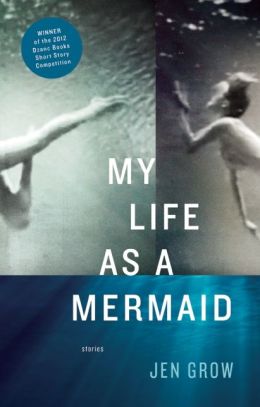
Jen Grow

Jen Grow is the author of My Life as a Mermaid, and Other Stories.

From her Q & A with Caroline Leavitt:

A lot of the stories have to do with water, which fascinated me. Even the cover, which is beautiful, shows two bodies under water. There’s that sense of floating through life, and not really being a part of it--at least for me. Could you comment?

I really like to swim. I turn into an eight year old kid when I’m near a body of water. Even now, forty years later, I still do this weird thing where I sort of plop headfirst into the pool so I can feel disoriented for a few seconds. I do it on the sly now, because let’s face it, I’m a middle-aged woman and it’s embarrassing when kids and adults ask me if I’m trying to teach myself to dive. And also, I swim where Michael Phelps and other Olympic athletes train. The pool is full of serious, vigorous swimmers, and then there’s me on the side, doing my head-plop into the water. Just so I can get dizzy and momentarily separate myself from the world. The muffling effect of water is such a great thing! That says way more about me than I probably should admit, but you’re right about my characters floating through life without being a part of it. That’s me, to some degree, a fish trying to describe water. Monet’s impressionism, I’ve heard, was born partially out of his nearsightedness. Maybe my writing is the same: I have blurry, aquatic vision and so I...[read on]
--Marshal Zeringue

Saturday, June 13, 2015

Ingrid Thoft

Ingrid Thoft's latest novel featuring Boston P.I. Fina Ludlow is Brutality.

From a Q & A at her website:

1. Tell us a little bit about your heroine, Fina Ludlow. How do you see her, and how did you begin to conceptualize her?

I wanted to create a strong, funny and flawed female protagonist who would push the limits and do all the things I’m too well-mannered to do! Like so many readers, I was fascinated by the Lisbeth Salander character in the Stieg Larsson books. She is strong, brash, and violent and operates outside of society’s norms. That character was born of abuse and neglect and didn’t have a “normal” family. I wondered what would happen if you created a character who was also strong minded and independent, but came from a domineering family unit and had to operate within the bounds of that family. If you have nothing holding you back and nothing to lose—like Lisbeth Salander—your actions can be extreme. But if you’re trying to operate within a family system and maintain your standing in that family, you have more to lose, and the stakes can be quite high.

2. You actually attended and graduated from the University of Washington certificate program in private investigation. What drew you to this program?

I sought out the program when I made the decision to create a character who is a professional investigator rather than an amateur detective. This decision was based on the limitations I encountered in an unpublished series I had already written featuring an amateur sleuth. Over time, I found her amateur status to be problematic as she could only stumble over so many bodies before it strains credulity! So I made the main character a professional investigator, which opened up a lot of possibilities and gives me options as the series progresses.

Having made that choice, I wanted to...[read on]
Visit Ingrid Thoft's website.

--Marshal Zeringue

Friday, June 12, 2015

Amy Greene

Amy Greene's books include 2014's Long Man.

From her Q & A with Annasue McCleave Wilson for Publishers Weekly:

The major event in this novel is a cataclysmic, man-made flood in East Tennessee in 1936, resulting from a TVA hydroelectric dam project. You grew up in the region and still live there—did any of your forebears experience this historical incident?

My family’s 40-acre farm was spared by the floodwaters, but Cherokee Lake [the lake created by the dam], which inundates our part of the valley, is less than 10 miles from the house my grandfather built. When the water is low in winter, you can see the beginnings of roads leading to the town underneath. As a child, I was fascinated by the silos rising from the middle of the lake. When I started doing research for the novel, I learned land that had been in families for generations was lost underwater. The bones of loved ones were disinterred [from graveyards covered by floodwaters] and moved, and thousands of families were displaced. It was easy to imagine the heartbreak Roosevelt’s New Deal caused during the 1930s, but for my own family, it was a blessing. Before, people here were starving and...[read on]
Visit Amy Greene's website.

The Page 69 Test: Bloodroot.

--Marshal Zeringue

Thursday, June 11, 2015

Stephen W. Kress

Stephen W. Kress is the National Audubon Society’s Vice President for Bird Conservation and director of the Audubon Seabird Restoration Program and Hog Island Audubon Camp. He is the author of Project Puffin: The Improbable Quest to Bring a Beloved Seabird Back to Egg Rock.

From his Q & A at the Yale University Press blog:

YUP: When you first started out, eminent ornithologists posed the question to you: why bother bringing puffins back to Maine since people could go see puffins in Iceland where they are still very abundant? Now that you have re-established the puffins, what is the most important reason for people to still pay attention to the bird, other from the fact they are colorful and charismatic?

SK: The threats that affect birds such as puffins today are far greater than the gunner’s bullets that nearly wiped out Maine puffins one hundred years ago. Because puffins are at the absolute southernmost end of their known breeding range in North America, it is likely to be one of the birds to best gauge climate change in our oceans. Because the forage fish which puffins rely on to raise their chicks are sensitive to ocean temperatures, we can learn about climate change by observing the foods which puffins feed their chicks. These observations can also inform us about the state of many ocean fish that are important to people as well as puffins. Many of these species are now vulnerable to commercial overfishing.

We already know that lobsters as a species have moved more than forty miles north in the last decade with warming waters. Puffins can’t move with the changing ocean temperatures because they are linked to land where they must nest on just a few islands that provide for their special needs. It is no surprise that in recent years we are also seeing puffins bring in fish for the chicks more known in mid-Atlantic waters. The concern is that while some species are edible, nutritious and the right shape for chicks, other species are not. The same fish are also used for livestock feed, fish farming, and even nutritional supplements in unsustainable ways. Puffin adults are amazingly adaptable to catch whatever is available. The big question is what will be available in the coming decades.

Because puffins are so charismatic, they capture the plight of other seabirds and the health of the seas. I believe that they can help to engage more people with protecting oceans from climate change, pollution and overfishing. Puffins are the pandas of the sea and among...[read on]
--Marshal Zeringue