Friday, February 10, 2017

Brian W. Kernighan

Brian W. Kernighan is the author of Understanding the Digital World: What You Need to Know about Computers, the Internet, Privacy, and Security. From his Q&A with Debra Liese for the Princeton University Press blog:

Who is this book for? What kind of people are most likely to be interested?

BK: It’s a cliché, but it really is aimed at the proverbial “educated layman.” Everyone uses computers and phones for managing their lives and communicating with other people. So the book is for them. I do think that people who have some technical background will enjoy it, but will also find that it will help their less technical friends and family understand.

What’s the basic message of the book?

BK: Computers—laptops, desktops, tablets, phones, gadgets—are all around us. The Internet lets our computers communicate with us and with other computers all over the world. And there are billions of computers in infrastructure that we rely on without even realizing its existence. Computers and communications systems have changed our lives dramatically in the past couple of decades, and will continue to do so. So anyone who hopes to be at least somewhat informed ought to understand the basics of how such things work. One major concern has been the enormous increase in surveillance and a corresponding reduction in our personal privacy. We are under continuous monitoring by government agencies like the NSA in the United States and similar ones in other countries. At the same time, commercial interests track everything we do online and with our phones. Some of this is acceptable, but in my opinion, it’s gone way too far. It’s vital that we understand better what is being done and how to reduce the tracking and spying. The more we understand about how these systems work, the more we can defend ourselves, while still taking advantage of the many benefits they provide. For example, it’s quite possible to explore interesting and useful web sites without being continuously tracked. You don’t have to reveal everything about yourself to social networks. But you have to know something about how to set up some defenses. More generally, I’m trying to help the reader to reach a better than superficial understanding of how...[read on]
--Marshal Zeringue

Thursday, February 9, 2017

Katherine Zoepf

Katherine Zoepf is the author of Excellent Daughters: The Secret Lives of Young Women Who Are Transforming the Arab World. From her Q&A with Deborah Kalb:

Q: You write, “Like a generation of young Americans, my interest in the Arab world was substantially shaped by the September 11th attacks.” How did you end up spending so much time in the Middle East after that, and focusing particularly on the region’s women?

A: I had been someone before that who followed the news pretty keenly but I wouldn’t say I had a particular regional interest. I was right out of college and was curious about a lot of things.

At the time of the Sept. 11 attacks, I had just moved to New York and one of my classmates was killed, and suddenly I became a little obsessed with getting to the region and learning as much as I could. I’ve always been someone who understands things better when I can try to go to the place and see how the world looks from there…

Q: And the focus on women?

A: That came a little bit later. It was a natural interest. I went initially to the region as a news reporter. I was just doing ordinary…Middle East coverage from Syria and Lebanon.

I came to feel in the aggregate the Middle East reporting Americans were getting didn’t convey an overall picture of the region that felt very true to me.

I would go home to the States every few months—my friends and family were reading things [I and others were writing] and the questions they were asking, don’t you think people are brainwashed?

I realized that looking at the Middle East from afar, there was a picture of...[read on]
--Marshal Zeringue

Wednesday, February 8, 2017

Hugo Drochon

Hugo Drochon is a historian of nineteenth- and twentieth-century political thought and a postdoctoral research fellow at CRASSH, the Centre for Research in the Arts, Social Sciences, and Humanities, at the University of Cambridge.

His new book is Nietzsche's Great Politics.

From Drochon's Q&A with Sean Illing at Vox.com:

Sean Illing: You don’t really write about Trump in the book, but you’ve suggested elsewhere that he’s a sort of caricature of Nietzsche’s idea of the ubermensch (often mistranslated at “superman”). Is that right?

Hugo Drochon: Well I've heard it said that Trump may represent some approximation of Nietzsche's ubermensch, and I think that's deeply mistaken. But the reasons why it's mistaken can help us think about what Trump actually is. First, it's wrong because Trump represents everything Nietzsche hated. The philistinism, the mediocrity, the worshipping of money for its own sake — this is exactly the opposite of what Nietzsche advocated. By ubermensch, Nietzsche meant someone who could live beyond good and evil, beyond conventional values, who refused to appeal to herd instincts.

There's a passage in Nietzsche's Thus Spoke Zarathustra in which he talks about the ubermensch, and I think it's quite relevant. Zarathustra, the protagonist, comes down from his mountain retreat and tells the people in the town square that he's going to teach them about the ubermensch, about what mankind should become, and the people are having none of it. They don't want to hear that they’ve stopped believing in God; that life is chaos; that nothing lasts; that they’re living in illusion.

Zarathustra realizes the people are too decadent to hear this and so he decides instead to teach them about the "Last Man." And the “Last Man” is the kind of person who doesn't want to think, who fears progress, who is risk-averse and desirous of comfort, who just wants everything to stay the same. Of course, the people erupt in joy when they hear this because this is what they really want.

This is what Trump is to me. This is what he represents. He's a kind of "Last Man" demagogue, telling the people that he's going make things great again, which is to say simple and how they once were — and they love him for it.

For Nietzsche, the celebration of a man like Trump was the inevitable result of...[read on]
The Page 99 Test: Nietzsche's Great Politics.

--Marshal Zeringue

Tuesday, February 7, 2017

Caroline Leavitt

Caroline Leavitt is the author of Cruel Beautiful World, and the New York Times bestsellers Is This Tomorrow and Pictures of You, as well as eight other novels.

A book critic for the San Francisco Chronicle and People, she’s the recipient of a New York Foundation of the Arts Grant in Fiction, and was a finalist in both the Sundance Screenwriters’ Lab and the Nickelodeon Screenwriters’ Fellowships.

From Leavitt's Q&A with Beverly Willett at South Magazine:

What’s the most profound thing you’ve uncovered about yourself?

It was with my current novel. I ended up writing about my relationship with my real-life sibling. I meant it to be a love letter to our relationship. Growing up she was my hero. And then she changed and became troubled and unhappy. And I’m this Pollyanna. I kept trying to help her and the more I tried the worst things became with us. As I was writing, the question became “how do you help someone you love when they don’t want your help?” The answer is...[read on]
Learn more about the book and author at Caroline Leavitt's website and blog.

The Page 69 Test: Pictures of You.

My Book, the Movie: Pictures of You.

The Page 69 Test: Is This Tomorrow.

My Book, The Movie: Is This Tomorrow.

My Book, The Movie: Cruel Beautiful World.

The Page 69 Test: Cruel Beautiful World.

Writers Read: Caroline Leavitt (October 2016).

--Marshal Zeringue

Monday, February 6, 2017

Peter Swanson

Peter Swanson is the author of three novels: The Girl With a Clock For a Heart, a LA Times Book Award finalist; The Kind Worth Killing, winner of the New England Society Book Award, and finalist for the CWA Ian Fleming Steel Dagger; and his most recent, Her Every Fear.

From his Q&A with Deborah Kalb:

Q: How did you come up with the idea for Her Every Fear, and for the book's title?

A: I’ve had the idea for many years although initially I thought of it as more of a love story than a murder mystery. I thought it would be interesting to have two characters fall in love with one another by living in each other’s apartment. I think it’s a much better story with a murder in it.

About the title, it was originally going to be just “every fear” which I took from James Fenton’s poem “A Staffordshire Murderer.” But I think “Her Every Fear” is catchier, and a better description of the book. Much of my main character Kate Priddy’s anxieties center on being a...[read on]
Read about Swanson's ten top books about voyeurs.

Visit Peter Swanson's website, Facebook page, and Twitter perch.

My Book, The Movie: The Kind Worth Killing.

The Page 69 Test: The Kind Worth Killing.

Writers Read: Peter Swanson (February 2015).

--Marshal Zeringue

Sunday, February 5, 2017

Katie Kitamura

Katie Kitamura's new novel is A Separation. From the transcript of her interview with NPR's Scott Simon:

SIMON: I'm going to try and be obscure about this.

KITAMURA: Oh, OK. I think I know what's coming (laughter).

SIMON: Well, midway through the novel...

KITAMURA: Yes.

SIMON: ...Da-da-dum (ph) - there's a murder. A lot of novels - a lot of novelists would use the mystery of a whodunit as a kind of lure to bring the reader through the rest of the story.

KITAMURA: Mm-hm.

SIMON: I'll leave it there.

KITAMURA: Right. I mean, so that is probably the primary big piece of plot that happens in the book. One of the things that I was thinking about a lot when I was writing the book was if it would be possible to write something that really was about the mind and the consciousness of the narrator and where the real so-called plot developments that happen aren't things that happen out in the world. They aren't bits of action - somebody arrives, somebody leaves, somebody gets killed, somebody robs a bank, whatever it is.

And so I think the most dramatic shifts that happen in this story have to do with changes in perception on the part of the narrator, the way she comes to understand less and less of what she feels towards Christopher. To me, those are the most important and dramatic shifts. So that's why, in a way, I didn't want to use the kind of conventional plot device of a kind of mystery, although I think, in a lot of ways, I did try to steal...[read on]
Visit Katie Kitamura's website.

--Marshal Zeringue

Saturday, February 4, 2017

Holly Webb

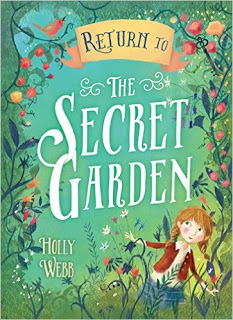
Holly Webb's new novel for children is Return to the Secret Garden.

From her Q&A with Deborah Kalb:

Q: How did you come up with the idea for Return to the Secret Garden?

A: It was a conversation with my editor, almost five years before I wrote the book. We were talking about our favourite books as children, and she suggested writing a sequel to The Secret Garden, which we'd both loved.

At the time I was shocked - I'd never considered it, and I wasn't sure how to approach someone else's characters, and the amazing setting of the original. But the idea grew on me slowly!

Q: How familiar do you think your readers will be with the original, and what did you see as the right balance between the original Secret Garden and your own characters?

A: It's so interesting. Lots of adults have told me that...[read on]
--Marshal Zeringue

Friday, February 3, 2017

Heather Graham & Jon Land

Heather Graham is a New York Times and USA Today bestselling author. She has written over one hundred novels and novellas including category, suspense, historical romance, vampire fiction, time travel, occult and Christmas family fare. Jon Land is the USA Today bestselling author of thirty-eight novels, including the bestselling series featuring female Texas Ranger Caitlin Strong. He is also the co-author of the nonfiction bestseller Betrayal. Their new novel is The Rising.

From the authors' Q&A with April Snellings for The Big Thrill:

THE RISING centers on a pair of fascinating characters: a high school football star raised by his adoptive Chinese parents, and a female science prodigy who serves as his ally, protector, love interest, and all-around foil. Can you tell us a bit about developing those characters?

HG: I think it’s something we often come across in life—not so much love at first sight, but incredible admiration, and then caring more and more deeply as you come to realize just how wonderful another person is. Life can be so superficial. I think that it was important to us that Sam and Alex come together in a far deeper way—and that what talents and assets each has work to help them both grow.

JL: Wow, that’s a great question, and I echo Heather’s comments entirely. I’d also add that this is really a hallmark of her work and what has made her a master of romantic suspense. Not too far into the book (spoiler alert!), Alex loses the two closest people he has in the world. So part of his growing attraction to Sam is that she’s all he has left, and she sticks with him against his own protestations to get herself out of harm’s way. That reveals so much about both their characters and, for me, the real treat is watching Sam’s attraction to Alex growing from a simple high school crush to something much deeper than that.

HG: Sam’s growing up to be a very modern woman, determined, brave, and sure of herself—and yet ready to listen and learn. She can stand alone, but is happy to lean on someone she loves.

JL: She’s fiercely independent, disciplined, and very goal-oriented. But...[read on]
Visit Heather Graham's website and Jon Land's website.

The Page 69 Test: The Rising.

--Marshal Zeringue

Thursday, February 2, 2017

Ed Lin

Ed Lin is the author of several books and is an all-around standup kinda guy. Waylaid and This Is a Bust were both published by Kaya Press in 2002 and 2007, respectively, and both were widely praised. Both also won the Members’ Choice Awards in the Asian American Literary Awards. His third book, Snakes Can’t Run, was published by Minotaur Books in April 2010; it was loved by many and also won an Asian American Literary Award, and was followed by in One Red Bastard 2012 and Ghost Month in 2014. Lin, who is of Taiwanese and Chinese descent, is the first author to win three Asian American Literary Awards.

Lin's latest novel is Incensed.

From the author's Q&A with Molly Odintz at MysteryPeople:

MO: Incensed is, and isn’t, a crime novel – it does contain gangsters, guns, and murder, but it’s just as much about Taiwanese politics and Taipei nightlife. How did you balance the topics you wanted to explore with the crime genre?

EL: I’m trying to challenge the paradigm of what a crime novel is. I am really against the good-vs-evil dynamic. I feel like everyday people are capable of monstrous acts under certain circumstances and that we all have positive and negative elements to our personalities. I think about the taijitu, the so called “yin-yang” circle. In places where the white or black is still dominant, there are still small circles of the opposite element.

In my Taiwan series, I’m portraying crime as a societal outgrowth. Only crimes that a society deems intolerable are illegal, after all. I saw a documentary on PBS that profoundly affected me. A single mother working two jobs lost them both and fell behind on her mortgage payments. The bank repossessed her house and held a bankruptcy auction. Someone bought her house for $20,000. They got a bargain. The bank got its tax writeoff. The single mom had sank $30,0000 into that house over the years and she and her kids ended up in a homeless shelter. That’s a crime but perfectly legal. I think about that a lot, the individuals who suffer from what society accepts and tolerates.

In Incensed, I’m likening homophobia, and immigration to a lesser degree, to that line dividing acceptable and tolerable. There are “good” and “bad” people on both sides. Jing-nan himself finds himself to be more homophobic than he likes to admit, hence...[read on]
Visit Ed Lin's website.

The Page 69 Test: Snakes Can't Run.

The Page 69 Test: One Red Bastard.

My Book, The Movie: Ghost Month.

Writers Read: Ed Lin (October 2016).

--Marshal Zeringue

Wednesday, February 1, 2017

Melanie Wallace

Melanie Wallace's new novel is The Girl in the Garden.

From her Q&A with Deborah Kalb:

Q: You tell the story in The Girl in the Garden from a variety of perspectives. How did you decide which characters' points of view you wanted to show?

A: I’m not sure I can claim to have told a story from different perspectives, but I tried to use one narrative “voice” – a stylistically consistent one – to describe the different experiences of several main characters while giving each a singular way of speaking and his/her own take on the world.

As the novel took shape I realized I was concentrating on one character at a time, and so had to attempt to interweave very different lives and disparate experiences into a cohesive tale that allowed these characters to come together and interact – believably – with one another in one place.

Q: The novel is set in the 1970s. Why did you choose that time period?

A: In the 1970s, which I lived through as a young adult, it was still possible to encounter – and, in my main character’s case, survive because of – the kindness of strangers.

I also needed a timeframe in which two very different characters who had survived two very different wars – the Second World War, and Vietnam – could...[read on]
--Marshal Zeringue