Sunday, November 10, 2019

Sheila Weller

Sheila Weller is the author of the new biography, Carrie Fisher: A Life on the Edge.

From her Q&A with Deborah Kalb:

Q: Why did you decide to write a biography of Carrie Fisher, and how would you describe her legacy today?

A: I love to write about distinctive, iconic, complex women – I have a kind of history of that – and Carrie Fisher was about as iconic as iconic and complex as they come.

I was always aware of her charisma – the famous Carrie-Penny parties! – and I loved her book Postcards From The Edge.

When she died, so tragically (and with Debbie dying right afterward), in late December 2016, her role as a feminist heroine hiding in plain sight came into focus, by way of all the tributes. You realize sometimes that you “knew” something about someone deep in your subconscious, even when you didn’t.

Then came the Women’s Marches – and posters of Princess Leia and Carrie were hoisted high. Her significance was unmistakable.

In addition, I grew up in Beverly Hills and “Hollywood” – a bit older than Carrie, but I knew that world well.

My uncle owned the famous Sunset Strip nightclub, Ciro’s, where her mother, as a budding young star, learned to be “sophisticated.” My mother was...[read on]
--Marshal Zeringue

Saturday, November 9, 2019

David Owen

David Owen's new book is Volume Control: Hearing in a Deafening World.

From the transcript of his Fresh Air interview with Dave Davies:

DAVE DAVIES: Well, David Owen, welcome back to FRESH AIR. What are some of the ways that moderate - even moderate hearing loss affects us that aren't so well-known?

DAVID OWEN: There are many, and it has an impact on health generally. People who have trouble hearing tend to have health - unrelated health issues, more unrelated health issues of all kinds. It puts a - it sort of overworks our brains. If you can't quite hear what people are saying, you have to work harder to figure it out, and the brainpower that you use to do that is brainpower that you can't use for anything else.

People who have trouble hearing also tend to withdraw. You know, I have an acquaintance who, at cocktail parties - he has a reputation for being just a grumpy, sullen person. But when I was working on this book, I realized that - I said, you know what? He really is - he can't hear, and the reason he sits at parties and glowers out at the crowd is that he doesn't know what's going on. So it has effects that we don't necessarily associate with it and that pervade all parts of our lives.

And then, you know, because of human nature, we tend to ignore it. The average wait for a person who first notices a hearing problem - the average delay between that moment and going to the doctor is 10 years. That's the average. So it's - we don't treat it the way we treat other sensory problems. If you have trouble seeing things, you go - you get glasses. But people tend to put off hearing - getting hearing aids for a long time.

DAVIES: Yeah, so people might be happier if they paid a little more attention to this.

OWEN: That's right. It's worth paying attention to.

DAVIES: You know, when I choose a restaurant, I think one of my highest priorities is...[read on]
--Marshal Zeringue

Friday, November 8, 2019

NoNieqa Ramos

NoNieqa Ramos is the author of the new YA novel The Truth Is.

From her Q&A with Deborah Kalb:

Q: How did you come up with the idea for The Truth Is, and for your character Verdad?

A: First, I had to realize I couldn’t write the book from transboy Danny’s perspective because I could never get his perspective right. It’s not my lane. There aren’t enough trans writers writing trans stories so it would have been plain wrong to do.

Ultimately, I enjoy writing characters who struggle with perception. I want them to chisel away at what they think is true and discover for themselves what is the closest approximation to reality. When I really found the voice of Verdad I wanted her to be high-functioning--going to school and succeeding in her classes--but still struggling with grief.

Verdad’s quest for truth, what is right and good--even if her own family members have told her otherwise--was what...[read on]
--Marshal Zeringue

Thursday, November 7, 2019

Saeed Jones

Saeed Jones is the author of Prelude to Bruise, winner of the 2015 PEN/Joyce Osterweil Award for Poetry and the 2015 Stonewall Book Award/Barbara Gittings Literature Award. The poetry collection was also a finalist for the 2015 National Book Critics Circle Award, as well as awards from Lambda Literary and the Publishing Triangle in 2015.

Jones's new memoir, How We Fight for Our Lives, describes how owning his homosexuality required distancing himself from his mother's love, and was recently named winner of the nonfiction Kirkus Prize.

From the transcript of Jones's Fresh Air interview with Terry Gross:

TERRY GROSS: Saeed Jones, welcome to FRESH AIR. Let's start in the library, not just because you're a writer, but because the library is where you first went to get answers to your questions about homosexuality. So before you do the reading, I just want to set it up a little bit. You'd been reading James Baldwin's "Another Country," which had two significances for you. One was the content of the book, and the other was the photo in the book. So tell us a little bit about both, which will lead into the reading.

SAEED JONES: Sure. Yeah. My mom didn't graduate from college. She grew up in Memphis, Tenn. She went to, you know, a state school there for a few semesters, but she kept her books. And among them were, you know, copies of books by Toni Morrison and Alice Walker, James Baldwin. And by the time I am 12, as you see in the opening chapter of my memoir, I start gravitating towards those books because they're in the middle of our living room. And I pick up her copy of "Another Country," and I'm immediately pulled in by the language, the setting in Harlem. It's sexy. It's invoking jazz, and it feels like jazz as I'm reading it. And, you know, there are interracial relationships. There's queerness. There's bisexuality, a lot of fluidity, a lot of back and forth with all of the characters.

But also I found a Polaroid photograph of my mom and this man, this young man, that I didn't know that was dated Jackson, Miss., 1982. And so I asked my mom about it when she got home from work that day and she - my mom was a bit terse. She held her cards close to her chest when it came to life stories. And she just eventually kind of admitted that, you know, that was a friend of hers. They were close when they were college students. They would take road trips. And then she just kind of went on and then quickly just threw off that, you know, and later he found out that he was sick and killed himself. And I'm like, wait, what? Huh? And then she just quickly said...[read on]
Saeed Jones's top six books on family roots and grief.

--Marshal Zeringue

Wednesday, November 6, 2019

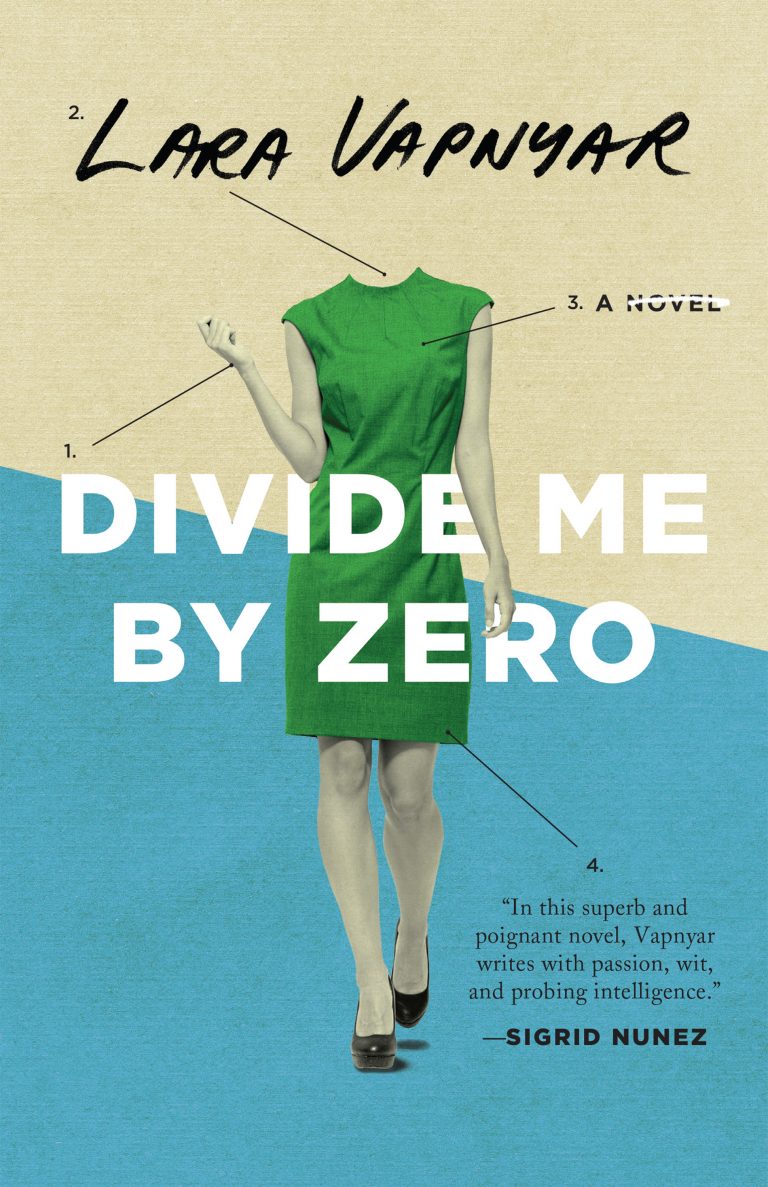
Lara Vapnyar

Lara Vapnyar's new novel is Divide Me by Zero.

From her Q&A with Deborah Kalb:

Q: In an interview with The Rumpus, you said, "This novel is my most intimate and biographical. I would say it’s a dark comedy that is part classic Russian novel, part Soviet math textbook, and part American self-help manual." Can you say more about the creation of Divide Me By Zero?

A: My initial approach was to write about the last year of my marriage which also came to be the last year in my mother’s life. I marveled at how people live their day-to-day lives for years, and nothing much happens. But then there are periods of high drama, when so much happens at once. I wanted to call the novel 11 Months, which would include the story of my love for B., my affair with Vadim, the dissolution of my marriage, and the death of my mother.

But then strange things started to happen to me all somehow connected to my late mother’s old books and clothes. I felt that my late mother’s ghost started haunting me.

Now, full disclosure. I don’t believe in...[read on]
Visit Lara Vapnyar's Facebook page.

Writers Read: Lara Vapnyar (August 2016).

The Page 69 Test: Still Here.

--Marshal Zeringue

Tuesday, November 5, 2019

Allison Stanger

Allison Stanger is Russell Leng ‘60 Professor of International Politics and Economics at Middlebury College, New America Cybersecurity Fellow, and an External Professor at the Santa Fe Institute. Her new book is Whistleblowers: Honesty in America from Washington to Trump.

From the transcript of Stanger's interview with Fareed Zakaria:

ZAKARIA: Allison, finally, there are people, the president himself and others, who really cast doubt on the efforts, the patriotism of these whistleblowers. There's something underhand, there's something kind of un-American about what they're doing. What do you say to that?

STANGER: Whistleblowing couldn't be more more American. Whistleblowers keep our elites honest. And it's an America tradition, as we discussed dating back to 1778. So it's important to realize that this is not a partisan, it's really an American issue. And if you look at the national security community, the intelligence community, they are doing something since Trump's election that they don't normally do. No previous president has been considered a national security threat by his own intelligence community. And we certainly haven't seen this sort of blatant corruption, the use of the office of the president for private gain, but I think Americans know that obviously Americans should elect their officials, not foreigners, and that public servants should serve the American people and not their own pocketbook.

So I'm hopeful that in the days ahead, we'll see...[read on]
--Marshal Zeringue

Monday, November 4, 2019

Sasha Dawn

Sasha Dawn teaches writing at community colleges and offers pro bono writing workshops to local schools. She lives in her native northern Illinois, where she collects tap shoes, fabric swatches, and tales of survival, and she harbors a crush on Thomas Jefferson. Her debut novel, Oblivion, was an Illinois Reads selection and one of the New York Public Library's best books for teens.

Dawn's new YA novel is Panic.

From her Q&A with Deborah Kalb:

Q: How did you come up with the idea for Panic, and for your character Madelaine?

A: My second young adult title, Splinter, starred Sami, a character loosely based on my eldest daughter. I knew I wanted eventually to write a book in tribute to my younger daughter (Madelaine, after whom the star of Panic is named), and as she grew, I centered on her love of music, which is an important element in many teens’ lives, and I knew I had the first character trait of my next protagonist.

This story is loosely based on Madelaine’s aspirations in musical theater. She attends one of the most prestigious performing arts academies in America, and while she has no trouble belting out a tune on stage in front of hundreds of people, she is an introvert and has limits when it comes to everyday interaction.

I learned a lot about...[read on]
Visit Sasha Dawn's website.

My Book, The Movie: Panic.

The Page 69 Test: Panic.

--Marshal Zeringue

Sunday, November 3, 2019

Margaret Wilkerson Sexton

Margaret Wilkerson Sexton's new novel is The Revisioners.

From the transcript of her interview with NPR's Scott Simon:

SCOTT SIMON, HOST: "The Revisioners" is a story that ties together women of different generations in a family line of different races that spans more than a century. It opens with Ava, mixed-race, single mother who moves in with Martha, her declining white grandmother and is brought closure to the story and spirit of Josephine, her other grandmother's great grandmother who escaped from slavery as a child to become a landowner and a matriarch. Margaret Wilkerson Sexton's new book is "The Revisioners." And she joins us from the studios of Youth Radio in Oakland. Thanks so much for being with us.

MARGARET WILKERSON SEXTON: Thank you for having me. It's my pleasure.

SIMON: Tell us about Ms. Josephine, the overwhelming major character.

SEXTON: So Josephine is a former enslaved woman and a former sharecropper. And though she has that very haunting history, she's flourishing in 1924. She's in our '70s. She's widowed. But she has huge family support. She's lucked upon owning a 300-acre farm. So she has resources that she never would have imagined having. And she's doing well when we meet her. However, this is the year that a white woman next door. And Josephine is reticent at first. But soon, they do form this cautious relationship that grows until Josephine discovers that the neighbor is a member of the women's branch of the KKK. And then many, many, many generations later, we have Ava, who is a biracial woman, as you said, and who is financially strapped and is - and decides to move in with her white grandmother. But soon, her grandmother's behavior becomes erratic and even racist. And...[read on]
Visit Margaret Wilkerson Sexton's website.

--Marshal Zeringue

Saturday, November 2, 2019

Elizabeth Chiles Shelburne

Elizabeth Chiles Shelburne grew up reading, writing, and shooting in East Tennessee. After graduating from Amherst College, she worked at The Atlantic Monthly. Her nonfiction work has been published in The Atlantic Monthly, Boston Globe, and Globalpost, among others and her short fiction has appeared in The Broad River Review and Barren Magazine. Her essay on how killing a deer made her a feminist was published in Click! When We Knew We Were Feminists, edited by Courtney E. Martin and J. Courtney Sullivan. She is a graduate of Grub Street’s Novel Incubator. She lives outside Boston with her husband and four children.

Shelburne's new novel is Holding On To Nothing.

From her Q&A with Deborah Kalb:

Q: How did you come up with the idea for Holding On To Nothing, and for your characters Jeptha and Lucy?

A: Lucy came to me with the line "Lucy had a smile that made people feel safe," which was the first line of the book for a long time. I pictured a really strong young woman, who experiences a lot of loss in her life and yet manages to maintain a scarred optimism.

Jeptha is inspired by some of the boys and men I saw around me growing up, who sometimes had rough reputations but good hearts. Jeptha deeply wants to be a good man, but doesn't really know how. I knew if Lucy and Jeptha were in the same room, there would be...[read on]
Visit Elizabeth Chiles Shelburne's website.

The Page 69 Test: Holding On To Nothing.

My Book, The Movie: Holding On To Nothing.

--Marshal Zeringue

Friday, November 1, 2019

Steph Cha

Steph Cha's new novel is Your House Will Pay.

From her NPR interview with Ailsa Chang:

AILSA CHANG, HOST: Past is prologue is the perfect description of the tempest brewing at the heart of a new novel. It's called "Your House Will Pay," and it's written by Steph Cha, who's Korean American. The book's based on true events that took place around the 1992 LA race riots. It explores how those tensions still simmer today.

And when we spoke, I asked her how much those lingering tensions shaped her novel.


STEPH CHA: You know, I started writing this book in 2014 right after Michael Brown's murder. And the rise of the Black Lives Matter movement kind of happened in the beginning stages of my writing this novel. And I remember seeing news coverage of the rioting in Baltimore after the death of Freddie Gray. And during that riot, Korean businesses were also targeted. And a lot of the resentments that were expressed, they could've come right out of early '90s Los Angeles.

And I found that really interesting.

CHANG: Yeah.

CHA: You know, seeing this renewed attention in the media as I was starting to write this novel, I kept thinking, this is not about the past at all. This is about right now.

CHANG: Your story is based on the real-life shooting of Latasha Harlins. She was an African American teenager who was shot dead by a Korean American woman who was running a store in South LA back in 1991. This woman had thought that Latasha was...[read on]
Visit Steph Cha's website and Twitter perch.

Coffee with a Canine: Steph Cha and Duke.

My Book, The Movie: Follow Her Home.

The Page 69 Test: Follow Her Home.

Writers Read: Steph Cha (April 2013).

--Marshal Zeringue