Thursday, July 31, 2014

Emily Arsenault

Emily Arsenault's new novel is What Strange Creatures.

From the author's Q & A with Caroline Leavitt:

A brother arrested for murder, a sister who must prove his innocence, trying to save him when her own life is in turmoil. Where did the idea come from? What made you haunted enough by it to write a novel?

To start with, I was pretty sure I wanted to write a story about a jaded brother and sister, and I was pretty sure I wanted their relationship to have some humorous elements. In very small ways, I based them on my mom and my uncle, who live a block away from each other in the same New England town in which they grew up. (Like Theresa, my mother eats out a great deal. And like her brother Jeff, my uncle is very frugal and scavenges her doggie bags.) Of course, I couldn’t write a novel about these two simply sitting together at a kitchen table and making wisecracks. I needed for them to have a challenge that would jolt them out of their sarcastic passivity. So I threw a murder at them.

How did you find out about Margery Kempe, the medieval mystic, and how does she function in the novel?

I learned about Margery Kempe through a survey of early English lit class when I was fulfilling credits for English teaching certification years ago. I was intrigued by her unusual life—particularly the fact that she managed to convince her husband to allow her to take a vow of celibacy—and to go on pilgrimages by herself—after she’d had fourteen children with him. When....[read on]
Learn more about the book and author at Emily Arsenault's website.

--Marshal Zeringue

Wednesday, July 30, 2014

Judith Frank

Judith Frank teaches English at Amherst College and is the author of All I Love and Know.

From her Q & A with Sarah Miller at The Hairpin:

So. I should disclose that I was a student of yours at Amherst–and, let’s be honest, your favorite. Moving on! Now. Did you sit down and say, "I'm going to write a book about a gay couple, who raise the children of one of the men's identical twin brothers in the Pioneer Valley, after that brother and his wife are killed in a terrorist bombing in Israel during the second Intifada?" and that's what happened? Or did it grow out of another idea?

I started with the twin brother and his wife being killed in a terrorist bombing (my twin sister in Israel loves this). Then I thought about how to challenge the gay brother and his partner to the max, and decided to bring two grieving children into the mix.

Once I had the premise, it didn't change–I just had to decide where to go from there. And I was aware that starting a novel with a terrorist attack was going to be challenging, because in terms of building a plot, where on earth do you go from there?

Your identical twin sister has been a good sport about your story?

She has been extremely good natured from the start about my killing off the twin. It helps that it's fiction, and it helps that these characters are men. But...[read on]
Visit Judith Frank's website.

The Page 69 Test: All I Love and Know.

--Marshal Zeringue

Tuesday, July 29, 2014

Rebecca Makkai

Rebecca Makkai is a Chicago-based writer whose first novel, The Borrower, is a Booklist Top Ten Debut, an Indie Next pick, an O Magazine selection, and one of Chicago Magazine's choices for best fiction of 2011. Her short fiction has been chosen for The Best American Short Stories for four consecutive years (2011, 2010, 2009 and 2008), and appears regularly in journals like Harper's, Tin House, Ploughshares, and New England Review.

Makkai's new novel is The Hundred-Year House.

From her Q & A with Evan Allgood at Slice:

You say in the Acknowledgments that The Hundred-Year House “started as a short story about male anorexia. I have no idea what the hell happened.” Well, what the hell happened?

I already said I have no idea! Here’s what I can reconstruct: I wrote a short story called “Gatehouse” somewhere around 2004, and it was about two couples crammed together in the coach house of a large estate. One of the men was anorexic, and the other man was the only one who noticed, but no one would listen to him. I put the story aside for a long time, because it didn’t work – but I liked that idea of the two couples in close quarters, and the strange relationship between the coach house and the main house. Years later I realized it should be a novel – and then it just sort of grew like a crystal in all directions. The anorexia stayed in there for quite a while, until I finally realized it had nothing to do with the rest of the book, and it needed to go. That was difficult, because it was the reason I’d....[read on]
Learn more about the author and her work at Rebecca Makkai's website, Facebook page and Twitter perch.

My Book, The Movie: The Borrower.

The Page 69 Test: The Hundred-Year House.

My Book, The Movie: The Hundred-Year House.

--Marshal Zeringue

Monday, July 28, 2014

Susan Spann

Susan Spann is a transactional attorney focusing on publishing law and a former law school professor. She has a deep interest in Asian culture and has studied Mandarin and Japanese. Her hobbies include Asian cooking, fencing, knife and shuriken throwing, traditional archery, martial arts, rock climbing, and horseback riding.

Spann's new novel is Blade of the Samurai.

From her Q & A with Erin Sweet Al-Mehairi:

Q: It sounds like the history and culture of China and Japan have always intrigued you, even before you went into law. What was the catalyst for this interest? What motivates you about the subject?

A: I “discovered” Japan in 1980, when I saw the SHOGUN miniseries on TV (the one with Richard Chamberlain in the starring role). The day the miniseries ended, I went to the library, checked out the James Clavell novel that inspired the program, and fell in love with the samurai era.

Ironically, my deeper interest in Asian history came from a book I never read. In 1983 (and yes, I’m dating myself a little), my seventh-grade history class was assigned to read a book called THROUGH CHINESE EYES, which talked about Asian history through the eyes of the people who lived it. Before that, I thought of history as “dates and dead guys” – but when my class ran out of time and didn’t get to reading that book, it made me wonder what I might have missed. Now, of course, I realize that I could have read the book on my own, but seventh-grade me considered the “missing book” an intriguing mystery to the “real” nature of history.

By the time I reached college, and discovered that “Asian Studies” was “a thing,” I ...[read on]
Visit Susan Spann's website.

My Book, The Movie: Blade of the Samurai.

Writers Read: Susan Spann.

The Page 69 Test: Blade of the Samurai.

--Marshal Zeringue

Saturday, July 26, 2014

Maggie Shipstead

Maggie Shipstead's newest novel is Astonish Me.

From her Q & A with Caroline Leavitt:

Your novel is so different from your first, Seating Arrangements, moving from sharp comedy to the haunting tragedy of what might have been. What was the writing like for you? Did it feel different to switch gears? What surprised you about this particular book?

Astonish Me was probably the most pleasurable writing experience I’ll ever have, mostly because I didn’t set out to make it a novel. I had a fellowship at Stanford for two years, and in my second year I wrote a short story about a retired ballet dancer named Joan and her rivalry with her next door neighbor in California. At the time, I’d also started working on what I thought would be my second novel. After I was done at Stanford and done with edits for Seating Arrangements, I took a break from the novel project to revise the ballet story, and the story started to expand. By the time I finished my initial “revision,” it was ninety pages long, which I think we can agree is a little bit lengthy for a story. I showed it to my agent, and she saw room for more expansion, so I went back to work. It was only about five months between when I started to revise the story and when I finished the sale draft, and for most of that time I felt like I was somehow cheating on my so-called real novel (which has since died) with this funky ballet side project. But then my publisher ended up buying it two weeks before Seating Arrangements was published, and I thought, oh, okay, it’s a book. The accidental nature of the whole process gave me a lot of freedom: I was really writing for my own enjoyment. Astonish Me’s tone is meant to mimic that of a ballet, especially toward the end, and that was a refreshing departure from the prickliness of Seating Arrangements.

Astonish Me is a great title, and though it was said, I believe, by a ballet master, it resonates for lots of other things going on in your novel. Can you talk about this, please?

Yes, Sergei Diaghilev, the impresario of the Ballets Russes, would tell the artists working for him to “Étonnez-moi,” which was sort of a command and sort of a dare and sort of a rallying cry. I think that’s what we...[read on]
--Marshal Zeringue

Friday, July 25, 2014

Josh Weil

Josh Weil was awarded the Sue Kaufman Prize from the American Academy of Arts and Letters for his debut collection, The New Valley. A National Book Award "Five Under Thirty-Five" author, he has received fellowships from the Fulbright Foundation, Columbia University, the MacDowell Colony, Bread Loaf, and Sewanee. His fiction has appeared in Granta, Esquire, One Story, and Agni.

Weil's debut novel is The Great Glass Sea. From his Q & A with Matt Bell at The Brooklyn Rail:

Matt Bell (Rail): The Great Glass Sea takes place in an alternate-present Russia, where the titular sea of glass—called the Oranzheria—has been built over a large expanse of farmable land, then lit by space mirrors to create an unending source of daylight. Twin brothers Yarik and Dima work this enormous greenhouse in alternating shifts, and as the novel opens they each inhabit a different half of this perpetual day. There’s so much impressive worldbuilding in the novel, and it seems like the book can take very little for granted: The reader has to be introduced to the Oranzheria and the way that it’s changed the course of your Russia, but they also have to be led through the historical events that have led to this moment, events that at a certain point broke from whatever Russian history we might already know. Could you talk about your approach to worldbuilding for this novel? With it being necessary to convey so much setting and background, how did you determine the priority for what the reader needed to know first?

Josh Weil: You’re right, the world of this novel took more preparatory building than anything I’ve written before. It was one of the hardest parts—especially in the editing process—to get right. And yet, in the beginning, in the earlier drafts, I didn’t think of it as worldbuilding. I didn’t even know the term (maybe it was just off my radar; I hear it a lot lately). All that stuff—the space mirrors, the Oranzheria, the way that the Russia of this novel is skewed differently from the actual Russia of today—was, honestly, guided simply by storytelling: what the story needed at what point, what was necessary for the reader to know to empathize, to comprehend the complexities of a relationship, to be sucked into the story. A lot of that comes down to getting why a character is ...[read on]
Visit Josh Weil's website.

Writers Read: Josh Weil.

The Page 69 Test: The Great Glass Sea.

--Marshal Zeringue

Thursday, July 24, 2014

Alafair Burke

Alafair Burke's newest novel is All Day and a Night.

From her Q & A with Ayo Onatade at SHOTS:

Ayo Onatade: -You will have two books published this year in the UK. If You Were Here in April, which was a standalone novel and features McKenna Jordan (whom most of us know in real life is the owner of Murder by the Book Bookshop in Houston) as an investigative journalist. What gave you the idea for the storyline?

Alafair Burke: - Despite the use of McKenna’s name, the marriage at the centre of the book is loosely based on my own. Like me, McKenna is a former prosecutor turned writer. Like my husband, McKenna’s husband, Patrick, is a West Point graduate who now does security management for the Metropolitan Museum of Art.

In real life, the lack of a common history between us (we met online) made it fun to get to know each other from true scratch. But as a writer who spends time occupying a fictional world, I have always wanted to find a way to mine the potential for secrecy in a relationship where either party could by lying about the past. From that came the story of McKenna’s search for her missing friend, Susan, who was a fellow West Point cadet with Patrick.

You have an official sound track for
If You Were Here. What made you decide to have one and would you in hindsight liked to have done it for any of your earlier books?

I did it for IYWH to answer the frequently asked question of whether the book title was related to the Thompson Twins song by the same title: yes! I also named sections of the book after other songs whose lyrics connect to the content of the book. I thought it would be a fun way for music lovers to enjoy a secondary track of the book. It might feel forced to try it with every novel, though. This came naturally.

The second is All Day and a Night which is due out in July and which sees you return to Detective Ellie Hatcher. It is part police procedural and part legal thriller; how much does it draw from your real life?

Sometimes it’s an act of self-therapy to...[read on]
Learn more about the book and author at Alafair Burke's website and blog.

Visit Alafair Burke's website and blog.

The Page 69 Test: All Day and a Night.

--Marshal Zeringue

Wednesday, July 23, 2014

Adele Griffin

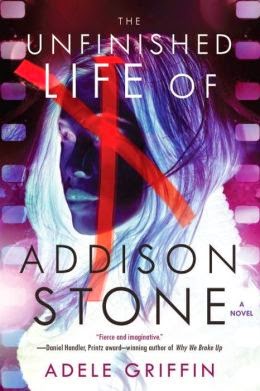
Adele Griffin’s new novel is The Unfinished Life of Addison Stone.

From her Q & A with Daniel Ehrenhaft, the Editorial Director of Soho Teen:

Daniel Ehrenhaft: I already know the answer to this one (dinner is involved), but I must ask, anyway: What was the genesis of The Unfinished Life of Addison Stone?

Adele Griffin: This has to be one of my favorite genesis stories. The Unfinished Life of Addison Stone is a New York art fable with its own New York publishing “back fable.” You and your lovely wife, Jessica Wollman, came over to our home for a dinner that ended up being one of those go-late, talky nights about every topic from the Edgar Awards to Edgar Winters (true! as you know!). At some point we were discussing our enchantment with books about bands—The Velvet Underground, The Ramones, The Sex Pistols.

You mentioned And I Don’t Want to Live this Life and I mentioned Ciao! Manhattan, the George Plimpton / Jean Stein biography of Edie Sedgwick. I confessed that I’d always wanted to write a modern Edie story, only this time starring a Banksy-type stunt artist. “That’s an amazing idea,” you said. “Do this book now, and with us!” And I agreed—although on Saturday night, I was playing pretty fast and loose with proclamations and cheesecake dessert.

Monday morning, my agent, Charlotte Sheedy, called to tell me there was a contract draft from you in her inbox. That same day, you sent me very encouraging note to take this risk. It was my, “if not now, when?” carpe diem moment. I jumped.

DE: Related, what (or who) were your biggest influences in putting the novel together?

AG: When I was writing Addison, my mind kept holding on two moments; a spring day in 1986 and again in 1996. The ’86 memory was...[read on]
Learn more about the book and author at Adele Griffin’s website and Facebook page.

Read--Coffee with a Canine: Adele Griffin and Edith.

Writers Read: Adele Griffin (June 2011).

Writers Read: Adele Griffin (November 2012).

--Marshal Zeringue

Tuesday, July 22, 2014

Richard Dawkins

Richard Dawkins, one of nonfiction's bad boys, is the author of 2013's An Appetite for Wonder, the first volume of what will be a two-part memoir.

From his Q & A with Rowan Hooper for NewScientist (reprinted at Slate):

RH: [One] battle of yours has been against group selection—the idea that evolution works by selecting traits that benefit groups, not genes. You destroyed that paradigm, but then it came back again.

RD: Something else came back under the same name. If you look carefully, it turns out to be things like kin selection rebranded as group selection. That irritates me because I think it is wantonly obscuring something that was actually rather clear.

I think part of why it came back is political. Sociologists love group selection, I think because they are more influenced by emotive evaluations of human impulses. I think people want altruism to be a kind of driving force; there's no such thing as a driving force. They want altruism to be fundamental whereas I want it to be explained. Selfish genes actually explain altruistic individuals, and to me that's crystal-clear.

RH: What subjects currently interest you in evolutionary biology?

RD: I'm fascinated by the way molecular genetics has become a branch of information technology. I wonder with hindsight whether it had to be that way, whether natural selection couldn't really work unless genetics was digital, high-fidelity, a kind of computer science. In other words, can we predict that, if there's life elsewhere in the universe, it will have the same kind of ...[read on]
Richard Dawkins is Lee Child's hero (outside of literature).

Learn about Richard Dawkins's five favorite books.

--Marshal Zeringue

Monday, July 21, 2014

Lorrie Moore

Lorrie Moore has written three novels (Anagrams, Who Will Run the Frog Hospital? and A Gate at the Stairs), and four collections of short stories (Self Help, Like Life, Birds of America, and Bark).

From her Q & A with Deidre at Your Hidden Shelf:

DM: Some stories [in Bark] are overtly political and some have a political backdrop. There’s a mood of disappointment overall in the book, a coming to a stage in someone’s life where one’s been through a significant amount of loss. How much of that is cultural and how much is personal experience?

LM: I think that’s what stories are reckoning with. In a sense they’re tiny little narratives of injury and of disturbance and three of the stories have public events in their background. So the first story [“Debarking”] has the invasion of Iraq which was driving everyone crazy in 2003 which was when I wrote the story. (And it was fact checked by The New Yorker so if anyone thinks I got the facts wrong they’ll have to take it up with The New Yorker.) That was really a huge thing and I’m not sure it was sufficiently appreciated by people in other countries how crazy-making that was for most Americans. It was really a hard time. And then we have the worn out intelligence analyst in “Subject to Search” and then there’s the guy that is just so happy that Obama is about to be elected [“Foes”]. So those are the three out of eight that have those kinds of public events in them. But that’s just true to how one lives. It’s not as if you live without those things in your life. So is there regret and rue and all of that? Sure, but there always is. I think there were in other collections of mine as well. But nobody stabs anyone! There’s a stabbing in the first collection and in the third collection someone jumps out a window. And someone shoots someone in Birds of America. So there are no real weapons here. I think it’s a ...[read on]
--Marshal Zeringue