Wednesday, February 23, 2022

Stephanie Wrobel

Stephanie Wrobel is the international bestselling author of Darling Rose Gold and This Might Hurt. She has an MFA from Emerson College and has had short fiction published in Bellevue Literary Review. Before turning to fiction, she worked as a creative copywriter at various advertising agencies.
My Q&A with the author:

How much work does your title do to take readers into the story?

The novel grapples with the concepts of fear and pain, so the title is thematically relevant. I hope it intrigues, above all else. I usually start my books with placeholder titles. For this one, it was Wisewood, the name of the self-improvement group that the book is about. It's hard for me to name a book before or while I'm writing it; I usually don't figure out the title until a few drafts in. The other title my editors and I liked was The Fearless. In the end, we chose the viscerality of This Might Hurt.

How surprised would your teenage reader self be by your new novel?

I don't think she'd be surprised at all. Cults have always fascinated me, and this was my chance to build one from scratch. She would be excited to finally get some answers to the questions she has long wondered: why do people join cults? Why do people lead them?

Do you find it harder to write beginnings or endings? Which do you change more?

Endings are harder than beginnings for me. I usually know my twists before I start writing, but there's also the question of when and where to end the story. I prefer a short, crisp ending—some readers would argue mine are too open-ended!—that allows for a "mic drop" moment. My beginnings rarely change in content, only in prose.

Do you see much of yourself in your characters? Do they have any connection to your personality, or are they a world apart?

I can find some piece of myself in most, if not all, of my main characters. In the case of the three narrators of This Might Hurt, I think my friends and family would say I'm most like Natalie: a perfectionist, organized, responsible, confident. But I think her younger sister Kit is the secret core of me, a side I don't share as readily with others: constantly searching for meaning, anxious, impulsive, restless. Though I share the least in common with Rebecca, I can still find elements that bind the two of us: her ambition and a self-discipline that often comes at the cost of all else.

What non-literary inspirations have influenced your writing?

For this book specifically, I listened to Billie Eilish's When We All Fall Asleep, Where Do We Go? nonstop as I developed Rebecca's character. It wasn't just the music and lyrics; even the sound effects, like the knife scraping in "You Should See Me in a Crown", embodied this character. More generally, there's so much excellent content for a writer to take inspiration from these days. Some recent favorites include Succession, The Lost Daughter, and Hacks.
Visit Stephanie Wrobel's website.

Learn more about This Might Hurt.

The Page 69 Test: Darling Rose Gold.

My Book, The Movie: Darling Rose Gold.

--Marshal Zeringue

Friday, February 18, 2022

Luanne G. Smith

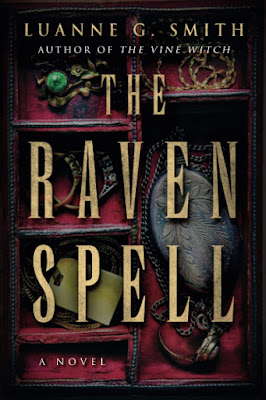
Luanne G. Smith is the bestselling author of The Vine Witch, a witchy historical fantasy series set in Belle Époque era France, and The Raven Spell, the first book in A Conspiracy of Magic, a gothic witch series set in a fantasy version of Victorian London. She’s lucky enough to live in Colorado at the base of the beautiful Rocky Mountains, where she enjoys reading, gardening, hiking, a glass of wine at the end of the day, and finding the magic in everyday life.

My Q&A with the author:

How much work does your title do to take readers into the story?

The Raven Spell was the second title we came up with. It was originally called The Raven Sisters, which worked well but had already been used by another 47North author. Titles aren’t copyrighted, so we could have used the original, but it would have infringed on another in-house author’s previous claim to the title. The Raven Spell is a good second choice. It hints at shadowy, dark magic and the ultimate secret the sisters are hiding. The follow-up in the duology is titled The Raven Song, which gives a nice balance.

What’s in a name?

There wasn’t a ton of consideration that went into choosing my main characters’ names. I wanted something very Victorian, very English for the sisters, hence Edwina and Mary. The cadence of the names together also lended itself to borrowing a well-known nursery rhyme, which opens the novel: Edwina and Mary, quite contrary. And then there’s old Tom Hob the elf who is named after my very hairy dog Tommy. I did also make an embarrassing mistake with one of my characters in The Raven Spell. I called a gentleman wizard Sir Henry Elvanfoot because I loved that name! But, alas, as it works within the English system, he should be called Sir Henry not Sir Elvanfoot. A clumsy faux pas that this American didn’t catch.

How surprised would your teenage reader self be by your novel?

I was very much on a literary path in high school. Shakespeare was my thing and I loved being involved in theater and choir. Working behind the curtain felt like I was a secret-keeper, aware of things the audience wasn’t. I don’t know if I knew then I wanted to write novels, but my teenage self would not have been surprised that I ended up writing fantasy. Those were my favorite parts of Shakespeare – Macbeth’s witches, the fairies in A Midsummer Night’s Dream, and Mercutio’s speech about Queen Mab infecting men’s dreams in Romeo and Juliet. It’s why the three novels in The Vine Witch series contain subtle odes to those plays and in that order.

Do you find it harder to write beginnings or endings? Which do you change more?

Beginnings come very easily for me. I love to kick off a novel and see where it goes. What is decidedly more difficult is reining in all those storylines and subplots at the end so that they sum up the story with some emotional oomph that resonates with the reader. I usually know I’ve hit a satisfactory ending when I start tearing up. The story feels done and I’m left a little bereft after carrying all those words to the end.

Do you see much of yourself in your characters? Do they have any connection to your personality, or are they a world apart?

A bit of both, really. Obviously, all of my characters are generated from somewhere within my psyche—both the protagonists and the villains. I can easily channel personal emotions into a character’s behavior or motivation for good or ill, but I’m less convinced any of the characters I’ve written represent me, per se. Because I write about witches, I’m often asked if I’m a witch too, but I’m ultimately a writer with a deep affection for the mysterious and supernatural side of life, which I’m lucky enough to explore in my novels.
Visit Luanne G. Smith's website.

--Marshal Zeringue

Monday, February 14, 2022

Bonnie Kistler

Bonnie Kistler is a former Philadelphia attorney and the author of House on Fire and The Cage. She graduated from Bryn Mawr College, magna cum laude, with Honors in English literature, and she received her law degree from the University of the Pennsylvania Law School, where she was a moot court champion and legal writing instructor.

She spent her law career in private practice with major law firms. Peer-rated as Distinguished for both legal ability and ethical standards, she successfully tried cases in federal and state courts across the country.

She and her husband now live in Florida and the mountains of western North Carolina.

My Q&A with the author:

How much work does your title do to take readers into the story?

The cage in my title refers to three different things: (a) the elevator where the inciting event occurs, sometimes called a “car” but more accurately a “cage”; (b) the jail cell where Shay ends up; and (c) something I can’t disclose without spoiling the story.

Readers will immediately grasp the first reference and understand that something significant happens in that elevator. Later they’ll recognize the jail reference. And by the end I hope they’ll be surprised by the third reference. (Notice how “cagey” I am there?)

What's in a name?

The main character is Shay Lambert, a young lawyer who’s entirely a creature of her own invention. She’s climbed out of poverty and a squalid family life into the Ivy League and a Wall Street law firm. She’s ditched all vestiges of her past, including her given name of Sharona in favor of the more elegant Shay. She’s also taken her husband’s name––Lambert––because it sounds more posh than her family name and because she hopes to erase her roots.

The second woman in the elevator is the HR director of the company. She’s English by birth and comes from a dynastic British family. I called her Lucy, a name I’ve encountered more often in the U.K. than in the States. For her surname, I decided to give her one of those double-barreled British names that the old, distinguished families often flaunt.

But here I made a major gaffe: I called her Lucy Barton-Jones. It wasn’t until the eve of printing that I remembered Elizabeth Strout’s novel I Am Lucy Barton––which was probably the subliminal source of my selection. So at the absolute last minute, I changed it to Lucy Carter-Jones.

How surprised would your teenage reader self be by your novel?

Teenage Me would be mystified that The Cage could have sprung from our shared brain. I was a country girl, well-read in classic literature but otherwise so unworldly. I knew nothing of corporate intrigue or life in Manhattan and certainly not life in Southeast Asia where some of the action takes place. I never even met a lawyer in real life until I started law school. My teenaged scribblings were family dramas and romances, not high-stakes thrillers.

In fact, I was so naïve that at age 19 I sent a novel off to a big-time New York publisher without having an agent or contacts or any other entrée. Of course it came back virtually by return mail with a terse note: “We don’t accept unsolicited manuscripts.”

It may have been that experience that convinced me to become a lawyer instead of launching straight into writing. At any rate, I’m glad I chose a different career. My advice to people who want to become authors is this: become something else first. Live in the real world. Engage with different kinds of people. Even if what you want to write are family dramas and romances, your writing will be that much richer for having experienced the wider world.

But here’s a little bit of irony: That publisher who rejected my teenage novel all those years ago? HarperCollins, now the publisher of The Cage!

Do you see much of yourself in your characters? Do they have any connection to your personality, or are they a world apart?

The main characters in my books are women lawyers dealing with some of the same issues and obstacles that I faced in my career. But since I write thrillers, the problems they grapple with are far worse than anything I ever encountered. Fortunately, these women are a lot smarter and more determined than I ever was.

What non-literary inspirations have influenced your writing?

I’m a big consumer of cinema and all the great work now being done in the limited series format on TV. I try to visualize my scenes as if they were playing on a screen. I’m especially influenced by the pacing of good movies and TV shows – brisk without being rushed, and with judicious use of cliffhangers.

I recently had a number of meetings with people in Hollywood (more about that someday!), and some of them told me that after reading The Cage, they assumed I was also a screenwriter. I took that as high praise.
Visit Bonnie Kistler's website.

--Marshal Zeringue

Tuesday, February 8, 2022

Gina Apostol

Gina Apostol is the author of the novels Insurrecto, Gun Dealers' Daughter, and The Revolution According to Raymundo Mata. She is the recipient of a PEN/Open Book Award and two Philippine National Book Awards. Her essays and stories have appeared in The New York Times, Los Angeles Review of Books, Foreign Policy, Gettysburg Review, and Massachusetts Review. She lives in New York City and western Massachusetts and grew up in Tacloban, Leyte, in the Philippines.

Apostol's new novel is Bibliolepsy.

My Q&A with the author:

How much work does your title do to take readers into the story?

The title is what the book is about: bibliolepsy. It’s a made-up word, so if you don’t know what it means, you should read the book. The title’s this neologism because my character’s love for books was bodily—and to call it bibliolepsy, like epilepsy or catalepsy, rather than bibliomania or bibliophile, for me sums up that electric bodily charge, a kind of enchanted seizure, that reading books had for this character.

What's in a name?

I was first going to name my character Primi Paragraf. You can tell I was only nineteen when I began it. I could also have named her Peri Phrastic, but I didn’t. I liked the word primipara—it means a person who is bearing her first child, and this was my first book. Anyway, I named my character Primi Peregrino instead, since the other name, yes, was corny.

How surprised would your teenage reader self be by your novel?

My teenage self began this novel. So she would not be very surprised, I think.

Do you find it harder to write beginnings or endings? Which do you change more?

The beginnings and endings of my novels are the ones that never change. I very stubbornly don’t change beginnings. I really am very stubborn. And I always know, before I begin my novels, where or how they will end. It’s the middle part that’s the nightmare—how to get from beginning to end. I never know that part. That’s why I write the novels—to figure it out. That’s where all my work and agony lie.

Do you see much of yourself in your characters? Do they have any connection to your personality, or are they a world apart?

All my novels deal with the act of reading, or have a text within a text, or have someone writing or recalling a story. So the connection is that I’m always thinking about storytelling, how a reader reads, et cetera. My novels, I guess, echo my preoccupations. Otherwise, no, I have never been a compulsive, poet-fucking bibliolept, a daughter of gun dealers, a late nineteenth-century revolutionary soldier, a white filmmaker doing a pseudo-Apocalypse Now based on the Philippine-American war, or a Filipino translator fighting the filmmaker doing a pseudo-Apocalypse Now. But all of them share my preoccupation with reading and with this key contemporary question: who should tell the story?

What non-literary inspirations have influenced your writing?

Elvis Presley’s “Suspicious Minds” was the ghost of my last book Insurrecto. Karen Carpenter is haunting my next one. So yeah, I sadly have seventies music running through my brain and in my books. I love including the corniest things about my childhood in my books—it’s part of the fun of writing. You make relevant what seemed only childish before.
Visit Gina Apostol's website.

--Marshal Zeringue

Saturday, February 5, 2022

Scotto Moore

Scotto Moore is the author of Your Favorite Band Cannot Save You, a sci-fi/horror novella published by Tor.com. For fourteen years, he was an active playwright in Seattle, with major productions nearly every year during that time, and 45 short plays produced during that time as well. He wrote book, lyrics, and music for the a cappella sci-fi musical Silhouette, which won the 2018 Gregory Falls Award for Outstanding New Play, presented by Theatre Puget Sound. He also wrote, directed and produced three seasons of the sci-fi/comedy web series The Coffee Table; and wrote and starred in the horror/comedy play H.P. Lovecraft Stand-up Comedian!

Moore's debut novel is Battle of the Linguist Mages.

My Q&A with the author:

How much work does your title do to take readers into the story?

The book doesn’t open in the middle of a fight scene; a battle’s not yet raging at the top of the story. So the title is this major clue you can hold onto that the story is absolutely going to build toward a serious mage battle of some kind. Who are the linguist mages, who are they fighting, are they fighting each other, what does linguist mage even mean – the title can’t help you with that stuff. Hopefully it helps you pick up a sense of the story’s absurdist edge. It’s meant to feel heightened, like it’s promoting a cage match or something.

What's in a name?

The only name in this book that had a direct inspiration is the MC, Isobel. In an early draft, we didn’t learn her real name, but she used “Isobel” as her alias in the game because “Isobel” was the name of her favorite Björk song. But this book is partially set in a medieval rave-themed VR game called Sparkle Dungeon, so I do use a lot of elaborate names and titles like “the Dauphine of the Shimmer Lands” and “the Once and Future Gleaming King of the Sparkle Realm and All its Glamorous Provinces; Protector of Shine, Blink, and Glow; Guardian of Prism, Crystal, and Diamond; and Master Commander of the Glittering Monks of Weaponized Psytrance.” The game is very tongue in cheek and self-aware, and those parts of the book are, too.

How surprised would your teenage reader self be by your novel?

I was already trying to write pretty weird sci-fi by the time I was a teenager, so that side of it wouldn’t be terribly surprising. I think the big surprise would be the heavy influence of electronic music and rave culture on the book. I wouldn’t have seen that coming at all. At that age, I was pretty much just listening to classic rock and whatever pop made it onto MTV.

Do you find it harder to write beginnings or endings? Which do you change more?

I’m one of those people who is only really capable of writing in sequence. So I live with the beginning a lot longer than the ending and it gets many more opportunities to change while I’m learning about where the story wants to go. And then I frequently start writing with only a sliver of an outline to work with and only the vaguest gut feeling about the quality I want the ending to have. The ending comes into view over the horizon as I write and I can sort of aim the story at it and course correct to get there by revising along the way. That to me feels easier than crafting a strong beginning, which I usually want to have a sharp, instantaneous “you are there!” vibe right from the first sentence. That said, I’m remembering now that the opening was the last thing I wrote on the draft I sent to my editor. A couple of my beta readers urged me to start with more action, and the game is a good vehicle to drop you into an action scene without making it life-or- death stakes, which to me would’ve felt over-the-top. This story’s a bit of a slow burn up until a couple key events change Isobel’s life and send things spinning.

Do you see much of yourself in your characters? Do they have any connection to your personality, or are they a world apart?

In my novella, Your Favorite Band Cannot Save You, the MC is a music blogger, inspired by my feelings about music blogging since 2004 or something, so there was a pretty direct correlation between that character’s whole ethos and mine. Of course, I made the MC much more popular as a blogger than I’ve ever been, so the MC is also wrapped up in being an influencer, which is sort of their fatal flaw really. With Battle of the Linguist Mages, Isobel’s clearly got my sense of humor, and she’s also at a point in her life where she’s recognizing for the first time how society is failing in major ways, which is drawn from my outlook as well. She’s much younger when she starts figuring it out than I was, but she’s also living in the future a bit, so it’s more obvious from there that a collapse of the American state is inevitable, is already in progress really.

What non-literary inspirations have influenced your writing?

Music in general has been a major influence, both in terms how much it’s infused throughout my prose work so far (I might have gotten that out of my system at this point), and how much it inspires me just to keep getting up every day. I’ve engineered my life to include music at almost every step. I’ll spare you a deep dive genre exploration, but my life really changed dramatically when a friend introduced me to electronic music in the mid-90s. That opened my eyes to think beyond what I’d grown up with. I made a vow to myself to keep up with current stuff, to stay adventurous in what I listen to, and that’s a foundational attitude for me about the arts in general.
Visit Scotto Moore's website.

My Book, The Movie: Battle of the Linguist Mages.

--Marshal Zeringue

Wednesday, February 2, 2022

Allison Buccola

Allison Buccola is an attorney with a JD from the University of Chicago. She lives outside Philadelphia with her husband and their two young children.

Buccola's new novel is Catch Her When She Falls.

My Q&A with the author:
How much work does your title do to take readers into the story?

It took a few tries to get the right title for Catch Her When She Falls. My first working title was No Stone Unturned, the name of the online blog that digs into Emily’s death. But that centered the blog too much, which is only one source of the pressure on Micah to reexamine the past. Next was Safe Harbor, since, when we meet Micah, she’s fleeing her hometown and looking for help and refuge, and then Show Me How to Disappear, a more exciting version of the same idea. We finally landed on Catch Her When She Falls, and I think it does a good job capturing a few different aspects of the book. There is Emily’s literal fall, of course, which sets Micah’s whole story in motion, but Micah is also spiraling and in search of help, and it’s uncertain whether that help is going to be there at the end.

How surprised would your teenage reader self be by your novel?

My teenage self would be very excited that I had written a book, and probably not too surprised about the genre. Psychological thrillers weren’t yet as huge as they are today—Gone Girl was still a few years off—but I’ve always loved mysteries and books that get into the characters’ heads.

Do you find it harder to write beginnings or endings? Which do you change more?

Beginnings and endings go hand in hand for me, and the beginning of Catch Her When She Falls is, in fact, temporally very close to the end. The book opens with Micah driving to find the brother of her best friend, who died when they were in high school. Micah has learned something about Emily’s death and she needs his help, but first she needs to figure out how to get him on her side. The main narrative is Micah rehearsing what she’ll say to accomplish this goal. As a result, the beginning (and middle) of the story is imbued with information that Micah has at the end of the story. So, any change to the beginning meant a change to the end, and vice versa.

Do you see much of yourself in your characters? Do they have any connection to your personality, or are they a world apart?

I don’t think there’s any character in the book who I’d say is a lot like me, but I share small traits or characteristics with most of them. Micah and I are very different personality-wise; I think she’s a lot tougher than I am. But I drew on my experiences as a waitress/bartender to create Micah’s coffee shop and her interactions with her customers. Ryan, Micah’s current boyfriend, is bookish and oblivious. The first is definitely true of me; the second is probably often true, too. And Micah’s best friend Natalie is, like me, usually orbited by her two children.

What non-literary inspirations have influenced your writing?

I came up with the initial idea for Catch Her When She Falls while listening to a true-crime podcast about a cold case. I started imagining the lives of the family and friends interviewed and wondering what their reaction would be to the new attention on the case. This got me thinking about Micah, a character who would have complicated feelings about revisiting the past, as best friend of the deceased and girlfriend of the supposed murderer. The story took off from there.
Visit Allison Buccola's website.

--Marshal Zeringue

Monday, January 31, 2022

Catherine Egan

Catherine Egan grew up in Vancouver, Canada. Since then, she has lived on a volcanic island in Japan (which erupted while she was there and sent her hurtling straight into the arms of her now husband), in Tokyo, Kyoto, and Beijing, on an oil rig in the middle of Bohai Bay, in New Jersey, and now in New Haven, Connecticut.

She’s written several books for teens, including the Witch’s Child trilogy: Julia Vanishes, Julia Defiant, and Julia Unbound.

Sneaks is Egan's middle-grade debut.

My Q&A with the author:

How much work does your title do to take readers into the story?

I usually have a terrible time thinking of titles, but Sneaks was my working title, and it stuck – it felt like the right title for a puzzle book about sneaky aliens! The official name for the interdimensional life forms in the novel posing as ordinary, inanimate objects is “Malsprite,” but they are commonly called “Sneaks” for the way they slip into the world and disguise themselves as something innocuous. The main characters are also required to do a fair bit of sneaking around, and many characters have hidden or secret agendas, so the title felt right in more than one way! I like that it’s simple and memorable and – I hope – suggests a fun, action-packed mystery.

How surprised would your teenage reader self be by your novel?

When I was a teenager, my reading (and my writing!) was very dark and dramatic, but I think my teenage self would not be so terribly surprised by this book. My stories are always primarily character-driven. The relationships between people make up the heart of everything I write and Sneaks is no exception. It’s a book about friendship, family, and connection. It’s also – I hope! – the sort of book I would have stayed up reading under the covers with a flashlight as a kid. I’ve always loved fantasy and aliens and character surprises and mysteries and puzzles with clues. This book feels a little like going back to my first book-loves.

Do you find it harder to write beginnings or endings? Which do you change more?

It depends on the book! Sometimes, the final scene is the first thing I write, and finding the right place to start can require many attempts. In this case, the opening scene, in which my main character sees a wristwatch crawling across the floor of its own accord, was one of the very first to come to me. The ending did change a few times, and was harder to get right. The basic points of where the plot ended up remained the same from outline to finished book, but the plot took some turns I hadn’t originally planned on, and the ending had to be adjusted to fit.

Do you see much of yourself in your characters? Do they have any connection to your personality, or are they a world apart?

I never think any of my characters are much like me, but they all contain feelings I’ve had. Often a character begins with an emotion; I build on to that emotion and around it, and the character emerges that way.

When I was a kid, I was quiet, which meant two things: I often felt invisible at school, and I was good at repressed anger. I wasn’t consciously thinking about it, but I think those feelings twisted themselves into the character of Charlotte. She was very easy to think about, but difficult to write because I wanted her to come across initially as kind of a cipher – Ben has gone to school with her for years and never given her much thought at all! But now he is slowly starting to notice things about her.

I see some of myself in Ben too – particularly his love for his brother and his dog and the way he misses his best friend, values connection and yet fails to notice things about people around him, sometimes with disastrous consequences! All of those are very familiar feelings to me!

The spaced-out parents, of course, come from my anxiety about parenting: Am I present enough or am I too caught up in my own stuff? Am I noticing what’s going on with my kids? (Hopefully they are not secretly battling aliens…).

What non-literary inspirations have influenced your writing?

Everything I do and think and read and watch trickles into my writing in one form or another. Most of the time, it’s hard to separate and pinpoint the influences, but recently, I’ve found myself toggling between two WIPs that, I realized quite belatedly, both sprang out of anxiety about climate change. Sneaks is more light-hearted, it’s kind of a puzzle novel full of oddball characters. The publisher has described it as Men In Black Meets Middle School, which I love, but I can’t claim that movie as an influence! Some of the story (not the aliens) comes from watching my own kids and their friends navigate middle school, which brought back plenty of memories of my own middle school years!
Visit Catherine Egan's website.

The Page 69 Test: Julia Vanishes.

My Book, The Movie: Julia Vanishes.

--Marshal Zeringue

Thursday, January 27, 2022

Marty Wingate

USA Today best-selling author Marty Wingate writes The First Edition Library series (Berkley) set in Bath, England, about the curator of a collection of books from the Golden Age of Mystery. Book one, The Bodies in the Library, concerns murder among an Agatha Christie fan-fiction
writing group, and in book two, Murder Is a Must (October 2020), an exhibition manager is found dead at the bottom of a spiral staircase.

Wingate's third novel in the series is The Librarian Always Rings Twice.

My Q&A with the author:

How much work does your title do to take readers into the story?

An agent once told me that although the book belongs to the writer, titles and covers are committee decisions. Occasionally, I have an idea for a title, but usually I let my agent or publisher (once, a reader) come up with something. The Librarian Always Rings Twice, came from the publisher, and is a reference to how often Hayley Burke, curator of the First Edition Society at Middlebank House, is interrupted and/or met with a new problem when she answers the door. If it isn’t her nemesis, Charles Henry Dill, then it’s someone claiming to be Lady Fowling’s grandson. Or perhaps the police.

What's in a name?

Sometimes, a character’s name comes to me first and then I then I learn about person. But many times, although I know the character has a name, I must locate it. I collect names from books, the credits to TV shows or movies, the news, lists of baby names, or browse my handy copy of A Dictionary of English Surnames. I keep lists and go over them, stopping occasionally to ask, “Is this you?” until it’s as if the character says, “Yes, that one’s me.”

How surprised would your teenage reader self be by your new novel?

My teenage self was reading Harry Kemelman’s Rabbi murder mystery series (beginning with Friday the Rabbi Slept Late), and so I wouldn’t be surprised that I’d followed in his footsteps. In fact, I often say he’s the reason it takes me so long to get to the murder in a book (past page 70 in The Librarian Always Rings Twice). There’s always more going on than a murder investigation.

Do you find it harder to write beginnings or endings? Which do you change more?

I love writing both beginnings and endings. Often, I have one or both already in my head from the start. Other times, I have to creep up on the ending before it comes to me. Beginnings are most often rewritten.

Do you see much of yourself in your characters? Do they have any connection to your personality, or are they a world apart?

There’s a bit of me in every character, I suppose. It could be something superficial—Hayley and I share a love of tea and cake—or a deeper character trait, such as Mrs. Woolgar’s intractability or Hayley’s daughter, Dinah, penchant for what others might call wasting her time by choosing to study a useless subject at university.

What non-literary inspirations have influenced your writing?

I am inspired by visits to Britain, which usually take place once or twice a year. I feel like a sponge absorbing atmosphere, characters, history, landscape—it all gets filed away in my brain to use at the appropriate moment in a book. This includes overhearing snatches of conversation, which I can twist to my own advantage. I was in Bath a few years ago and heard a young woman order “One Earl Grey tea and one normal tea.” I never even had to make a note about it. That exchange, rather embellished, found its way into Murder Is a Must, book two in the First Edition Library mysteries.
Visit Marty Wingate's website.

My Book, The Movie: The Librarian Always Rings Twice.

The Page 69 Test: The Librarian Always Rings Twice.

--Marshal Zeringue

Sunday, January 23, 2022

Peter Mann

Peter Mann grew up in Kansas City. He teaches history and literature at Stanford and is a past recipient of the Whiting Fellowship. He is also a graphic artist & cartoonist and draws the online comic The Quixote Syndrome. The Torqued Man is his first novel.

My Q&A with the author:
How much work does your title do to take readers into the story?

The Torqued Man might seem an enigmatic title at first blush, but readers soon discover it speaks to the predicament of both main characters in terms of their conflicted identities and convoluted allegiances.

German spy handler Adrian de Groot is a closeted gay man living in Hitler’s Germany as well as a literary translator and anti-Nazi who finds himself working for the Reich. For these reasons, his Irish charge Frank Pike refers to him as The Torqued Man: “pulled one way by inclination, and another by propriety... with merchant’s blood but literature in his heart, he had become a reluctant middleman for book-burners.”

Yet Irish spy Frank Pike is similarly torqued. An Irish socialist recruited to collaborate with the Nazis, he must untangle himself through a secret redemptive mission aimed at bringing down Hitler’s empire. To do this, he adopts the alter ego of the Celtic hero Finn McCool, who, when the battle frenzy is upon him, undergoes “a torqueing.”

What's in a name?

Names are important in this novel. Adrian de Groot is a somewhat odd name for a German, since “de Groot” (meaning big) is a common Dutch or Frisian name. But it signals Adrian’s liminal identity. As a German from the northern border town of Flensburg, his roots are more Dutch, Danish, Frisian, and the cosmopolitanism of Hanseatic ports. Yet, despite this marginal geographical or cultural status, he is still firmly within the Reich. Adrian’s first name is my nod to Thomas Mann’s novel Doctor Faustus: The Life of the Composer Adrian Leverkühn, Told by a Friend, whose narratorial perspective was an important model for me.

Frank Pike, the anglicized name of Proinnsias Pike, is both a nod to the real-life historical figure Frank Ryan who inspired my character, as well as an evocation of Pike’s sharp, thrusting, libidinous personality.

Because both characters are engaged in espionage, they also have several aliases. Pike’s official cover in Germany is Frank Finn, but he soon takes on the mythical alter ego of Finn McCool. And Adrian is first known to Pike in Spain as Johann Grotius, who in Berlin adopts the new alias of Emil Fluss, according to Pike, “sounds like something you pour down a clogged drain.”

Do you find it harder to write beginnings or endings? Which do you change more?

Openings have an energy of pure possibility that I like, but I definitely find endings tough. And by endings I mean third acts, not just the final pages or paragraph. Those final words I find easier and enjoyable, like putting a good button on a joke or scene where you’ve already done the important legwork of premise and payoff. But the challenge, at least for me, is earning my endings by building the right amount of dramatic tension that can then be satisfyingly resolved. I like to think I got it right in this book, but it took some wandering in the dark before I found my way.

Do you see much of yourself in your characters? Do they have any connection to your personality, or are they a world apart?

Parts of me are definitely there: Pike’s cheery cynicism, his penchant for the profane as well as pints of porter; Adrian’s contempt for mass modernity, his bookishness, his struggle between feelings of complicity and desire for justice, and, of course, both men’s love of Don Quixote.

What non-literary inspirations have influenced your writing?

Studying and wandering around Europe, particularly trips to Germany, Spain, and Ireland and long stints in Berlin, Madrid, Salamanca, Prague, and Copenhagen. I wonder if the annals of history count as “literary” in this question—if not, then certainly the abyss of the past is an endless source of inspiration.

Also, German Expressionist painting and woodcuts, Marx Brothers and Tarantino movies, Monty Python, and the historically- and literary-minded concept albums of musicians like John Cale, The Kinks, The Decemberists, Terry Allen, and Neutral Milk Hotel. Though the music I listened to most while writing the book included Paco de Lucía, Bach fugues, Ariel Ramirez’s “Misa Criolla,” and the incredible musical time travel offerings of radioooo.com.
Visit Peter Mann's website.

--Marshal Zeringue

Friday, January 21, 2022

Barbara Nickless

Barbara Nickless is the Wall Street Journal and Amazon Charts bestselling author of the Sydney Rose Parnell series, which includes Blood on the Tracks, a Suspense Magazine Best of 2016 selection and winner of the Daphne du Maurier Award for Excellence; Dead Stop; Ambush; and Gone to Darkness. Blood on the Tracks and Dead Stop won the Colorado Book Award, and Dead Stop was nominated for the Daphne du Maurier Award for Excellence.

Nickless's latest book is At First Light, the first novel in a new series starring Professor Evan Wilding.

My Q&A with the author:

How much work does your title do to take readers into the story?

The short answer is … not much.

While pondering options for At First Light, I looked first at my protagonist, Dr. Evan Wilding, a forensic semiotician with a career as a police consultant interpreting the signs and symbols left behind by murderers. And since the first book in the series deals with a killer who leaves riddles for the investigators in his runic poems, I considered The Riddle Master or possibly The Runologist. Something to suggest what type of mystery—and what kind of hero—lay between the covers.

But because I’m writing a series, I need titles that can riff on each other, cluing readers in that each book is linked to the others. I also look for titles that offer a sense of menace.

As a backup for my publisher, I chose a theme related to time of day, with the intention of having the central murder in each book occur at the time of day reflected in the title. And that option is what my publisher decided to run with. Thus, in At First Light, the victim dies at the break of dawn, with other victims also chosen to die at first light. In the second book of the series (coming out later this year), the victims die at night, and so we have Dark of Night. It’s clear that my titles don’t do much heavy lifting in terms of telling the reader what to expect. Instead, my publisher relies on other techniques to let potential readers know these books are mystery-thrillers. And a sidebar: For my own fun, I always include the title somewhere in the body of the book.

What's in a name?

I wish I could explain how Dr. Evan Wilding’s name crawled out of the primordial soup of my subconscious brain and presented itself to me. But, alas, that answer lies twenty years in the past (if, in fact, it lies anywhere at all). I created the character of Evan at a writer’s boot camp as part of a writing exercise. The character appeared as a man in full in the middle of the night—his dwarfism, his interest in language, his intelligence, his police work. And his name.

The name given by the media to the serial killer in At First Light also popped up without much thought. What else do you call a murderer who, after torturing and slaying his victims, leaves them with poems styled after the Old English poets and written in futhorc—the Viking runes used in England during the Viking Age?

How surprised would your teenage reader self be by your novel?

My teenage self would be astonished that I’d decided to write mystery/thriller novels. After a childhood love of Encyclopedia Brown followed by a youthful fascination with Sherlock Holmes, I went all in for medieval literature during my college days. And that is the part that would not astonish my teenage self—that At First Light is filled with references to Beowulf and the difficult meter of Norse poetry.

Do you find it harder to write beginnings or endings? Which do you change more?

I am much more comfortable with beginnings, for that is when the entire fictional world unrolls at my feet, casting open doors and windows and daring me to take any number of intriguing paths. Maybe Evan and Addie will fall in love. Maybe the killer is driven by something other than revenge. But, as the story goes along, doors and windows must—out of narrative necessity—close. The ending becomes both a Holy Grail and a Dreaded Thing. It’s The Thing That Must Be Rewritten.

My former series starred a former Marine who knew her way around guns and hand-to-hand combat. Every book in that series ended with a literal or metaphorical bang. But with Evan, who tops out at four foot five and who spends much of his day behind a desk, I need endings that are very different. Endings that require brains over brawn. I’m learning a new skill set when it comes to writing The End.

What non-literary inspirations have influenced your writing?

The Middle Ages and Viking Age history. The art of falconry (I worked for years rehabilitating injured birds of prey). Scholars who’ve deciphered the seemingly undecipherable—or spent years trying (think Egyptian hieroglyphs, the Rongorono writing of Rapa Nui, Mayan glyphs). There is also my time as a sword-fighting member of the Society for Creative Anachronism. And the fact that I’ve always wanted to learn how to throw an axe.
Visit Barbara Nickless's website.

The Page 69 Test: At First Light.

--Marshal Zeringue