Thursday, September 29, 2022

Lygia Day Peñaflor

Lygia Day Peñaflor is the author of Creep: A Love Story, All of This is True, and Unscripted Joss Byrd. She also teaches young Hollywood stars on television and movie sets. Her students have included cast members of Gossip Girl, Boardwalk Empire, Spielberg's West Side Story, and others. She lives on Long Island, NY, where she rides horses and flies from a trapeze.

My Q&A with the author:

How much work does your title do to take readers into the story?

There couldn’t be a more perfect title for this book. Creep: A Love Story sets the stage immediately. We have our narrator Rafi: a creep. And we have Laney Villanueva and Nico Fiore: a love story. When the popular couple walks into the Holy Family High School attendance office, where Rafi works at the front desk, she is instantly obsessed with them.

“Creep” by Radiohead was a huge inspiration for this novel. Those who know the song will pick up on its dark, desperate tone from the title. The words “weirdo” and “I don’t belong here” will come to mind, too, which are perfect ways to describe Rafi and her place in Laney and Nico’s lives, as her behavior escalates to full stalking mode. This title understood the assignment.

What's in a name?

I used the name Holy Family High School to emphasize the deep connection Rafi feels with her school. Rafi’s own family is fractured. Her mom left her to be raised by her grandparents, and her dad travels as a roadie for a touring rock band. Holy Family is the place where Rafi feels closest to her parents, since they are graduates of the school and fell in love there.

For Laney Villauneva, I wanted a last name that’s recognizably Filipino and also very pretty. Villanueva sounded just right. I got the name Laney from Rachel Leigh Cook’s character, Laney Boggs, in the movie She’s All That. It’s one of those movies I always watch if it happens to be on. It happened to air often while I was drafting. I loved the way Freddie Prinze Jr. said “Laney.” It sounded like he loved her.

How surprised would your teenage reader self be by your novel?

My teen self would be floored. The premise of this book came from a brief encounter I had when I was a senior in high school. A freshman I’d never spoken to before approached me and said, “You have the cutest boyfriend.” Teen Me would be shocked that I remembered this and that I’ve written an entire novel based on it.

As a teenage reader, I enjoyed books that put me inside a character’s mind – I would love the intimacy of Rafi’s first-person present-tense narrative. I would be surprised that other people fantasize about spying on their classmates and thrilled to witness Rafi act on that fantasy to such a disturbing degree.

Do you see much of yourself in your characters? Do they have any connection to your personality, or are they a world apart?

I definitely admired the cool senior couples when I was in school. They seemed very mature, and their secret world of couplehood fascinated me. I always wondered about them, “Are they happy? Are they sweet to each other? Are they dramatic and tumultuous? Are they in love?” I gave Rafi my curiosity and awe, except on a much more intense level. I see myself in Laney, too, because I became one of those enviable seniors with a cute boyfriend. Laney is also a dancer, and she’s from a Filipino American family with a close-knit group of cousins. She and I share those things in common. I feel connected to both of these characters. I think I always will.

What non-literary inspirations have influenced your writing?

I used to be embarrassed to say that I learned story structure mostly from television and movies over books, but I’m not embarrassed to admit that anymore. It doesn’t matter where you acquire these skills, as long as you get them from somewhere. I absorbed so much of what I know about writing from Degrassi, The Wonder Years, Stand by Me, Little Darlings, Clueless, Skins, ‘80s sitcoms, Frasier. They taught me voice, point of view, character development, pacing, and plot. And dialogue! I love dialogue the most. I learned how to hear it and how to write it from watching television.
Visit Lygia Day Peñaflor's website.

--Marshal Zeringue

Monday, September 26, 2022

Christopher Swann

Christopher Swann is a novelist and high school English teacher. A graduate of Woodberry Forest School in Virginia, he earned his Ph.D. in creative writing from Georgia State University. He has been a Townsend Prize finalist, longlisted for the Southern Book Prize, and a winner of the Georgia Author of the Year award. He lives with his wife and two sons in Atlanta, where he is the English department chair at Holy Innocents’ Episcopal School.

Swann's new novel is Never Go Home.

My Q&A with the author:

How much work does your title do to take readers into the story?

I tend to like titles that create an image in a reader’s mind and have something to do thematically with the story. But my Faulkner family thriller series is different. Never Turn Back is the first in that series, and my editor suggested the title. I didn’t know if I was going to turn it into a series, but when I did, I decided the subsequent books all have to be “never” titles—“never” plus a verb plus a third word. I’ll see how many books I write in that series and how many “never’ phrases I can come up with!

What's in a name?

Everything. Even the minor characters’ names matter. In Never Go Home, the first chapter has Susannah Faulkner interacting with a real slimeball, and I wanted to give that guy a slightly unserious name. I settled on Bobby—some people can pull off that name all their lives, and some people should stick with Robert or Bob. This character goes by Bobby. And then “Bonaroo” popped up in my head, and Bobby Bonaroo was born. One of my friends said I had to get rid of the name because it’s ridiculous. I said I have to keep the name because it’s ridiculous!

As for Suzie Faulkner: I first named her brother, Ethan, and then cast around for a last name. He’s an English teacher, and so “Faulkner” came to mind. He even makes a joke about it in Never Turn Back. I almost named Susannah “Savannah,” then realized that’s the name of the protagonist’s sister in Pat Conroy’s The Prince of Tides, and so I went with Susannah—Suzie for short.

Names are important, both because of their inherent meanings and as a way for readers to connect with and remember your characters. I always try to keep characters in a book from having names too similar to each other, so readers don’t get confused.

Do you find it harder to write beginnings or endings? Which do you change more?

Beginnings are easier for me. There’s nothing more fun than writing the opening scene of a story, especially for a character like Suzie Faulkner in Never Go Home. I struggle more with endings. That may be why I like to write novels as opposed to short stories. You have to wrap up a short story in ten pages or so, but you don’t have to end a novel for a few hundred pages. But I think I’ve gotten better at endings, or at least more confident. Practice makes perfect. If my wife reads the end of one of my novels and says, “You nailed the ending,” I know it’s good.

Do you see much of yourself in your characters? Do they have any connection to your personality, or are they a world apart?

The protagonist in my first novel is a novelist and high school English teacher—he’s a more haunted and (hopefully) selfish version of me. In my fourth novel, Never Go Home, my protagonist Suzie Faulkner is a young woman with a vengeful streak, a rather fluid sexual identity, and a skill set that includes firearms, martial arts, and skip tracing. I tend to be diplomatic and avoid conflict; Suzie has little filter and has no problems with conflict, even violence if she believes it’s justified. My protagonists have gotten progressively farther away from my own identity and life experiences. And that’s a good thing, for me—it makes the act of creation that much more fun.

What non-literary inspirations have influenced your writing?

That’s a great question! Movies are a close second to books—Jaws, Sense and Sensibility, The Silence of the Lambs, The Untouchables, and Captain America: the Winter Soldier among others have informed my sense of plot and character and action combined with more intimate, emotional, character-driven scenes. Long-form television shows like Ozark confirm my sense of crime as the perfect vehicle for a story, especially a story spun out over a long period of time. And my teaching career has provided me with a lot of knowledge to draw upon for any scenes or stories that involve school settings.
Visit Christopher Swann's website.

The Page 69 Test: Never Go Home.

My Book, The Movie: Never Go Home.

--Marshal Zeringue

Wednesday, September 21, 2022

Martha Anne Toll

Martha Anne Toll writes fiction, essays, and book reviews, and reads anything that’s not nailed down. Her debut novel, Three Muses, won the Petrichor Prize for Finely Crafted Fiction. Toll brings a long career in social justice to her work covering BIPOC and women writers. She is a book reviewer and author interviewer at NPR Books, the Washington Post, Pointe Magazine, The Millions, and elsewhere. She also publishes short fiction and essays in a wide variety of outlets. Toll has recently joined the Board of Directors of the PEN/Faulkner Foundation.

My Q&A with the author:

How much work does your title do to take readers into the story?

I consider titles tremendously important. Three Muses frames my entire book. These mythical women are Song, Discipline, and Memory, and those three concepts braid the book together. For about nine of the ten years that I was writing this book, I called it "The Three Muses." Then one day I woke up and realized there was power in removing the article. Too often "the" gets in our way! The title as it is now, is meant to take readers right into the novel.

What's in a name?

I gave my male protagonist the name "John," because I was looking for the simplest, most American sounding name I could think of. John comes from a shattering, traumatic childhood spent in a concentration camp and arrives in New York as a refugee. His immediate and extended family have all been murdered. I was interested in the irony of such an American name, and the seemingly simplicity held behind it. I am not sure where the name "Katya" came from. She is the ballerina protagonist in Three Muses. I played around with some "hard c" sounding names like Clara (which resonated with The Nutcracker) but ultimately landed on Katya.

How surprised would your teenage reader self be by your novel?

I don't know if this is a good thing or a bad thing, but I think my teenaged self is actually quite similar to my adult self, particularly in our reading tastes (well okay, I am not the Herman Hesse fan I once was). I think my teenaged self would understand this novel, but perhaps not as deeply as my adult self does after having worked on it for ten years!

Do you find it harder to write beginnings or endings? Which do you change more?

I find it impossible to write beginnings and endings. So impossible, in fact, that it is not unusual for me to start in the middle of a project of this size. Three Muses had at least four different endings through the years, and I've lost track of how many beginnings.

Do you see much of yourself in your characters? Do they have any connection to your personality, or are they a world apart?

I don't see myself in the characters in Three Muses. Nevertheless, since I created them, I feel we share many values and emotions. But as to their personalities and the choices they make, they are a world apart from me.

What non-literary inspirations have influenced your writing?

Music music music. I trained for many years to be a classical musician (viola) and that is the biggest influence on my writing--the sound of music, the repertoire, the meaning that I see in it, the discipline that it takes to gain mastery over an instrument, and the importance and beauty of collaborating in musical ensembles such as chamber groups and orchestras. For Three Muses, I drew heavily on my very early introduction to ballet as well. Ballet had a huge impact on my life, even though I stopped studying seriously when I was twelve.
Visit Martha Anne Toll's website.

My Book, The Movie: Three Muses.

--Marshal Zeringue

Thursday, September 15, 2022

Susan Richards

Susan Richards is the author of the Jessica Kallan mystery series and stand-alone novels of suspense. She strives in each story to create characters who are confronted by circumstances that push them to their limits, test their strength, and challenge their beliefs and integrity—people who would do almost anything to protect the people they love.

Richards’s new novel, Where Secrets Live, was a finalist in the Mystery/Suspense category of the 2018 Daphne du Maurier contest.

Born in Omaha, Nebraska, she has lived throughout the Midwest and currently resides in Northern Minnesota. She also spent several years in the Pacific Northwest, moving back to Minnesota to be closer to her family. Every winter she wonders what the hell she was thinking.

My Q&A with Richards:

How much work does your title do to take readers into the story?

The title that my publisher and I landed on, Where Secrets Live, says everything about this book, telling the story of a highly dysfunctional family, buried in decades of secrets.

My original working title was something quite different—more ethereal—and I loved it. When my publisher asked for alternative titles, it was a sad letting-go for me. But after months of working with Where Secrets Live, I’m very happy with it. It gives readers a definite feel for the book.

What's in a name?

I have to be honest . . . I find naming characters one of the most difficult parts of writing a book. I know going in, who my characters are and the roles they will play—but finding a name is not that easy.

In Where Secrets Live, it was a little easier to name my people than in my previous books because most of the main characters were members of a wealthy, old-money family. I wanted the names to sound classy and for some reason, classy to me involves lots of syllables. Elizabeth. Meredith. Frederick. It worked.

But as difficult as the naming process is, once they’ve been given a name, that’s who they become. At some point, they seem to evolve into the name they’ve been assigned.

How surprised would your teenage reader self be by your new novel?

Initially, she’d be incredibly surprised! Her first thought would probably be, “Holy crap! You actually did something with your life!”

But after that she’d realize that it was inevitable that I became an author—because writing has always been a passion—and becoming a mystery author was a given, because those are the books that she and I have always loved.

I know she’d be proud that I accomplished what I set out to do and there is no doubt in my mind that she would love the story I told with all the twists and turns and damaged people.

Do you find it harder to write beginnings or endings? Which do you change more?

Hands down, beginnings are harder. I know where I want the story to go, but it’s crucial to get that perfect jumping off place—that one sentence that sets the mood for what is to come.

It can take me weeks to find that. In the meantime, I’m actively writing and creating, but I will go back to the beginning again and again. The first few paragraphs will go through probably more revisions than the entire book, until I get them where I need them to be. Once I do that, I’m happy. I feel better about the whole book then.

By the time I get to the end, I have a momentum going and usually know how I will wrap things up.

Do you see much of yourself in your characters? Do they have any connection to your personality, or are they a world apart?

Outwardly, I don’t think there’s anything about my characters' lives or personalities that resemble my own. Inwardly, there are a lot of parallels with me and the protagonist, Liz. Our devotion to family is foremost and a driving force in both our lives. Liz is braver than I am, a trait I would love to cultivate.

What non-literary inspirations have influenced your writing?

Wow. Life, I guess. Being a part of relationships, both healthy and unhealthy ones can be the impetus to some great stories. Music and nature are also things that touch me deeply and can be the fuel for scenes or characters.
Visit S.C. Richards's website.

My Book, The Movie: Where Secrets Live.

The Page 69 Test: Where Secrets Live.

--Marshal Zeringue

Friday, September 9, 2022

Annelise Ryan

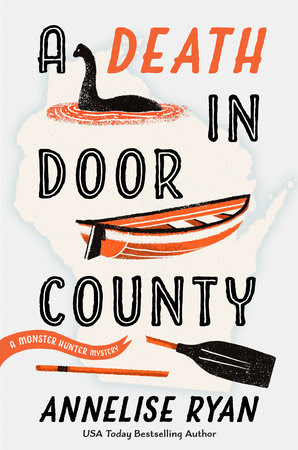
Annelise Ryan is a pseudonym for the author of the new Monster Hunter Mystery series, the first of which, A Death in Door County, is out this month.

Ryan also penned the often hilarious 12-book Mattie Winston Mystery series featuring the adventures of a wryly cynical nurse-turned-coroner in a small Wisconsin town.

My Q&A with the author:

How much work does your title do to take readers into the story?

The title of my most recent book, A Death in Door County, certainly gives the reader the setting if they know Door County, Wisconsin at all. If they don’t, they may well have heard of it and know that it’s a popular, idyllic vacation spot, so a death there takes on extra interest. If they haven’t a clue about Door County, I provide plenty of history and description.

My first title for the work (the publisher changed it) was A Monster At Death’s Door, and I did like this title a lot because it conveyed more of what the book was about: the possibility of a homicidal Loch Ness-type monster lurking in the waters of Lake Michigan, and the treacherous waterway that divides Green Bay and Lake Michigan at the tip of the Door county peninsula, which is known as Death’s Door. It earned that moniker because of all the shipwrecks there—literally hundreds of them—thanks to the underlying geography and unpredictable, deadly storms that brew up with little warning.

What's in a name?

My main character’s first name is Morgan, which means water born. And since she was born on a boat on the waters of Loch Ness while her cryptozoologist parents were hunting for Nessie, it seems appropriate. Morgan’s main sidekick is her huge rescue dog, Newton—Newt for short—who dropped into her life one day, kind of like Newton’s apple. Hence the name. Morgan’s police sidekick and potential love interest is named Jon Flanders, a name that befits the original settlers to the area and that also allowed me to use the nickname Flatfoot Flanders, a moniker that popped into my head in the middle of a shower one day.

As for my name, it’s not Annelise Ryan. I spent nearly 50 years working as a nurse, the last 20 in an ER setting. As a mystery writer, using a pseudonym came in handy because I didn’t want my patients knowing I spent my spare time thinking up clever ways to kill people.

How surprised would your teenage reader self be by your new novel?

Probably not very. I’ve always loved puzzles, mysteries, romance, and adventure, and A Death in Door County has all of these. I grew up reading what I now write. I’ve also always been fascinated by the strange, the odd, the unexplainable, which is why I made my main character Morgan a cryptozoologist—someone who hunts for creatures rumored but not proven to exist, like Nessie and Bigfoot.

Do you find it harder to write beginnings or endings? Which do you change more?

I always know my starting point. I love to toss my characters into intriguing/dangerous/mysterious/funny situations and then see what they do, where they go, and where they take me. I often think I know who the bad guy is when I start a book and yet by the time I’m done, I realize it’s someone else. When I go back to add in clues for the reader, I discover they’re already there. It’s like my subconscious knew all along.

Do you see much of yourself in your characters? Do they have any connection to your personality, or are they a world apart?

There are bits of me in every character I create. Even the bad ones. They all come from my mind, after all. But all of my characters are amalgams, Frankenstein-ish creatures pieced together with details from all kinds of people I’ve encountered during my lifetime.

What non-literary inspirations have influenced your writing?

The world of science, medicine, and the paranormal have always been fascinations for me. My books contain carefully researched facts and scientific principles even when they deal with ideas that are unproven. My goal is to make those ideas believable, or to use the phrase my character uses in A Death in Door County, to create “plausible existability.”

My career in medicine was a varied one. I literally worked everything from birth (obstetrics) to death (hospice) with two decades in ER settings. it gave me ample opportunities to observe people under the best and worst of circumstances and I think that has helped me to create more realistic characters. It has also given me a great deal of knowledge about how fragile the human body and psyche can be.

The other circumstance that I think greatly influenced my writing was my family’s mobile lifestyle. We moved a lot. And each new place meant trying to make new friends and fit in. I learned to lie a lot, making up stories to make myself and my life seem more interesting. When I got older, I simply made a career out of it.
Visit Annelise Ryan's website.

--Marshal Zeringue

Saturday, September 3, 2022

Bobi Conn

Bobi Conn is the author of the memoir In the Shadow of the Valley. Born in Morehead, Kentucky, and raised in a nearby holler, Conn developed a deep connection with the land and her Appalachian roots. She obtained her bachelor’s degree at Berea College, the first school in the American South to integrate racially and to teach men and women in the same classrooms. Conn attended graduate school, where she earned a master’s degree in English with an emphasis in creative writing. In addition to writing, she loves playing pool, telling jokes, cooking, being in the woods, attempting to grow a garden, and spending time with her incredible children.

Conn's new novel is A Woman in Time.

My Q&A with the author:

How much work does your title do to take readers into the story?

My title creates a little mystery rather than pulling readers into the story. From the title, the reader doesn’t know what time period might be referenced (though the cover image provides some clues). However, I chose this title because it relates to the story in three different ways, which the reader cannot understand until they finish the book. I won’t be giving anything away by telling readers here that on one level, the title refers to the protagonist’s existence during a specific era and the novel explores the constraints and possibilities for women of that era. This story also follows a girl through into young adulthood so the title would be written “a woman, in time” to reflect that arc. And finally, this story seeks to illuminate the relationships that exist between one generation and the next, and therefore, this main character is a woman who lives for a specific time (a lifetime, like all of us) but there are aspects of her that are timeless.

What's in a name?

Most of my characters have names that I chose based on their root meanings and/or Biblical meanings. I love the idea that names tell us a lot about a person (when they fit that person) so I made this choice as a kind of Easter egg for readers who are interested in delving into deeper layers of the story. The protagonist, however, is named Rosalee after the name I picked for my daughter (Rose) when I wrote about her in my memoir. I also love how “Rosalee” sounds like a character in a ballad. There are a couple of other female characters who I named after my grandmother and a beloved teacher. Since the women in this story all represent women in my own family, I sometimes picked female names that reflected my actual relations.

How surprised would your teenage reader self be by your new novel?

I think my teenager reader self would be thrilled that I have a new novel, and I hope she would also recognize the hints of magical realism in it. I fell in love with magical realism when I was sixteen, so I think that version of my self would be enthralled with that aspect of the novel, though it could also hit a little close to home since it is based on some of the stories I grew up hearing about my family.

Do you see much of yourself in your characters? Do they have any connection to your personality, or are they a world apart?

I suspect some of my characters – and maybe all – have some aspect of me in them. I feel like I sink into a new character and am able to occupy that imaginary life when I’m writing about them, but in the end, I think we see the world as we are. That is to say, our psychology is inextricable from our perceptions and creations, so I think my characters represent my personality at times, or my hopes, fears, and beliefs at others. I do hope I’m nothing like the couple of cruel characters who show up in this book.

What non-literary inspirations have influenced your writing?

As I mentioned earlier, some of this story is based on stories I grew up hearing and namely, about my great-grandfather who was a moonshiner during Prohibition (and long after). I grew up in Eastern Kentucky and oral storytelling is a rich aspect of Appalachian culture. I suspect that, and the 70s- and 80s-era country music I grew up on, helped inspire my love of stories. And while I’m not part of it now, I grew up in an evangelical Christian church, so the King James Bible first introduced me to language, symbolism, and other elements of writing that I appreciate so much. My grandest aspiration in writing is to illuminate those aspects of our human experiences that bind us together and make our individual lives so meaningful. For that, I have a lot of non-literary inspirations to credit, but growing up surrounded by nature was my first influence and in many ways, the most important.
Visit Bobi Conn's website.

The Page 69 Test: A Woman in Time.

--Marshal Zeringue

Tuesday, August 30, 2022

Hayley Scrivenor

Hayley Scrivenor is a former Director of Wollongong Writers Festival. Dirt Creek is her first novel. Originally from a small country town, Scrivenor now lives and writes on Dharawal country and has a Ph.D. in creative writing from the University of Wollongong on the south coast of Australia. An earlier version of Dirt Creek was shortlisted for the Penguin Literary Prize and won The Kill Your Darlings Unpublished Manuscript Award.

My Q&A with the author:

How much work does your title do to take readers into the story?

Esther Bianchi, a twelve-year-old girl who goes missing on her way home from school, lives in a small country town in Australia called Durton. A nickname for the town, one used on the playground by the kids who live there, is ‘Dirt Town’. By that logic, Durton Creek also becomes ‘Dirt Creek’. And because it’s been a long, hot and dry spring in the town, ‘Dirt Creek’ is just about right, in terms of the water level.

It’s interesting, because Dirt Creek is the name my American publisher preferred, but the book is called Dirt Town in my home country of Australia. Dirt Creek is an important site in the book—lots of important events happen there—and I like the way the title brings that into focus more. I do get a lot of messages asking about the difference, but I like having different titles in different countries. It makes me feel like I wrote more than one book!

What's in a name?

I spent quite a bit of time thinking about the names of characters. Some have been the same almost since the start: Veronica, the missing girl’s best friend, goes by ‘Ronnie’, and that always felt absolutely right for her character. The character of Lewis, a young boy who sees Esther after she’s supposed to have gone missing, gets called ‘Louise’ by his classmates, I had to reverse-engineer a name that kids could play with in that way. Sometimes, names can become a little in-joke with yourself, too. There is a character named ‘Constance’, who is the mother of the missing girl. I called her Constance because she changes her mind a lot, over the course of the story.

How surprised would your teenage reader self be by your novel?

I think teenaged Hayley would be shocked, and also delighted. I think I would be very surprised to find that I (we?) had written about the small town where we grew up. When I left at the age of twelve, I’d thought I’d never look back.

Do you find it harder to write beginnings or endings? Which do you change more?

I spent a lot of time on both, and for Dirt Creek I think I worked equally hard on both, although what would become the beginning was written in a bit of a rush, towards the end, and I would say the ending went through more incremental changes.

The beginning is so important, and, in my case, it’s where I introduce a kind of ‘Greek chorus’ that we’ll hear from throughout the novel. I think it’s helpful to set the terms of engagement very early with a book, particularly when you’re trying to do something a little different with the structure. I would also say that I had, from very early on, a clear understanding of where the main characters would ‘end up’. The real challenge is bringing the reader down to a safe landing, so they feel like the story ends when it should. I worked hard to find that sweet spot of showing the fallout of events, without going on for too long. In the end, I wanted the reader to feel the far-reaching implications of Esther’s disappearance, to really miss her, so every decision was made with that in mind.

Do you see much of yourself in your characters? Do they have any connection to your personality, or are they a world apart?

Ronnie is certainly very close to me, in that she is always thinking about where her next snack is coming from. There are a lot of food references in the book: you can tell I was hungry a lot of the time I spent writing it! Ronnie is also a good friend, which I hope I am, and probably a bit gullible, which I definitely am. Each of my characters have big chunks of me in them. The glory of fiction is you get to work through and think about things that trouble you without feeling too exposed. One example would be that I gave a lot of my own uncertainty and fear about my sexuality when I was a kid to the character of Lewis. Other ones feel too private – which is why I’ll always be a fiction writer, first and foremost!
Visit Hayley Scrivenor's website.

--Marshal Zeringue

Saturday, August 27, 2022

Randee Dawn

Randee Dawn writes about entertainment glam by day and fantastical fiction worlds by night. A former Soap Opera Digest editor, she now scribbles about the wacky universe of showbiz for Variety, The Los Angeles Times and Today.com. The co-author of The Law & Order: SVU Unofficial Companion, Dawn appeared on L&O once! In the courtroom! Her short fiction has been published in multiple anthologies, and in her spare time she’s a trivia writer for BigBrain Games. Based in Brooklyn, New York she lives with a brilliant spouse, a fluffy Westie, many books and never enough mangoes.

Dawn's first novel is Tune in Tomorrow: The Curious, Calamitous, Cockamamie Story Of Starr Weatherby And The Greatest Mythic Reality Show Ever.

My Q&A with the author:

How much work does your title do to take readers into the story?

The full title of Tune in Tomorrow is actually Tune in Tomorrow: The Curious, Calamitous, Cockamamie Story Of Starr Weatherby And The Greatest Mythic Reality Show Ever. Since I don't want people walking away in the middle of my giving that full title, I stick with Tune in Tomorrow. I think it tells you exactly what you need to know: "Tune in tomorrow" is a classic cliffhanger entertainment phrase and the rest of it is both explanatory and suggests that humor lies ahead. And that's perfect: This is a story about a reality TV show run by mythical creatures, for mythical creatures, but starring humans – particularly, a new hire called Starr Weatherby, who's about to have a whole lot of adventures. To my surprise, the publisher was perfectly happy with including all of the title – though the longer version just did not fit on the front cover of the book.

What's in a name?

Names are sometimes well-researched and mean things in my stories; in this case, an aspiring actor with grand designs on her career would of course want to be called "Starr." We learn later that her real name is far less glamorous – apologies to all the Samantha Wornickers of the world – and that she picked "Starr Weatherby" because it sounded refined and glamorous, at least to her inexperienced mind. Other characters' names just seemed to fit their personalities: a delightful, enthusiastic faun who calls himself "Jason Valentine" felt right in my mind; Emma Crawley, our British werepanther, is a nod to the Crawleys of Downton Abbey. Some of the locations – Shadow Oak, Dorsey's Regard – are pulled from where I grew up: They're names of streets and developments in my suburban Maryland neighborhood.

How surprised would your teenage reader self be by your novel?

Very surprised. I did not think of myself as a "funny" writer. I both wanted to write about genre but also take it very seriously. It's so easy to make fun of fantasy or science fiction, and I didn't want to laugh at it. With this book I hope to both honor the genre and laugh with it. When I was in college, an editor at our newspaper read one of my monthly columns and said I should write funny more often. I didn't think I could do funny on demand, and when I kept trying to be serious, I lost my position on the paper. So maybe he saw something I didn't. In any case, my teenage self would be horrified that it took this long to get a book published, but she is thrilled that it finally happened – and astonished that it's a humorous book.

Do you find it harder to write beginnings or endings? Which do you change more?

I tend to have the general story in mind before I ever put the words on paper. (Outlines are a rarity for me; Tune in Tomorrow was outlined, but that made it an outlier.) But figuring out when to start the story has been a challenge – I often need to write the first draft, then discard the first chapter or so before things really get going and start with that instead. In this case, I'd initially framed the book as a memoir Starr was telling her biographer, with an opening and closing chapter that eased us into things. Both of those things vanished as I re-wrote – they were the equivalent of throat-clearing. Having developmental editors and a good agent who could point out that they weren't necessary was really important to getting the book in its proper shape. That said, I love writing beginnings and endings! Starts and ends are the most emotional times for me. The soft middle of the book is where I find things are most challenging.

Do you see much of yourself in your characters? Do they have any connection to your personality, or are they a world apart?

There's a little of me in all of my characters, but by the time they're fully developed on the page, that "me-ness" has faded into the background. I empathize with all of my characters, including the wicked ones, because I tend to believe in what Sheldon Kopp wrote in The Eschatological Laundry List: "All evil is potential vitality in need of transformation."

What non-literary inspirations have influenced your writing?

Because Tune in Tomorrow takes place in the world of television, absolutely TV and show business – which I have covered as an entertainment journalist for years – influenced the making of this story. As for it influencing my writing, I do have the "movie" of every story in my head when I'm writing it, like a storyboard come to life. So the story is incredibly visual to me and I sometimes have to focus on the other senses to give it more dimensions.
Visit Randee Dawn's website.

The Page 69 Test: Tune in Tomorrow.

--Marshal Zeringue

Tuesday, August 23, 2022

Jerome Charyn

“One of the most important writers in American literature” (Michael Chabon), Jerome Charyn is the award-winning author of more than fifty works, including The Secret Life of Emily Dickinson.
A renowned scholar of twentieth-century Hollywood, he lives in Manhattan.

Charyn's latest novel is Big Red: A Novel Starring Rita Hayworth and Orson Welles.

My Q&A with the author:

What's in a name?

Since Rita and Orson are historical, I can’t really comment on their names. But I can tell you how I created Rusty Redburn.

Names are very important to me, and that’s one reason why I admire Dickens and Nabokov so much. Like them, I love to play with names.

Since Rusty had an ambiguous sexuality, I thought the name “Rusty” could suggest a kind of tomboy or someone who could float between male and female. Today we’d call her nonbinary. And the name Redburn comes from one of my favorite authors, Herman Melville – it is the title of one of his books. The music of language means so much to me, and the sound of Rusty Redburn seemed perfect.

Do you find it harder to write beginnings or endings? Which do you change more?

The first sentences are always impossible to write. Sometimes it takes me a month or two to find them. And writing the last sentence is even more impossible. Because the first sentence thrusts you into the narrative but the last sentence suggests the ending of a narrative that has no ending. So it’s completely random and utterly impossible to write. Books always continue after their last sentence and that’s where I place myself.

Do you see much of yourself in your characters? Do they have any connection to your personality, or are they a world apart?

I see myself in all my characters. I hate them and love them with the same velocity. If they are historical, like Orson, their personae are more powerful than mine. And therefore they overwhelm me and leave me without a trace.

What non-literary inspirations have influenced your writing?

I’m a creature of the movie house. I saw movies before I ever read a book. Images are to me as powerful as words and far more dangerous because they can cut into you like a knife.

Words do have their own importance – my favorite works are Hamlet and the poems of Emily Dickinson, because the language of both writers defy all sense of logic and they themselves inhabit a space where none of us has ever traveled.
Visit Jerome Charyn's website.

The Page 69 Test: Under the Eye of God.

My Book, The Movie: Big Red.

--Marshal Zeringue

Saturday, August 20, 2022

Mark Pryor

Mark Pryor is a former newspaper reporter and felony prosecutor, originally from England but now living in Austin, Texas. He is the author of the Hugo Marston mystery series, set in Paris, London, and Barcelona. Pryor is also the author of the psychological thrillers, Hollow Man, and its sequel, Dominic. As a prosecutor, he appeared on CBS News's 48 Hours and Discovery Channel's Discovery ID: Cold Blood.

Pryor's new novel is Die Around Sundown.

My Q&A with the author:

How much work does your title do to take readers into the story?

The title comes from an album by my favorite band Kings of Leon, that album being Come Around Sundown. I wanted to evoke the idea of something dark and mysterious coming the reader's way, an inevitable and inescapable draw towards sundown and death. Of course, not the death of a specific person, not until you get into the book, but that idea that with darkness comes danger. And that is true for the main story line, the investigation Henri Lefort is pursuing, but also his tortured past, which unfurls more slowly throughout the course of the book.

What's in a name?

In this book, everything. Let me explain: just prior to writing it, I'd finished a YA novel set in Amsterdam during WW2. In that book, I named the main character for my eldest child. So when I started Die Around Sundown, and once I realized I had two main characters who were a male and a female, it made sense to name them after my other two kids. Ergo, Henri for Henry and Nicola for... well, Nicola. The amusing thing about it, for me, is that in real life they are very similar and butt heads like crazy, so making them get on well and even share an apartment as adults was delicious.

How surprised would your teenage reader self be by your new novel?

What a great question! In this case, not even a little bit. As a teenager I read nothing but mystery novels, and was obsessed with WW2. So for frizzy-haired teenage Mark to pick this book up and read it, it's a given. I think he'd be thrilled and impressed that he/I had the focus to write an entire novel, too!

Do you find it harder to write beginnings or endings? Which do you change more?

To start a novel, words and scenes rattle around together in my brain until exactly the right moment in the action reveals itself. It's like watching a movie but paying half attention, until something happens that makes you go, "Whoa, what?" It's only then that I put words onto paper, only once I know that I cannot possibly start the book a second later. I suppose it's the same with the end, but that's a slower reveal in that it comes to me as I'm writing.

As for which I change more, it's hard to say. I think I approach writing a little differently, in that I don't abide by the "write a terrible first draft and fix it later" maxim. What I put down on paper the first time is usually very close to what ends up there. I think that's a function of having been a journalist (I write quickly) and a lawyer (I write with precision). It's also a function of being lazy and hating editing, but that's our little secret...

Do you see much of yourself in your characters? Do they have any connection to your personality, or are they a world apart?

I think in this book more than any other, they are a world apart. Perhaps it's because the book is set in 1940, and I cannot imagine myself in that world. I do see some similarities, for example Henri's smart-aleck personality is (I have heard) a trait I occasionally exhibit.
Visit Mark Pryor's website.

My Book, The Movie: Die Around Sundown.

--Marshal Zeringue