Thursday, February 20, 2014

Tara Ellison

Tara Ellison was born in London and raised between Sydney and Hong Kong before coming to the United States.

After enduring her own “miserable divorce” and the ensuing malaise, she realized that what she needed most was a good laugh. She turned to her passion for writing and began work on Synchronized Breathing. It is her hope that other ladies enduring trying times might get a kick out of Scarlett’s missteps on the path to love – and share a laugh along the way.

Ellison is married and lives in Los Angeles, California. Synchronized Breathing is her first novel.

A brief Q & A with the author:

How would you complete this line: "You might well enjoy my book if you like..."?

You might well enjoy my book if you like… Bridget Jones or if those old reruns of Sex in the City still make you laugh. Movies and books about dating mishaps have always grabbed my attention and everyone can relate to a romance derailing or a bad break-up. When I decided to write Synchronized Breathing (the story of a marriage imploding and one woman’s disastrous efforts to get back in the dating game), I knew exactly the tone and flavor I was looking for. Fun, with a racy edge.

If they make your book into a movie, who should direct it?

If they make Synchronized Breathing into a movie … Judd Apatow or Jay Roach would want to direct it. (Yes, let’s just put that out there. I aim high, people!) Judd Apatow is a big supporter of women being funny on film. He also knows how to fully exploit the comedic potential in dating, which makes him a natural match for Synchronized Breathing. And what can I say about Jay Roach? He is sublime. Who can forget Austin Powers or Meet the Parents? What a talent. Fun Fact: I used to work for his wife as an assistant many years ago. You’d think that would embolden me to send the book to him, but alas, so far I have not worked up the nerve.

What is your second favorite art form?

My second favorite art form is…film! This is a no-brainer. I fell in love with American movies when I was a child living in Sydney, Australia. Star Wars changed my life! I became obsessed with coming to the U.S. and pursuing an acting career, which I did for a long time until I found that writing held more allure for me. Getting lost in a bookstore or absorbed in a movie for a few hours is heaven to me. I find tremendous comfort in watching films. When I feel blue, I can disappear into a movie and forget about my problems for two hours. What could be better? Well, second only to a good book, but sometimes you want to be passive and have someone else do all the creative work for you (and not have to do the internal work of reading). But luckily we don’t have to choose one or the other.

I’ve also always loved to dance. Dancing is a very primal way of telling a story. The way I look at it, writing, dancing and films are all branches of the same (creative) tree. Telling a story in any number of forms is what hooks me.
Visit Tara Ellison's website, Facebook page, and Twitter perch.

--Marshal Zeringue

Wednesday, February 19, 2014

Aram Goudsouzian

Aram Goudsouzian is chair of the history department at the University of Memphis. He earned his B.A. from Colby College and his Ph.D. from Purdue University. He is the author of King of the Court: Bill Russell and the Basketball Revolution, The Hurricane of 1938, and Sidney Poitier: Man, Actor, Icon.

His new book is Down to the Crossroads: Civil Rights, Black Power, and the Meredith March Against Fear.

From Goudsouzian's Q & A with Leonard Gill for the Memphis Flyer:

Why has James Meredith's "March Against Fear" not been the subject of a large-scale study such as yours?

Aram Goudsouzian: It's a familiar story to historians. They know the Meredith march is where "black power" began and Stokely Carmichael and Martin Luther King were on it. It's discussed in the big biographies of King. In Taylor Branch's, for example. But there's been nothing particularly in-depth. People focus on Selma in '65 or Memphis in '68. The Meredith march got caught in the cracks somehow.

But part of the appeal of this story for me is that it's relatively self-contained. The march took place over the course of three weeks, but it allows you to talk about so many aspects of the civil rights movement. The personalities give you so many different perspectives. It basically collects every major figure in the movement.

James Meredith being one of them. He was the focus of national attention when he integrated the University of Mississippi years earlier. But he's also been a figure hard for historians to estimate as a civil rights leader.

To some degree, he's an impossible man to explain, because he's so full of contradictions. He purposely likes to mask himself. He was my first interview for this book, and he started out by telling me, "James Meredith ain't nothing but a trickster."

I do think there are consistent elements to his ideology that date back to Ole Miss and continue when people thought he'd gone off the deep end — supporting Jesse Helms and David Duke. But...[read on]
Visit Aram Goudsouzian's website and Facebook page.

The Page 99 Test: Down to the Crossroads.

My Book, The Movie: Down to the Crossroads.

--Marshal Zeringue

Tuesday, February 18, 2014

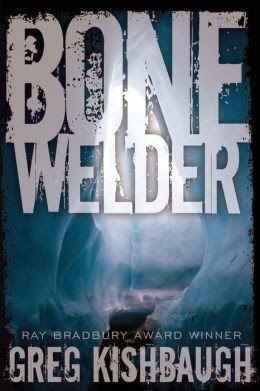
Greg Kishbaugh

A Ray Bradbury Fiction Writing Award winner with work appearing in a number of publications including the renowned Cemetery Dance magazine, Greg Kishbaugh is the Associate Editor of Evileye Books and the editor of the Burning Maiden anthology series. He is the co-founder of Kaleidoscope Entertainment, a company specializing in high-end comics and graphic novels.

Kishbaugh's new novel is Bone Welder.

A brief Q & A with the author:

How would you complete this line: "You might well enjoy my book if you like..."?

You might well enjoy my book if you like ... the lyricism of Ray Bradbury, the white-knuckle horror of the Walking Dead, the modern day supernatural mythos of the X-Files and Grimm, and the old-school gothic thrills of the Universal Monster Movies and the Twilight Zone.

If they make your book into a movie, who should direct it?

Because of Bone Welder's Gothic tone, Guillermo del Toro and Alfonso CuarĂ³n would be a perfect visual fit; and they both have a clear love (and understanding) of monsters.

What is your second favorite art form?

My second art form is a tough choice indeed. I am heavily influenced by artwork of all kinds, but the works of Frank Frazetta can certainly be found in the dark atmospherics of Bone Welder. So, too, the mist-infused black and white artwork of Creepy and Eerie magazines, and the spectacular four-color mayhem of the EC comics such as Tales From The Crypt and the energetic, muscular art of the great comic artists like Jack Kirby, John Romita and Gene Colan.

Music has also always been an enormous influence. As someone who came of age in the punk area of music, I am heavily influenced by punk's primary ethos that the most important thing you can bring to any creative pursuit is passion.
Visit Greg Kishbaugh's website and follow him on Twitter.

--Marshal Zeringue

Monday, February 17, 2014

Beverle Graves Myers

Beverle Graves Myers is the author of Whispers of Vivaldi and five previous mystery novels featuring Tito Amato, the 18th-century sleuth with a stellar talent for sleuthing. A former psychiatrist, Myers divides her time between Louisville, Kentucky and southwest Florida.

From her Q & A at Omnimystery News:

Omnimystery News: What prompted you to write a historical series featuring the recurring character of a castrato opera star?

Beverle Graves Myers: I've always admired two very different but highly enjoyable series with a recurring character: Elizabeth Peters' long-running series featuring Victorian archaeologist Amelia Peabody and Stephen Saylor's Gordianus the Finder books set in ancient Rome. I realized that it was the rich family life and professional growth of both protagonists that made these books so special to me. So I started my own series with Tito Amato as a young man returning to Venice from a music conservatory in Naples. Tito is part of a dysfunctional family long before the term existed. Not surprisingly, qualms about his status as a castrato singer also bedevil him. Over the series, Tito grows to accept and even embrace his vocal talents and the opportunities they provide. He also learns to handle fame and jealous rivals, and overcomes a bout of ego excess. On a deeper level, the brutal surgery that was forced on Tito results in a sensitivity for other marginalized people and a compulsion to seek justice on their behalf. The Jews of the Venetian ghetto, friendless strangers, carnival acrobats and dwarves, and many more seek help from Tito. Along the way, he makes a peace, of sorts, with his father and other family members. If Tito didn't...[read on]
Visit Beverle Graves Myers' website, Facebook page, and Twitter perch.

Writers Read: Beverle Graves Myers.

My Book, The Movie: Whispers of Vivaldi.

The Page 69 Test: Whispers of Vivaldi.

--Marshal Zeringue

Sunday, February 16, 2014

Julianna Baggott

Julianna Baggott's novels include Fuse, Pure, and Burn.

From her Q & A with Noah Charney for The Daily Beast:

You have published in a wide variety of genres (and under a variety of names). How does your approach differ for each genre?

The genre follows my mood. And when one genre is fighting me, I turn to another.

Pure has received the most attention and acclaim. What prompted you to try a novel that’s an Adult/Young Adult crossover, and how did you adjust your plotting and writing style for this different readership?

I started out as an adult novelist. I’ve also written novels for middle grade readers. My oldest two kids are now 17 and 15. It seemed like a ripe time for me to be thinking about the teen years, which I find to be naturally post-apocalyptic. Childhood is over. Adulthood looms....[read on]
Visit Julianna Baggott's website and blog.

The Page 69 Test: Pure.

Writer Read: Julianna Baggott.

--Marshal Zeringue

Saturday, February 15, 2014

Mike Sager

A brief Q & A with Mike Sager, author of High Tolerance:

How would you complete this line: "You might well enjoy my book if you like...."

You might well enjoy my book if you liked… The movie Crash, the show Weeds, or Tom Wolfe’s book Bonfire of the Vanities­—or have an interest in Hollywood celebrity, sex, drugs, music, crime, race relations, murder, or medical marijuana. High Tolerance is the result of my three decades working behind the scenes in LA and Hollywood for Rolling Stone and Esquire. I got the idea for the book during the Writer’s Guild of America strike in 2008. My first act of research was to walk the picket line for a few days with a writer/producer friend. For research I also: Worked in a medical marijuana shop in Malibu. Smoked pot with Snoop Dogg. Smoked freebase with Rick James. Spent three days and nights with Paris Hilton, two dinners with Angelina Jolie, three days with Diane Lane, an afternoon with Hilary Swank, an evening with Joan Baez many years ago in Washington, DC­—she rode on the back of my motorcycle and it was reported in the Washington Times. Performed on a rap song with Ice Cube. Frequented Hollywood Boulevard and the Hollywood Station police precinct. Also helpful were some of my other journalistic experiences, including: Living with a crack gang in Venice; working as Rolling Stone’s drugs correspondent and covering the War on Drugs; writing extensively about the beating of black motorist Rodney G. King (I eventually met both Rodney and one of the two friends who was with him in the car that fateful night). And of course I spent nearly two decades as a husband and a coach and remain a father to this day of a bi-racial child. They say you should write about what you know. This is what I’ve learned in nearly forty years with my boots on the ground.

If they make your book into a movie, who should direct it?

PT Anderson was inspired by my Rolling Stone article, “The Devil and John Holmes,” to create the classic movie Boogie Nights. I think he would do great with High Tolerance. My book has a lot of fun stuff—drugs, music, a beautiful starlet, a billionaire rap mogul, a sex tape that is leaked to the world—but it’s also about fatherhood and race and celebrity and the impact of the media on lives and perceptions around the entire world. In other words, like Boogie Nights, there’s a spoonful of medicine with the sugar, a little depth there with the fun. Boogie Nights is a classic because it caught the zeitgeist of the era, the universality. I think High Tolerance tries to go there too.

What is your second favorite art form?

All artists have inside them a similar creative flame. If we’re lucky, we find the right apparatus with which to apply it. I started with guitar and moved to photography, but I settled on words because that’s the medium that felt most natural. I think prose has within it the ability to express all five senses and all the forms of art. And even more, writing can explore the deeper parts that pictures can’t tell. I grew up in the sixties, a child of television and the movies. I’ve always had a cinematic approach to my writing; I use scenes and characters and dialogue in my stories as a director might use in a film. Whether I’m doing non-fiction journalism or writing a novel, I always feel like I’m making movies with my words.
Visit Mike Sager's website, Facebook page, and Twitter perch.

--Marshal Zeringue

Friday, February 14, 2014

Chang-rae Lee

Chang-rae Lee latest book is On Such a Full Sea. From his conversation with Maud Newton for the Barnes & Noble Review:

Maud Newton: I've been a fan of your novels for a long time, but this is a really different kind of thing.

Chang-rae Lee: Yes. Obviously, I knew it was a very different kind of thing, but I tried not to think about it. The more I thought about it, people asked me what I'm working on and I started talking about it, I'd get kind of scared. [Laughs]

MN: It's both futuristic and contemporary, quasi-apocalyptic yet hopeful about humanity at the same time. A couple of years ago you told James Mustich that you were working on a contemporary novel. Is this that book?

CRL: No. But this book came out of that book, and that book was about contemporary China. I had gone to China and done research, and it was going to be focused on the factory cities along the Pearl River Delta, outside of Shenzhen. It was going to be a social realist novel about that whole world, and have an American connection, and it was just going to be this big, sprawling book about China. But after doing all the research -- I really enjoyed it, going over there and seeing everything. I went into this cool factory and saw all the dormitories, this whole little world --

MN: What was your primary impression of it? Mostly depressing, or was it--?

CRL: It was...[read on]
--Marshal Zeringue

Thursday, February 13, 2014

Kerry Schafer

Kerry Schafer was born and raised in Canada, moved back and forth across the border several times, and finally settled on a compromise. She now lives in Washington state, but within an hour’s drive of her home and native land. She is the author of the Books of the Between (Between and Wakeworld) and the Dream Wars Series (Dream Runner, Dream Thief, Dream Wars).

From Schafer's Q & A at SciFiChick.com:

For those who haven’t read Between, can you tell us a bit about Vivian and Weston and catch us up on their story?

Vivian has been handed rather a difficult destiny – with dreamshifter, dragon, and sorcerer blood in her veins, she’s got all sorts of conflicts and challenges to sort out. In Between she has a pretty sharp learning curve trying to get her mind around realities beyond what she had ever dreamed. Since there are already dragons running amok in the waking world, she doesn’t have a lot of time to figure out what dreamshifting is all about and is always running to try to keep up. In Wakeworld she’s starting to get a handle on the dreamshifter business until a powerful dragon locks her out of the Between with Zee (the man of her dreams) on the other side. As much as she hates her inner dragon, she’s going to have to come to terms with it in order to find a way to get to Zee and save the worlds from destruction. She also has to figure out how to work with Weston.

Weston Jennings makes his first appearance in Wakeworld. He was designated as his father’s heir to the dreamshifter role when he was only a child. However, he didn’t want this and resisted, which precipitated a devastating family tragedy that drove him underground. Now he’s being forced to face up to his past and has to make a choice whether or not to finally embrace his power and help Vivian with her quest.

What is a dreamshifter?

A dreamshifter is tasked with the responsibility of...[read on]
Visit Kerry Schafer's website, Facebook page, and Twitter perch.

The Page 69 Test: Wakeworld.

My Book, The Movie: Wakeworld.

--Marshal Zeringue

Wednesday, February 12, 2014

Amy Chua and Jed Rubenfeld

Amy Chua and Jed Rubenfeld are professors at Yale Law School. Chua, one of Time magazine’s 100 most influential people in the world in 2011, is the author of Battle Hymn of the Tiger Mother, which unleashed a firestorm debate about the cultural value of self-discipline, as well as the bestselling World on Fire. Rubenfeld examined the political dangers of “living in the moment” in Freedom and Time; he is also the author of the international bestseller The Interpretation of Murder.

Their new book is The Triple Package: How Three Unlikely Traits Explain the Rise and Fall of Cultural Groups in America.

From Chua and Rubenfeld's Q & A with CNN's GPS Digital Producer Jason Miks:
You’ve suggested that there is a problematic aversion to comparing some kinds of data, for example between cultural groups. Is this a problem, do you think, in America today?

Chua: I think it’s a terrible problem, and I actually didn’t realize it was quite this bad until this latest book. Of course I knew it would be somewhat controversial and thought provoking. But I think there’s not a single statement that we make that is not backed up by a study. So when we say that Asian-Americans have SATs scores 140 points above the average, that’s just a fact. Or when we say that X, Y and Z groups have median incomes almost twice the national average, then it’s from the U.S. census.

So I think the idea that you can’t give a statistic or say that a group is exhibiting a certain characteristic at any given point – for example, that they are studying 70 percent more hours – without being accused of chauvinism and stereotyping is a problem. And I think it’s going to make it very difficult to devise really good policies on education or poverty reduction policies. Of course we need to fix our institutions. Of course it’s not a level playing field out there. Of course the priority should be eliminating structural barriers to getting jobs. But why should it be mutually exclusive? We should also be able to look at what some cultures are doing, and if we say that this is an area that we can’t talk about, then we are tying one hand behind our back.

Rubenfeld: We’ve actually been called a lot of names because of this book, and it’s astonishing how much people are willing to misrepresent or misunderstand what we have written just because we touch on these sensitive subjects. So, for example, over and over you can find in the media the statement that we claim some groups are better than others. But we actually never say that. We simply point out that in this moment in time, some groups are doing better than others. That’s simply a matter a fact that anyone can look up. And the information comes from the U.S. Census, so are they saying the Census is racist?

We state facts in the book, and we also point out that the groups that are doing better change over time – it is very dynamic. Twenty years ago the groups would have been different from today, and 20 years from now the groups will be different again. It’s a very dynamic story that couldn’t be more...[read on]
--Marshal Zeringue

Tuesday, February 11, 2014

Charlie Quimby

Charlie Quimby's new novel is Monument Road.

From a Q & A with the author:

How would you complete this line: "You might well enjoy my book if you like..."?

You might enjoy Monument Road if you've already found books about the New West to your liking—for example, Kent Haruf for the spare writing, Annie Proulx and Brady Udall for the humor and Louise Erdrich for evoking the spirit of a culture. I've also been compared to the non-western John Irving for throwing in some unexpected plot twists.

As I wrote my novel, I held out hope that I could perform a similar balancing act to the one Colum McCann pulled off in Let the Great World Spin. My story has a rancher named Leonard Self heading off to scatter his wife's ashes from a high overlook—and to follow her off to his own end. As he progresses toward his goal, other stories arise, but it's unclear until the end how they all relate to each other. A high-wire act between the World Trade Center towers might not seem to have much to do with Leonard's discoveries about himself and his relationship to his community, but trust me.

If they make your book into a movie, who should direct it?

Many readers have told me the landscape in Monument Road practically functions as a character—but the land never gets any lines in a movie. Its role must be expressed visually and through the responses the landscape evokes from other characters. That calls for a director who can relate to the mountains and high desert as something more than scenery and who can show the relationship between place and the unfolding internal experiences of the human characters. Terrence Malick's Days of Heaven might be in that ball park, though the era and setting for Monument Road are the contemporary west.

I'd be intrigued to have someone like Michelangelo Antonioni, who once said, "A director's job is to see." He's speaking of seeing the politics and psychology and conflict embedded in a scene, not just the physical setting. In Zabriskie Point, he put two characters in a stunning Death Valley locale. The woman says: "This is such a beautiful place. What do you think?" The man says: "I think it's dead." They're both right, and their contradictory responses reflect their inner states. But Antonioni was rather contemptuous of actors, and his films have an artier tone than my novel strives for—plus, as an Italian, he brings a European view that illuminates but also can wildly miss the reality of America.

Because my book is full of complex characters, the ideal director should bring great performances out of the actors, too, and not just impose his own vision. Robert Redford, then, is the guy I'd ultimately choose because he loves and understands the west as a contemporary place and a changing culture. He's directed A River Runs Through It, played Jeremiah Johnson and has reached the age of my main character, Leonard Self. (And no, he shouldn't play the part.)

Redford's a supporter of small, independent films that move people deeply but don't run up the box office numbers—and Monument Road would be that kind of film.

What is your second favorite art form?

I'm tempted to answer this one with the response Sarah Palin gave Katy Couric about newspapers and magazines—"all of them"—because I'm a dilettante. At various times in my life, I've been consumed with acting, writing plays, photography, book arts and graphic design, and writing and performing music.

If pinned down, though, I'd go with the theater. Starting with the written word, it pulls together different arts forms to get people in a room to share an experience—to laugh, cry, feel human and then hang around and talk about it.

Monument Road alludes to theater in a variety of ways. One character is driven to interpret the role of Joan of Arc as never before, a desire that leads her to a bad place. Another character uses his singing and performance in church pageants both as a way of attracting people and hiding his real nature. A third character is chagrined because his role in a high school musical condemns him to a series of performances in the community that he finds corny and insincere. There's a fair amount in the book about the difference between acting with integrity and being fake or imitating others.

Acting requires empathy, finding your way into characters different from you and then embodying them in a way that's convincing and emotionally compelling. A novelist draws from the same well. You don't need empathy if all you're doing is working out a plot or setting up a joke. You can issue instructions to windup creatures who perform their business and don't really have a life beyond the scene. Real acting is being authentic. That's what we demand of characters when we read literary fiction.

A lot of what occurs in theater boils down to people talking. You can write in sword fights and lighting effects, but so much of what happens on stage comes via the spoken word. In Monument Road, I use dialog to reveal social class, to convey emotion, to wrap up readers in the minds and the hurts of my characters. I tried to create a particular way of speaking that's true to the inter-mountain west. Every line in the book has been read and re-read, the way an actor would rehearse, so when readers hear a character's words, they also feel their heartbeat.
Visit Charlie Quimby's website and learn about his new novel, Monument Road.

Read--Coffee with a Canine: Charlie Quimby & Roxy.

--Marshal Zeringue