Wednesday, November 20, 2019

Catherine Wilson

Catherine Wilson is the author of How To Be an Epicurean: The Ancient Art of Living Well.

From the author's Q&A with Deborah Kalb:

Q: How did you first become interested in Epicureanism, and at what point did you decide to write your new book?

A: My main field of expertise is 17th and 18th century history and philosophy of science—quite remote, you might think, from ancient philosophy and certainly from self-help!

But the Epicureans, who theorized that the world was composed of atoms and void, were the most scientifically sophisticated of all the ancient philosophical schools, so I gravitated towards their writings.

I was mainly interested, from the early 1980s onwards, in the theme of subvisible reality in the Scientific Revolution, and I wrote several books and many articles on that topic.

Then, in 2003 I published a book on moral and political philosophy Moral Animals, laying out some ideas about how morality works (or should work) from a naturalistic perspective.

When I started writing specifically about Epicureanism, there was already a solid literature on Plato, Aristotle and the Stoics, and their relation to 17th century philosophy. Epicureanism was I think considered a fringe philosophy by early modern scholars.

For one thing, it was atheistic and mortalistic, and every philosopher in the 17th century put God and the immortality of the soul right in the middle of their theories. When I argued that these references weren’t always to be taken at face value, I...[read on]
--Marshal Zeringue

Tuesday, November 19, 2019

Carrie Goldberg

Carrie Goldberg is the author of Nobody’s Victim: Fighting Psychos, Stalkers, Pervs, and Trolls.

From the transcript of her NPR interview with Michel Martin:

MARTIN: So there are so many eye-popping stories in your book, including your own. It's hard to know where to start. I mean, could you just give us a sense, as briefly as you can, of the range of things we are talking about here.

GOLDBERG: This book covers stories that range from revenge porn to young people who've been sextorted to a high school student who was sexually assaulted outside of school.

MARTIN: There is also a man you write about in the book who was also subjected to vicious behavior by a vengeful ex. Just tell us briefly what happened to him.

GOLDBERG: So when Matthew (ph) first came to me, he told me about when it first started. Somebody had approached him while he was outside smoking a cigarette and walking his dog and recognized him. And Matthew had no idea who this man was and came to learn that he'd been sent through the gay dating app, Grindr. And Matthew's like, I don't even have an account on Grindr. There must be some mistake.

And then a few minutes later, somebody else came. Over the next few months, it continued happening almost a thousand times. It turned out that Matthew's ex-boyfriend was impersonating him on Grindr. And Matthew did everything that any one of us would do. He made a dozen police reports. He got an order of protection against his ex. He flagged these profiles and nothing stopped...[read on]
--Marshal Zeringue

Monday, November 18, 2019

Elizabeth LaBan

Elizabeth LaBan lives in Philadelphia with her restaurant critic husband and two children. She is the author of The Restaurant Critic’s Wife, Not Perfect, and Pretty Little World, which she co-authored with Melissa DePino. She also wrote the young adult novel The Tragedy Paper, published by Knopf, which has been translated into eleven foreign languages, and The Grandparents Handbook, published by Quirk Books, which has been translated into seven foreign languages.

LaBan's newest novel is Beside Herself.

From her Q&A with Deborah Kalb:

Q: How did you come up with the idea for Beside Herself, and for your character Hannah?

A: There were a few things that came together to form the basic idea for the novel.

One was the title itself. I often use that phrase, saying that I’m beside myself, or someone else is beside herself, and at one point my husband said, “that would be a great title for your next novel.” So, I had that in the back of my mind.

More than that, though, I am always interested in exploring marriage and family, and how people deal with unexpected bumps, or sometimes huge potholes, in the road. When do people call it, knowing they just can’t stay in a particular situation, and when is it salvageable?

The main plot of Beside Herself came from that question, and then grew from there to include Hannah’s reaction and desperate attempt to figure out what came next.

Hannah is not based on any one person I know, she is someone I got to know as...[read on]
Visit Elizabeth LaBan's website.

The Page 69 Test: The Restaurant Critic's Wife.

The Page 69 Test: Not Perfect.

Writers Read: Elizabeth LaBan.

The Page 69 Test: Beside Herself.

--Marshal Zeringue

Sunday, November 17, 2019

Tessa Arlen

Tessa Arlen's new novel is Poppy Redfern and the Midnight Murders.

From her Q&A with Jean Vallesteros:

What do you hope for readers to be thinking when they read your novel?

I have tried to take the reader back to the WWII Homefront in England and an isolated village trying to an American airfield that has been built on its outskirts. Rural England in 1942 was deeply conservative, immersed in tradition, and its country people often very narrow in their view. Little Buffenden is no exception: its villagers are a pretty insular bunch who strenuously resist change in all forms. But patriotism during the war years was the order of the day and Little Buffenden gradually comes to some sort of acceptance. Then one of the local girls who was dating an American is murdered. Inevitably the village closes ranks.

We all suffer from fear of the unknown: the fear of difference, or being different, in our world today. As I worked on the story I found myself paying attention to this theme: the business of being different or ‘other,’ either from within a close knit community or...[read on]
Visit Tessa Arlen's website.

See Tessa Arlen’s top five historical novels.

Coffee with a Canine: Tessa Arlen & Daphne.

The Page 69 Test: Death of a Dishonorable Gentleman.

My Book, The Movie: Death of a Dishonorable Gentleman.

The Page 69 Test: Death Sits Down to Dinner.

My Book, The Movie: Death Sits Down to Dinner.

The Page 69 Test: A Death by Any Other Name.

The Page 69 Test: Death of an Unsung Hero.

Writers Read: Tessa Arlen (November 2019).

The Page 69 Test: Poppy Redfern and the Midnight Murders.

--Marshal Zeringue

Saturday, November 16, 2019

Lucy Ives

Lucy Ives's latest novel is Loudermilk.

From her Q&A with Deborah Kalb:

Q: You write, "When I began writing this novel, I was, mostly without knowing it, reproducing a trope from the libertine canon." How does Loudermilk fit into that canon?

A: I'm not sure if I can—or, one can—write a libertine novel in this era. When I wrote that my novel "reproduces" that trope, I meant that it quotes one aspect of an earlier style of novel-writing—probably without becoming part of that canon. Mistaken identity, weird twins, stories of metamorphosis: these are all things we associate with plays and prose that predate the 19th century (think about Shakespeare, for example).

You have to work pretty hard to get a scenario like this to seem believable in the contemporary moment, although some silly Hollywood films have been successful: Twins, Freaky Friday, and so on. And, to be honest, Loudermilk probably fits a bit more comfortably into that canon (i.e., the comic-loss-of-control-over-self/identity-in-the-U.S. canon), even as it has plenty of elements of high culture...[read on]
--Marshal Zeringue

Friday, November 15, 2019

Attica Locke

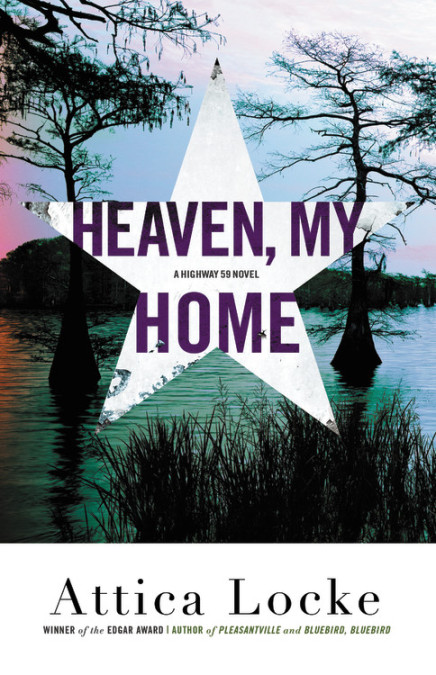
Attica Locke's latest mystery is Heaven, My Home.

From her CrimeReads Q&A with Molly Odintz:

Molly Odintz: As a Texan who grew up hearing about Lake Caddo as the only natural lake in Texas, I was really excited to see the book was set there. How do you think of geography when you’re writing?

Attica Locke: It’s usually the number one or number two thing I’m thinking about—particularly with the Highway 59 series. I knew before I wrote the first book that each book in the series would touch on a town along Highway 59. I wanted to write about Caddo Lake because I’d seen it as a child and as a young adult, and it’s so evocative and amazing and interesting. I knew I was going to write about Caddo Lake before I had a story—geography shaped this whole story.

MO: Is Lake Caddo as creepy and beautiful in real life as it is in the book?

AL: Probably creepier. I’m so glad I didn’t just go by photographs! There was a part of me that knew I had to go there. In March 2017 I did a research trip to Caddo Lake. I stayed in a cabin on the lake and then I went to Jefferson for a few days. I took a boat tour over part of the lake and to be in it is…I can’t explain it. I hope I captured it in the book. When you go through one of the Cypress forests, it’s so insanely majestic-looking—you’re literally floating through woods in water. It gets so quiet. They say it’s the Spanish moss, but if...[read on]
--Marshal Zeringue

Thursday, November 14, 2019

Debbie Cenziper

Debbie Cenziper's new book is Citizen 865: The Hunt for Hitler's Hidden Soldiers in America.

From her Q&A with Deborah Kalb:

Q: What inspired you to write Citizen 865, and how did you choose to focus on the search for the men who worked in the SS camp in Trawniki, Poland, during World War II?

A: At a cocktail party in Maryland, I happened to meet a lawyer from the U.S. Department of Justice. Over a long conversation, she described a unit of Nazi hunters deep inside the massive federal agency that had spent decades tracking Nazi perpetrators in the United States.

Put simply: I was stunned that the work had gone for three decades. In a country that had sacrificed so much to defeat Hitler and save the Jews of Europe, how was it possible that Hitler's helpers were living in America's cities and suburbs?

Other journalists and authors have eloquently described the work of the Office of Special Investigations, which was established in 1979 in the Criminal Division of the Justice Department.

I found one of the unit's lesser-known investigations particularly compelling: the search for the men of Trawniki. I...[read on]
--Marshal Zeringue

Wednesday, November 13, 2019

Kimberly Sue

Kimberly Sue is the author of Getting Wrecked: Women, Incarceration, and the American Opioid Crisis.

From her NPR interview with Emily Vaughn:

What are some of the arguments that jail is not the best public health solution to opioid use?

Incarceration in many cases harms people. We know that, for example, having been in solitary confinement increases your risk of death after release — like in the case of Kalief Browder, a young Bronx man who killed himself after three years at Rikers.

And the rate of opioid overdose in the first two weeks after people leave prison and jail is between 30 and 120 times higher than the general population.

In most of the county-level jails in this country, people are forced to withdraw off lifesaving, stabilizing medications [like methadone] against their will. Methadone is a treatment for opioid use disorder that you cannot access in jails in many places in this country.

There are documented cases of suicide around the country — including in my book — of people who are going through withdrawal in jails and either committing suicide or dying as a combination of medical neglect and loss of body fluids related to dehydration.

Can you describe that example from your book?

One of the women I took care of and interviewed at MCI-Framingham, a women's state prison in Massachusetts, was in the health services unit — where they send people when they're first coming in — and she heard someone withdrawing from methadone. That person was screaming — she was, you know, in agony. And then...[read on]
--Marshal Zeringue

Tuesday, November 12, 2019

A.J. Banner

A. J. Banner's newest novel is The Poison Garden.

From her Q&A with Deborah Kalb:

Q: You said in our previous interview, "I have no idea where I get my ideas" for your books. Was that the case this time around too?

A: The sociopath I knew in my college years might have given me the idea (subconsciously) for the killer in The Poison Garden. I'm sure that dangerous encounter from my past will sneak into future books as well. Diabolical, narcissistic personalities make novels of psychological suspense so much more exciting, don’t you think?

Q: Poison plays a big role in the novel. Did you need to do much research to write the book?

A: For research, I loved reading Wicked Plants: The Weed That Killed Lincoln’s Mother and Other Botanical Atrocities by Amy Stewart, a fascinating A-Z rundown of plants that intoxicate, incapacitate or kill people. I also interviewed...[read on]
Visit A.J. Banner's website.

The Page 69 Test: After Nightfall.

Writers Read: A.J. Banner.

--Marshal Zeringue

Monday, November 11, 2019

Bernardine Evaristo

British writer Bernardine Evaristo is the award-winning author of eight books and numerous other published and produced works that span the genres of novels, poetry, verse fiction, short fiction, essays, literary criticism, and radio and theatre drama. Her writing and projects are based around her interest in the African diaspora. Her novel Girl, Woman, Other won the Booker Prize.

From the transcript of her interview with NPR's Scott Simon:

SCOTT SIMON, HOST: Bernardine Evaristo's novel "Girl, Woman, Other" has just been published in the United States after sharing Britain's Booker Prize with Margaret Atwood's "The Testaments." It follows 12 characters whose lives touch each other or come close or sometimes nowhere near and gives flesh-and-blood portraits of people who are often introduced with hyphens, like Amma, a socialist, lesbian playwright, and Megan/Morgan, who is nonbinary, and Winsome, a Barbadian Anglo immigrant and unhappy wife.

Bernardine Evaristo, a great writer who's Anglo-Nigerian, joins us from London. Thanks so much for being with us.


BERNARDINE EVARISTO: You're welcome. It's good to be here.

SIMON: Help set the scene of these unfolding shared stories for us.

EVARISTO: Yes. So basically, it's a novel about 12 primarily black British women. They're aged 19 to 93. The youngest, Yazz, is a university student, and the oldest, Hattie, is a farmer in the North of England. And I have women of every generation in between. They have different occupations, different cultural backgrounds, which very much reflects black British presence and history. So some of them have roots in Africa. Some of them have roots in the Caribbean. They are different sexualities.

And then the book opens with Amma, who is a black lesbian theater director. And she has a show opening at the National Theatre in London. She has spent nearly 40 years working in theater as a director and writer and very much on the margins feeling overlooked, very radical in her politics. And suddenly, she's got this big break. And then the story kind of goes off into all these other stories. And at the end of the novel, we see the show opening and the sort of gathering together of lots of characters in the book.

SIMON: You've said in interviews, I want to put presence into absence.

EVARISTO: Oh, well, so there are very few black British novels getting published. That's the truth of it. So when I decided to write this novel, I wanted to put as many black British women into it as possible to show the sort of heterogeneity of who we are in this society and to explore us as fully realized, complex, flawed individuals whose stories are...[read on]
--Marshal Zeringue