Sunday, January 31, 2010

John Wray

From a Q & A with John Wray about his novel, Lowboy:

You actually wrote this book on the subway. Why? What was that experience like?

My reasons for writing on the subway were simultaneously practical and romantic: I liked the idea of being in constant motion as I worked, and also, of course, of spending as much time as possible in the environment and under the conditions I was writing about. But at the same time, I needed a place to work that was cut off from temptations like the Internet and the presence of my girlfriend, who works at home. Also, it only cost four dollars a day—two if I never left the subway!

It turned out to be harder than I’d thought to concentrate on the trains, and for the first few weeks I was also hampered by my self-consciousness, which almost approached stage fright on certain days. But there are scenes in Lowboy that would never have been written if I hadn’t found myself in certain MTA stations, and many of those are my favorites in the novel. Rockefeller Center, for some reason, was especially fertile ground, and so was the out-of-service old City Hall station on the 6 line, which I snuck into on several occasions.

Lowboy is a paranoid schizophrenic. How does one write about mental illness in novel? How do you get it right?

Attempting to inhabit the consciousness of a schizophrenic was without a doubt the most difficult thing I’ve ever tried in fiction. I was helped, to some degree, by the fact that I’ve always been interested in mental illness, and by the fact that I’ve come into close contact, in my life, with both schizophrenia and manic depressive disorder; but writing from the point of view of a sufferer—and, above all, writing in a way that neither reduced the condition to a set of clinical symptoms, nor amplified it into the kind of caricatures of insanity that are so rampant in our culture—was a...[read on]
--Marshal Zeringue

Saturday, January 30, 2010

Joyce Carol Oates

Joyce Carol Oates is a recipient of the National Book Award and the PEN/Malamud Award for Excellence in Short Fiction. She has written some of the most enduring fiction of our time, including the national bestsellers We Were the Mulvaneys and Blonde (a finalist for the National Book Award and the Pulitzer Prize), and the New York Times bestsellers The Falls (winner of the 2005 Prix Femina Etranger) and The Gravedigger’s Daughter. She is the Roger S. Berlind Distinguished Professor of the Humanities at Princeton University and has been a member of the American Academy of Arts and Letters since 1978. In 2003 she received the Common Wealth Award for Distinguished Service in Literature and The Kenyon Review Award for Literary Achievement, and in 2006 she received the Chicago Tribune Lifetime Achievement Award.

Her recent novels include Little Bird of Heaven, Dear Husband, and A Fair Maiden.

From her Q & A with Anna Metcalfe for the Financial Times:

What book changed your life?

Lewis Carroll’s Alice in Wonderland and Through the Looking-Glass. I was eight.

* * *
Who would you most like to sit next to at a dinner party?

Charlotte Brontë. Or – though she wouldn’t speak to me – Emily Dickinson.

* * *
What are you most proud of writing?

My novel Blonde about the American girl Norma Jeane Baker who is made into “Marilyn Monroe”.
Read the complete Q & A.

Learn about the two dates when Oates says she was the happiest.

--Marshal Zeringue

Friday, January 29, 2010

Neil Cross

Neil Cross' latest novel in the UK is Captured. A previous novel, Burial, releases in the US in March.

From his Q & A with Ali Karim at The Rap Sheet:

AK: ...After several non-genre novels you penned Burial, which knocked my socks off. The book carried the same themes of morality and trust that, incidentally, are also themes you mine in the BBC-TV espionage series, Spooks. Would you agree that morality and trust are themes of special interest to you?

NC: Absolutely. One thing that interests me about American crime fiction, particularly, is it has a unifying theme--it is “free will exercised as sin.” This is opposed to much British crime fiction, especially during the Golden Age, which is about the restoration of order; someone’s been killed, things are out of whack, for Christ’s sake let’s get things back to normal, so things can run smoothly. I’m more interested in “free will exercised as sin,” as opposed to the “restoration of order.”

AK: I’m guessing you must have read Patricia Highsmith, then.

NC: I’m obsessed by Patricia Highsmith.

AK: [Laughing] So am I. I am totally obsessed with her Tom Ripley books. In fact, I have...[read on]
The Independent asked Cross: Which fictional character most resembles you? Read his answer.

--Marshal Zeringue

Thursday, January 28, 2010

DC Pierson

From a Q & A with DC Pierson, author of The Boy Who Couldn't Sleep and Never Had To:

Q: Before you wrote The Boy Who Couldn't Sleep and Never Had To (BWCS) you were an active blogger, comic and short story writer. Why did you decide to write a novel?

A: I had just graduated from college. I was living in Astoria, Queens, and I boarded the N train one day. My friend and fellow comedian Eliza Skinner turned out to also be on the train. In the course of conversation, she mentioned that she liked my writing, and she asked if I'd ever thought about writing a novel. I told her I had, and it was something that I'd definitely like to try my hand at one day. Eliza said something along the lines of, "A lot of people say that, and a lot of them never do it." This was precisely the right thing to say to trigger my competitive spirit.

That day, at my temp job, I somehow got around the firewall that was supposed to prevent staffers from sending personal e-mails, and sent Eliza an e-mail telling her that she had really gotten under my skin with her "a lot of people say that" remark, and that I would write a novel if she would be my "novel sponsor" by bothering me constantly and guilt-tripping me until I actually had a finished product. She agreed. I respond best to guilt and haranguing, so this arrangement ended up working out really well.

That night, I called my temp agency and told them I could not go back to that job the next day. I called when I knew my temping rep would have already gone home for the day, because I am a coward. Then I took a nap.

Q: How long did it take you to write BWCS?

A: I started writing...[read on]
Visit DC Pierson's website.

--Marshal Zeringue

Wednesday, January 27, 2010

Neil Cross

Neil Cross' latest novel in the UK is Captured. A previous novel, Burial, releases in the US in March.

From his Q & A with the Independent:

Choose a favourite author and say why you like her/him

I love Patricia Highsmith for her unforgiving eye. And Raymond Carver for the tenderness of his.

* * *
Which fictional character most resembles you?

The fictional character with whom I most profoundly identified was Yossarian in Catch-22. Always did, still do.

* * *
Who is your hero/heroine from outside literature?

Until recently, I'd have said Indiana Jones. Now I'd say David Tennant as the Tenth Doctor. This programme is filled with fierce joy and wonder and magic, sometimes scary magic.
Read the complete interview.

--Marshal Zeringue

Tuesday, January 26, 2010

Meg Cabot

Meg Cabot's Princess Diaries series, which is currently being published in over 38 countries, was made into two hit movies by Disney. Meg also wrote the Mediator and 1-800-Where-R-You? series (on which the television series, Missing, was based), two All-American Girl books, Teen Idol, Avalon High, How to Be Popular, Pants on Fire, Jinx, a series of novels written entirely in email format (The Boy Next Door, Boy Meets Girl, and Every Boy’s Got One), and a chick-lit series called Queen of Babble.

From a Q & A with Cabot about The Princess Diaries:

What inspired you to create the character Mia from The Princess Diaries? Do any of Mia's characteristics, qualities, childhood (aside from the princess thing, of course!) relate to your own?

I was inspired to write The Princess Diaries when my mom, after the death of my father, began dating one of my teachers, just as Mia's mom does in the book! I have always had a "thing" for princesses (my parents used to joke that when I was little, I did a lot of insisting that my "real" parents, the king and queen, were going to come get me soon, and that everyone had better start being a LOT nicer to me) so I stuck a princess in the book just for kicks...and VOILA! The Princess Diaries was born.

The voice of Mia, of course, is taken directly from my own diaries that I kept when I was in high school...I still have them, though I am the only one who will ever be allowed to read them. I was pretty much a huge geek in high school—although I was pretty involved with the school's drama group. Most of what's in my journals from those days is about boys, boys, boys, and that's why I am the only one who is allowed to look at them! It is too embarrassing!

New York City is described in such rich detail. Do you feel the setting of a story is important?

I really do think New York City would be...[read on]
Visit Meg Cabot's website.

--Marshal Zeringue

Monday, January 25, 2010

Ali Shaw

Ali Shaw graduated from Lancaster University with a degree in English literature and has since worked as a bookseller and at Oxford’s Bodleian Library.

The Girl with Glass Feet is his first novel.

From a Q & A at his publisher's website:

The Girl with Glass Feet is a wonderfully inventive, magical novel. What was the inspiration behind it?

My writing almost always begins with an image, which normally just arrives in my head unprompted. I remember being on an escalator in a railway station when I suddenly saw in my mind a girl with feet made of glass. I couldn’t tell you whether something prompted it – the image is the most vivid thing I can remember about that railway station. I got home and started exploring it, asking what kind of person had feet made of glass, and how on earth would she cope? And I loved the idea that she hadn’t always had feet of glass, but that slowly they had transformed into it. Which of course meant the rest of her body was in danger of turning into glass as well. Coupled with this, I had the idea for another character I wanted to write about. Midas Crook, a man so over-sensitive and unsure of himself that he needed to filter the experiences of his life through a camera. Photography would be his way of putting distance between himself and the rest of the world. He would take more pleasure in reflecting on photographs than he would in actually living day-by-day.

You worked as a bookseller in Oxford for several years. What was that experience like?

I worked as a bookseller at Blackwell Broad Street, a bookshop in Oxford that’s been running since 1879. I was writing the novel during that time, and when the UK edition of The Girl with Glass Feet was released, in May of this year, I went into the shop and had the privilege of seeing the finished novel on sale. It was amazing to think that inside that book were words I had written on my lunch break in that very shop.

One of the...[read on]
Learn more about the book and author at Ali Shaw's website and blog.

The Page 69 Test: The Girl with Glass Feet.

--Marshal Zeringue

Sunday, January 24, 2010

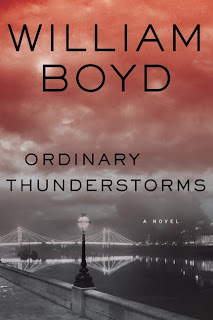
William Boyd

William Boyd's books include A Good Man in Africa, winner of the Whitbread Award and the Somerset Maugham Award; An Ice-Cream War, winner of the John Llewellyn Rhys Prize and shortlisted for the Booker Prize; Brazzaville Beach, winner of the James Tait Black Memorial Prize; Any Human Heart, winner of the Prix Jean Monnet; Restless, winner of the Costa Novel of the Year; and the newly released Ordinary Thunderstorms.

From Boyd's Q & A with Cynthia Crossen at the Wall Street Journal:

"Ordinary Thunderstorms" is more like a thriller than many of your earlier novels.

There's a thrillerish aspect to it. I cherry-pick a genre if it suits me. I like a powerful narrative motor, and a genre will often provide that. Then I construct my elaborate, complex car around that motor. "Ordinary Thunderstorms" has the dynamic of the hunter and the hunted, but there's a lot more to it than that.

* * *
You've said that one of the seeds of "Ordinary Thunderstorms" was learning that the river police haul 50 or 60 bodies out of the Thames every year.

And that's just in London, not the length of the Thames. We never hear about these deaths unless they're particularly gruesome. The Thames is tidal—it has a fall of between 15 and 20 feet—and it's extraordinarily changeable. I live about 200 yards from it, and every time I walk by, it's different.
Read the complete interview.

Learn about William Boyd's thoughts on the perfect setting for writing.

--Marshal Zeringue

Saturday, January 23, 2010

Terry Castle

Terry Castle's books include The Apparitional Lesbian: Female Homosexuality and Modern Culture (1993) and Boss Ladies, Watch Out! Essays on Women and Sex (2002). Her anthology, The Literature of Lesbianism, won the Lambda Literary Editor's Choice Award in 2003. She lives in San Francisco and is Walter A. Haas Professor in the Humanities at Stanford University.

Her new book is The Professor and Other Writings.

From her interview with Deborah Solomon in the New York Times Magazine:

Is it odd to be known for having written a derisive essay about a former friend, Susan Sontag, who once described you, rather generously, as the “most enlightening literary critic at large today”?

I like to think that the piece is as much a tribute, a work of homage, as it is a piece of satirical description.

I missed the tribute part. It was published shortly after her death and characterizes her as a pompous and self-absorbed aesthete who once told you, for instance, “how a Yugoslav woman she had taken shelter with had asked her for her autograph, even as bombs fell around them.”

We were in Palo Alto, and she proceeded to demonstrate how one evades sniper fire by running down the street toward Baskin-Robbins. She asked me if I had ever had to evade sniper fire, and I said, “Unfortunately not.”

That’s funny.


When I said “Unfortunately not,” she didn’t pick up on it.
Read the complete Q & A.

--Marshal Zeringue

Friday, January 22, 2010

Eric Puchner

Eric Puchner teaches at Stanford University, where he was a Wallace Stegner and John L’Heureux Fellow. His short stories have appeared in The Chicago Tribune, Zoetrope: All Story, The Missouri Review, Glimmer Train, Best New American Voices 2005, and other journals and anthologies. He has won a Pushcart Prize and the Joseph Henry Jackson Award for Music Through the Floor. His new book -- his first novel -- is Model Home.

The start of his Q & A with Erin Gilbert for Publishers Weekly:

Does your own childhood bear any resemblance to that of the Ziller kids?

Not in terms of any of the actual events being autobiographical, but I did spend my teen years in Southern California, partly in a gated community that was similar to the Herradura Estates from the novel, and we were downwardly mobile in the same way. My father was a failed businessman who constantly lived beyond his means, and some of the details from the book, like the furniture and cars being repossessed, were things I lived through. But in terms of the actual family itself, it bears absolutely no resemblance to my real-life family.

Real estate fiascos and financial struggles are pretty timely subjects. Was that intentional?

It wasn't actually. When I began, it was before the whole subprime loan disaster, and I was thinking about what happened to my own father. I hadn't anticipated the whole real estate crisis.

Is there any idea or feeling that you want your readers to be left with?

I had a friend...[read on]
Visit Eric Puchner's website.

--Marshal Zeringue