Thursday, October 10, 2013

Ben H. Winters

Ben H. Winters's novels include The Last Policeman, which was the recipient of the 2012 Edgar Award from the Mystery Writers of America (it was also named one of the Best Books of 2012 by Amazon.com and Slate) and Countdown City, the second book in the Last Policeman trilogy.

From his Q & A with Marty Mulrooney at Alternative Magazine Online:

In my review of Countdown City, I said how “It’s not unusual for the middle installment of a trilogy to sag, but Countdown City positively soars.” Following the critical acclaim for The Last Policeman, was it daunting writing a sequel?

Fortunately, I was already well underway on the sequel – plotting it out, considering the characters and the story – before TLP even came out. And any positive feedback only validated my sense that I know what the hell I’m doing when I sit down to write.

Did Countdown City require as much research as the first book?

Not quite as much, because I didn’t have to learn about asteroids all over again. I did do a lot of interviews, though, including with a former Green Beret, who told me all about treating gunshot wounds if you’re alone in the wilderness.

There is a dark humour that runs throughout both books – do you think it’s important to include some levity when writing about what is essentially quite a terrifying prospect?

Important only in the sense that if this were a real true thing that were happening, I guarantee you that a lot of people would be making darkly sarcastic remarks right up until the whole world exploded. That’s just how people are: everyone has...[read on]
Learn more about the book and author at the official Ben H. Winters website.

The Last Policeman is on Christopher Buehlman's list of eleven novels that will creep you out.

My Book, The Movie: The Last Policeman.

The Page 69 Test: The Last Policeman.

The Page 69 Test: Countdown City.

--Marshal Zeringue

Wednesday, October 9, 2013

Jessica Anya Blau

Jessica Anya Blau's books include the nationally bestselling novel The Summer of Naked Swim Parties and the critically acclaimed Drinking Closer to Home.

Her latest novel is The Wonder Bread Summer.

From the author's Q & A with Mourning Goats:

Did I hear right? Wonder Bread is taken from a lot of real events you've been through?

Yup, sure is. Here's the round up of stuff I've encountered in real life: 1. The bread bag full of cocaine. 2. The girl (moi!) working at a dress shop that's really a front for cocaine dealing. 3. The quadriplegic with the head pointer who makes "erotic" films (in real life the guy made sex films that he called "art", in the book the guy makes porn). 4. The blind date with the quadriplegic (my blind date was with a paraplegic). 5. A guy named Vice Versa (the real one wasn't a hit man). Hmmm, there's more, but I can't remember right now.

What's the hardest thing you ever had to write?

The hardest things for me to write are promo/ad copy sort of things. Fiction is way easier than stuff like that. Actually, the hardest things to write are mission statements, essays, statements of purpose. The kind of stuff you have to write to get into colonies. I find that kind of writing agonizing.

Did I hear that the very first story you sent out was published? What did that feel like?

It did and I was shocked. I was...[read on]
Learn more about the book and author at Jessica Anya Blau's website, Facebook page, and Twitter perch.

Read--Coffee with a Canine: Jessica Anya Blau and Pippa.

The Page 69 Test: The Wonder Bread Summer.

My Book, The Movie: The Wonder Bread Summer.

--Marshal Zeringue

Tuesday, October 8, 2013

Anita Hughes

Anita Hughes was born in Sydney, Australia and had a charmed childhood that included petting koala bears, riding the waves on Bondi Beach, and putting an occasional shrimp on the barbie. Her writing career began at the age of eight, when she won a national writing contest in The Australian newspaper, and was named "One of Australia's Next Best Writers." (She still has the newspaper clipping.)

Hughes received a B.A. in English Literature with a minor in Creative Writing from Bard College, and attended UC Berkeley's Masters in Creative Writing program.

Her debut novel Monarch Beach was released in June 2012, followed by Market Street in March 2013.

Hughes's latest novel is Lake Como. From her Q & A with Meredith Resnick at The Writer's [Inner] Journey:

Meredith: How do you find that a work of your takes shape? Does form follow idea? Or does idea follow form? Or is it a process that gets worked out in the writing, waiting, reflecting, pondering? Are you a let-it-be type of writer, or a shape-it, form-it, make-this-thing-work kind of one?

ANITA: I start with a location – I love to set my novels in gorgeous locations: Laguna Beach, San Francisco, Lake Como, because I feel like I am there while I am writing it. Then I spend some time visualizing the locations, seeing the streets and houses in my mind. After that I think of a problem and let that sit for a while. Lastly, I create my characters. I love strong women and great female friendships so my heroine always has to have someone she can turn to in good and bad times.

Meredith: We all seem to have rules we are attached to—whether they actually work for us or not is another story. What is it about rules that make us feel like we are doing something correctly? Why, once we set up rules does it seem we need to break them to set ourselves free?

ANITA: I think rules...[read on]
Visit Anita Hughes's website.

Writers Read: Anita Hughes (July 2012).

My Book, The Movie: Market Street.

My Book, The Movie: Lake Como.

--Marshal Zeringue

Monday, October 7, 2013

Valerie Plame

Valerie Plame's new CIA thriller is Blowback.

From her Q & A with Katie Baker for The Daily Beast:

The Daily Beast: You and Vanessa Pierson, your novel's protagonist, seem to share a lot of the same qualities—you are both blonde, you both have a CIA background, you share the same initials. How much of your own story and psychology is in your heroine?

Valerie Plame: There are a lot of things. I draw on my own experience. I very much wanted to depict a female CIA ops officer that was much more realistic, who has flaws but is smart and loves her job—but what comes with that is a great deal of frustration and challenges and trying to have some sort of normal relationships—hard under the best of circumstances, but especially in an otherwise crazy career. We both come from military families: My dad was Air Force and fought in WWII, but because of the timing, her father is Air Force and he was in Vietnam. Brother in the Marines, same as me. All the places in the book, I’ve been to, lived there or traveled there, worked there. I think that’s part of the appeal of, say, Bond. You’re not watching them for the dialogue—it’s taking you to exotic locales.

Did you have the same rebellious streak that Vanessa has?

I would say, growing up, I was very conscious of authority. And yet the CIA recruits a certain type of person to go into operations. They want someone who has a lot of initiative, and is willing to work right at the edge. But it’s not good to have cowboys. They exist, but it’s not a good idea to have people who go off and try to do ...what their own judgment is telling them. As you saw at the beginning of the book, it was her judgment call that lead her to decide to do that ops meeting. She was so close and it had tragic consequences. In terms of authority, she is really pushing the system as hard as she possibly can. I probably...[read on]
--Marshal Zeringue

Sunday, October 6, 2013

David Berg

In 1968 David Berg’s brother, Alan, was murdered by Charles Harrelson, a notorious hit man and father of actor Woody Harrelson. Alan was only thirty-one when he disappeared; six months later his remains were found in a ditch in Texas. Run, Brother, Run: A Memoir of a Murder in My Family is Berg’s story of the murder.

From Berg's Q & A with Randy Dotinga for the Christian Science Monitor:

Q: You write about the influence of your father over the lives of you and your brother. What role did he play?

A: Machiavelli writes that the world conspires, usually in the form of a disapproving parent, to obscure our talents and gifts even from ourselves. The sooner you're able to shake that bond, the more likely you are to succeed.

Even up until the moment of his death, my brother Alan was still seeking his father's approval. He was smart and funny and a very capable guy and a great salesman, too, but he never understood that about himself. Up to the moment he was murdered, he was still seeking Dad's approval.

Q: What about you?

A: Somehow, I knew my father's approval was not worth winning.

Q: How did this tragedy affect you?

A: I know that I was ashamed of the way Alan died on some subconscious level, and I was ashamed of being ashamed. I think I poured all of that anger and embarrassment into...[read on]
--Marshal Zeringue

Saturday, October 5, 2013

Caroline Leavitt

Caroline Leavitt is the New York Times bestselling author of Pictures of You, which sold to six countries, went into five printings, and was a San Francisco Chronicle Lit Pick, a Costco "Pennie's Pick" and a NAIBA bestseller. Pictures of You is also a USA Today ebook bestseller and is on the Best Books of 2011 List from the San Francisco Chronicle, Providence Journal, Kirkus Reviews and Bookmarks Magazine. It's also one of Kirkus Reviews Top 5 books of 2011 about the Family and love.

Is This Tomorrow is Leavitt's tenth and latest novel. From Leavitt's Q & A with Katy Flaherty at Writers’ Program:

Writers’ Program: In Is This Tomorrow, you do a great job of juxtaposing the cultural norms of 1950s–so often viewed with nostalgia and longing for a “simpler time”—with the realities of being an outsider in this culture. What made you choose the fifties as the jumping off point for the novel?

Caroline Leavitt: The fifties were such a weird time. It was supposed to be a white picket fence suburban paradise, but the suburbs back then were all about everyone being the same, and if you dared to be different–or if you simply were different, you paid a high price. Setting the book in the 1950s gave me a lot of drama. Ava Lark is divorced at a time when no one gets divorced. She’s also Jewish at a time when being Jewish was virtually the same as being that dreaded of all dreaded things: a Communist. And she works at a time when mothers didn’t work.

WP: Your writing immediately transports the reader to a different time and place. From Ava’s outfits to Lewis and Jimmy’s road trip stops, everything seems very authentically of the time. How did you go about researching to get the details so spot on?

CL: After it took me three days to find out what 1950s cops used instead of crime tape (wooden saw horses and rope), I hired a librarian who was amazing. I’d ask her for one thing, like researching what people ate back then, and she’d come back with things I hadn’t thought to ask!

The greatest boon...[read on]
Visit Caroline Leavitt's website and blog.

Writers Read: Caroline Leavitt.

The Page 69 Test: Is This Tomorrow.

My Book, The Movie: Is This Tomorrow.

--Marshal Zeringue

Friday, October 4, 2013

Donald Driver

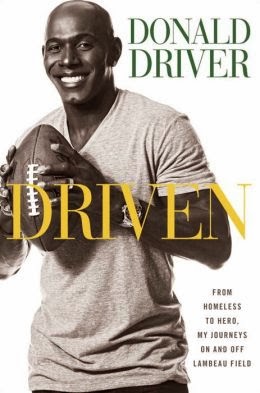
Donald Driver is a Super Bowl champ, Dancing with the Stars winner, and an author of children’s books. His new memoir is Driven: From Homeless to Hero, My Journeys On and Off Lambeau Field.

From Driver's Q & A with Josh Sorokach at The Barnes & Noble Book Blog:

Driven chronicles your amazing transformation from a young person stealing cars and selling drugs to a caring husband, loving father, and football icon. What advice would you give people growing up in tough situations who want to improve their circumstances and change their lives?

First, you have to realize nothing is impossible if you have the will and determination to make it happen. Anyone can say they are going to do something, but the people who are able to improve their circumstances are the ones who actually take steps to achieve their goals. Everyone has the power inside them to change their lives, we just have to make up our minds that we are actually going to do it and then follow through on that promise to ourselves.

Second, you have to educate yourself. Whether that is in school or in some sort of trade, your own education is something you can control and is critical to success in any field…even sports. There is no way I could have played fourteen years in the NFL if I didn’t work my butt off on the practice field perfecting my technique, or spend hours upon hours in the film room studying defenses.

In Driven, you reveal a story from your youth about narrowly escaping the police when an elderly stranger covered for you after you crashed your stolen car into her automobile. Do you ever think about how your life would have been different if she hadn’t given you that second chance?

All the time. Miss Johnson saw something...[read on]
--Marshal Zeringue

Thursday, October 3, 2013

Joan Steinau Lester

Joan Steinau Lester is an award-winning journalist and author. Her latest book is the novel Mama's Child.

From her Q & A with Renee Swindle:

R: What was the genesis for Mama’s Child? Was it a book you’ve always wanted to write?

J: Ah. The mother-daughter bond is such an enduring theme, in literature and life. The tension between emotional poles on the daughter’s part—“I’m like you, I’m not anything like you!”—combined with the mother’s sometimes-guilty web of adoration, protection, and resentment (“Grow up, so I can have my own life!”) can create fertile ground for misunderstandings. Add in the charge of “race,” and you have an irresistible mix.

Since I was passionate during the civil rights era, I had yearned to set a novel in that time period. Part of my impetus was to rehabilitate the image of ‘60s activists, who’ve been portrayed in our more conservative era as self-indulgent, rather than inspired idealists leaning against a great historic injury. I also witnessed the personal toll such dangerous involvement took on the young activists.

Once these two themes converged in my imagination—mother/daughter conflict, and the Movement’s personal impact—I was hooked. Still, it took me TEN years to find a form that perfectly suited the content.

R: You’re the author of five award-winning books of both non-fiction and fiction. Do you prefer one form of writing to the other? How many works in progress do you have going at any given time?

J: Like many writers, I love...[read on]
--Marshal Zeringue

Wednesday, October 2, 2013

Lyndsay Faye

Lyndsay Faye's new novel is Seven for a Secret.

From her Q & A with Elise Guest at Eight Bookcases:

What's your first book-related memory?

Hmmm. I don't have one. I was never not reading, really. My parents were obsessed with great storytelling and read to me all the time, and I started reading very early, before I can quite remember it--I was extremely lucky to have a pair of book lovers for parents. That and FYI, I have a memory like a steel sieve. I do know that before I could read, I'd correct my mom when she tried to skip paragraphs in bedtime stories. I was an obnoxious little animal.

What's one word or turn of phrase that you've felt compelled to work into your writing?

There's a lot of a language called "flash patter" in the Timothy Wilde novels, and in the new one, Seven for a Secret, I absolutely could not stop myself from including an interlude about what the word "O.K." actually means (it's an acronym). Tim and Val Wilde, who patter flash, comprehend its meaning and their friend Mr. Piest has to ask what on earth O.K. signifies (the word was coined as...[read on]
Visit Lyndsay Faye's website.

Writers Read: Lyndsay Faye (April 2012).

The Page 69 Test: The Gods of Gotham.

The Page 69 Test: Seven for a Secret.

--Marshal Zeringue

Tuesday, October 1, 2013

Liad Shoham

Liad Shoham is one Israel's leading crime writer and a practicing attorney with degrees from Jerusalem's Hebrew University and the London School of Economics. All his crime novels (five to date) have been critically acclaimed bestsellers. Lineup is the first of his thrillers available in English.

From Shoham's Q & A with Lenny Picker at Publishers Weekly:

How did The Wire influence Lineup?

The series had an enormous effect on me. I watched it with my wife when she was toward the end of her pregnancy, and was having difficulty sleeping. Through watching the series, I realized how powerful it was to see a dramatic story told from various angles. I think that when you write the way I do, about “the system”—when you try to expand the scope to include social issues—presenting the problem from various standpoints enriches the story and gives it a level of complexity. You understand the motives and interests of the different players. There’s no good and bad, there’s only complexity. That’s why Lineup is told from the standpoint of the victim, her family, the police, the prosecutors, the courts, journalists, gangsters, and...[read on]
--Marshal Zeringue