Wednesday, February 17, 2021

Sam Taylor

Sam Taylor grew up in Arizona's desert and now lives among Connecticut's trees. She writes fantasy novels for teenagers, and magic is always at the heart of her stories. (What world isn't better with a bit of magic?)

For her writing, Taylor has won the Tassy Walden Award for New Voices in Children's Literature and twice received the Young Adult Romance Writers of America Rosemary Award. She's worked as a proofreader, copywriter, and instructor of university writing courses before deciding to write her own books.

Taylor's debut novel is We Are the Fire.

My Q&A with the author:

How much work does your title do to take readers into the story?

My editor, Emily Settle at Macmillan, came up with the title We Are the Fire. It’s partly inspired by some lyrics from the song “Missile” by Dorothy, which my editor said would be a great theme song for my book. And she’s right!

I loved this title the moment my editor suggested it because it had the bold, powerful, punchy vibe that I’d been searching for to draw readers into this story. In my book, the fire magic is forced onto the teen characters through alchemical transformations. And some of them—particularly Oksana—greatly struggle with what they’ve become. But winning the fight for their freedom starts with reclaiming themselves and repurposing these powers they didn’t choose to have. They truly have to become the fire.

How surprised would your teenage reader self be by your new novel?

It’s certainly much darker than anything I read as a teenager and would have expected to write! Teen Sam would be quite shocked and maybe even a little overwhelmed by this book. (Teen Sam also had a lot to learn about herself and the world.) But I’d have absolutely loved my cover, and I think a part of me would have been very proud and awed to know I’d write such a bold and fierce story.

Do you find it harder to write beginnings or endings? Which do you change more?

I rewrote the beginning of We Are the Fire many more times than the ending, so I’d have to say beginnings. Though I tend to have a lot more energy and momentum while writing story beginnings, as a fantasy writer, it’s challenging to figure out how to introduce readers to the worldbuilding: what information to include in those first chapters, what to hold back for later, how to pace everything in, and how to present the characters’ feelings toward their world and their conflicts with it.

I’ve lost count how many times I rewrote that first chapter in particular; it underwent some major changes until the line edits stage with my editor. When I finally landed on the current opening—Oksana and Pran witnessing the Scarlet Embers attack and rebellion—it felt so obvious, so right, I wasn’t sure how I hadn’t figured that out before! But it’s a truth many writers come to terms with: you have to write a lot of the wrong words before you uncover the right ones.

Do you see much of yourself in your characters? Do they have any connection to your personality, or are they a world apart?

I definitely see a lot of myself in Pran, for good and for ill: especially his ambition, his thirst to prove himself, and doing what it takes to succeed. Though thankfully, I’m not pitted against such dire circumstances, and therefore I’m not faced with the gut-wrenching choices he must make. I’m just trying to launch a writing career, and therefore my scheming consists of spotting out new ways to promote my debut novel (released during a pandemic, alas). But like Oksana, I also struggle to balance of taking care of others while holding true to my own dreams and hopes for myself.

What non-literary inspirations have influenced your writing?

Lots of music! It always helps to listen to music while I write; that can easily transport me to the mood of each scene. The movie score-esque group Two Steps from Hell fit particularly well with many moments in my book.

I also love to cook and bake foods inspired by my writing. Eating a slice of spiced cake with cardamom buttercream while working on revisions for this book was an excellent treat.

And visiting a historic alchemy lab and museum within Heidelberg Castle in Germany was an inspiring experience. It helped to see real tools that had been used by alchemists in our world, so I could better visualize the alchemy for my story’s world.
Visit Sam Taylor's website.

The Page 69 Test: We Are the Fire.

--Marshal Zeringue

Tuesday, February 16, 2021

Nancy Johnson

A native of Chicago’s South Side, Nancy Johnson worked for more than a decade as an Emmy-nominated, award-winning television journalist at CBS and ABC affiliates nationwide. A graduate of Northwestern University and the University of North Carolina at Chapel Hill, she lives in downtown Chicago and manages brand communications for a large nonprofit. The Kindest Lie is her first book.

My Q&A with the author:

How much work does your title do to take readers into the story?

The title of the book works on multiple levels. The Kindest Lie centers on Ruth Tuttle, a successful, Black chemical engineer who has been harboring a secret—she gave birth to a baby when she was just seventeen and left him behind in the dying Indiana factory town where she grew up. The title reflects the lies she’s told herself over the years about outrunning her past. When she returns to her hometown to search for her son, she discovers that her grandmother and brother have been lying to her as well in an effort to ensure her success. Often, these well-meaning lies are borne out of love and expectations. Also, the title works on the macro level—America has been lying to itself for centuries, pretending to be more honorable and just than it really is.

What's in a name?

Names carry great significance in my novel. In the first chapter, we learn that Mama insisted that her grandmother be named Ruth. For one, it’s biblical, but more importantly this grandmother believed that a racially ambiguous name like Ruth would at least get her granddaughter to the interview.

Midnight is the surprising nickname for the 11-year-old white boy who figures prominently in the narrative. Adrift and looking for connection, Midnight attaches himself to a group of Black and brown boys from school and immediately he becomes known as the little white boy who wants to be Black. That’s why his friends gave him this nickname and he’s never sure if the kids he desperately wants to like him actually do or if they’re just making fun of him.

How surprised would your teenage reader self be by your novel?

My teenage self would be very surprised that I’ve centered Black characters in my novel. In high school, I rarely saw myself reflected on the page and I didn’t realize that my experience and understanding of America were important enough to be part of the literary canon. Obviously, I hadn’t read enough to know the literary greatness of Black authors who preceded me.

Do you find it harder to write beginnings or endings? Which do you change more?

Beginnings are easier for me to write than endings. In the first paragraph of my novel, I tell you that Ruth Tuttle gave birth at age seventeen and pulled away from her little shotgun house in Indiana without her baby. Right away, you learn the secret she’s been carrying all these years. What you don’t know is how that secret will impact her marriage, the life of her son, and that of Midnight, a boy she meets who’s untethered and vulnerable.

I struggled to find the right way to end the book. I didn’t want a neat, tidy wrap-up. The story began with the palpable hope Ruth and her friends felt the night Barack Obama was elected president. I knew I wanted a hopeful ending that also felt earned. Ultimately, at the close of this book, there’s ambiguity and you don’t know what the future will hold for some of the characters. The ending felt real and inevitable to me.

Do you see much of yourself in your characters? Do they have any connection to your personality, or are they a world apart?

I identify strongly with Ruth as a professional Black woman who wears a mask and code switches to navigate predominantly white spaces before going “home” to the Black community. One might think that Midnight would have been the most challenging character for me to write because of the differences in age and race; however, I connected strongly with his journey. As a kid who was bullied relentlessly, I often stood on the outside of things. I brought my own isolation and desire to belong to his character.

What non-literary inspirations have influenced your writing?

The 2008 presidential election inspired this book. So many people were hopeful because America had elected its first Black president. While I understood the sense of hope and shared in it, I recognized the fallacy of a post-racial America. The occupant of the White House had changed, but the racial divide remained deeper than ever. The Great Recession left Black and white families out of work and that scarcity exacerbated racial tensions in the fictitious town of Ganton. I set out to examine the interior lives of Ruth, Midnight, and their family members at a historic moment in America. I didn’t realize it in the beginning, but through those characters, I was also telling the story of America.
Visit Nancy Johnson's website.

--Marshal Zeringue

Sunday, February 14, 2021

Gwen Florio

Gwen Florio grew up in a farmhouse filled with books and a ban on television. After studying English at the University of Delaware, she began a thirty-plus year career in journalism that has taken her around the country and to more than a dozen countries, including several conflict zones.

Her first novel in the Lola Wick mystery series, Montana won the Pinckley Prize for Crime Fiction and the High Plains Book Award, and was a finalist for the Shamus Award, an International Thriller Award and a Silver Falchion Award. She has since released four other books in the Lola Wick series and one standalone novel.

Florio's new book, Best Laid Plans, is the first installment of a new mystery series.

My Q&A with the author:

How much work does your title do to take readers into the story?

Best Laid Plans is actually the first time a title I gave a manuscript was still on the book when it was published, something that makes me inordinately happy. I think it lasted because it works in three ways: It’s a play on my protagonist’s name, Nora Best. It’s the title of the book that Nora was supposed to write about her cross-country trip with her husband in their new Airstream trailer, a book about choosing adventure over the well-planned, career-climbing lives so many people lead. Most of all, it’s a nod to the fact that Nora’s own best-laid plans go straight to hell within the first few pages of the book.

What's in a name?

I had Nora’s name before I chose the book’s title, although obviously the one led to the other. I borrowed Nora’s last name from my then-editor at the newspaper where I was working at the time. Kathy Best is a nationally known talent and one of the (ahem) best editors with whom I’ve had the privilege of working. She also has a terrific name and graciously agreed to let me use it for my protagonist.

My other favorite name in the book is Forever, the “trail name” of the outdoorswoman who befriends Nora. Forever is a through-hiker, someone who hikes the entire length of the Appalachian Trail, the Pacific Crest Trail and the like. I gave her the nickname because of her preference for forever being in the outdoors, rather than constrained by the rules of towns and society. She’s utterly self-reliant and I admit to envying her competence in the outdoors.

How surprised would your teenage reader self be by your novel?

My teenage self would be delighted and also surprised by the subject matter. I was a flashlight-under-the-blankets reader – still am, actually, although now I read books on my phone into the night – and I couldn’t imagine a better life than being a writer. But I figured I’d write books about horses: think Walter Farley’s Black Stallion series, Marguerite Henry’s books and (as I got older) Dick Francis’ novels. I did put a horse in my first novel, Montana, an Appaloosa named Spot. However, although I’ve always read mysteries, my younger self couldn’t have imagined doing the sort of plotting required – a feeling that comes back to me whenever I bog down in the middle of a manuscript.

Do you find it harder to write beginnings or endings? Which do you change more?

I nearly always know both the beginning and ending of a novel when I start. As I’ve often said, it’s the 89,000 words in the middle that are the problem. Knowing the ending really helps when I’m stuck in the murky middle – it's the light at the end of a very long tunnel, guiding me on my way. That said, I’ve changed endings on two different novels, once at the suggestion of an editor and once at my agent’s suggestion. One change was fairly minor; the other significant, but each made the novel in question stronger – the best possible outcome.

Do you see much of yourself in your characters? Do they have any connection to your personality, or are they a world apart?

My characters are generally far braver than I. They take crazy risks! Sometimes, as I type, I find myself muttering, much as one does at a scary movie, “Don’t open that door! Don’t sass the man with the gun! Can’t you tell that guy is going to do you wrong?” With Best Laid Plans, I deliberately chose an older protagonist because of the freedom afforded women whose kids are grown, their career boxes checked, and (in my protagonist’s case) are newly single. The idea of someone who’s shed the responsibilities of her thirties and forties and now can do whatever she wants was enormously attractive, and something with which, to an extent, I can identify. I just have more sense than to backtalk the bad guy.

What non-literary inspirations have influenced your writing?

I grew up on a wildlife refuge and nature has always been extremely important in my novels. In fact, most generally started with a particular place, and then I came up with a plot that revolved around something that might happen in that place. For years I had a job that required roaming around the Rocky Mountain West, where many of my novels including Best Laid Plans are set. While many people think of mean city streets when it comes to crime fiction, I find the vast empty spaces of the West infinitely more intimidating. Out here, if you get into trouble, it could take police or a sheriff a very long time to reach you. You’ve got to rely on your own skills to survive.
Visit Gwen Florio's website.

Coffee with a Canine: Gwen Florio & Nell.

My Book, The Movie: Best Laid Plans.

The Page 69 Test: Best Laid Plans.

--Marshal Zeringue

Saturday, February 13, 2021

Allison Epstein

photo credit: Kristin DiMaggio
Allison Epstein earned her M.F.A. in fiction from Northwestern University and a B.A. in creative writing and Renaissance literature from the University of Michigan. A Michigan native, she now lives in Chicago, where she works as a copywriter. When not writing, she enjoys good theater, bad puns, and fancy jackets.

Epstein new book, A Tip for the Hangman, is her first novel.

My Q&A with the author:
How much work does your title do to take readers into the story?

The goal of the title was to sweep the reader up into the dangerous world of Elizabethan espionage: full of secrets, impossible choices, and people who can be swayed for the right price. A Tip for the Hangman is a pun to that effect. (My friends know I'm an incorrigible pun-lover.) On one level, my spies are searching for heretics and traitors, so the secrets they uncover will tip off the hangman about his next victim. On another, it was customary at the time for condemned prisoners to pay a monetary tip to the executioner—a weird, grim factoid that hints at how some of my characters seal their own fates.

I love the title, but it was a mess getting there: my team and I had a document with 75 options, and we went back and forth for weeks. The working title was The Devil and the Rose, which my agent loved but others thought wasn’t specific enough. Now, though, I can’t imagine this book with any other name.

What's in a name?

Since 90% of the characters in my book are real historical figures, I didn’t have to think much about naming them! In the case of Kit Marlowe, the name fortunately had the perfect feel for the character I was shaping. “Kit,” as a nickname for Christopher, feels both of-the-period and modern. It rolls off the tongue like a stage name—perfect for a playwright and a spy. And the single syllable feels full of energy—perfect for a fast-thinking liar, and also great to snarl at a guy who’s just done something stupid.

There’s a drawback to this approach, though. 60% of sixteenth-century men had the same three first names, which is why my book has five Thomases and five Roberts. There’s one scene with so many men named Thomas it almost broke me and my copy editor both.

How surprised would your teenage reader self be by your novel?

I read mostly high fantasy as a teen, so I might have expected my book to feature more elves and/or vampires than it does. Then again, I was a Shakespeare nerd even in high school, and I have fond memories of getting cast as Iago in junior-year English, so the turn to Elizabethan historical fiction does track. The way A Tip for the Hangman thinks about sexuality probably would have surprised me more, as mine wasn’t something I figured out until much later.

To be honest, teenage me would also be surprised there’s cursing and sex in this book. I was a very well-behaved young person.

Do you find it harder to write beginnings or endings? Which do you change more?

It’s funny, but the beginning and the end of A Tip for the Hangman barely changed from draft to draft. It always started and ended where it now starts and ends, and the last three chapters in particular are virtually unchanged from when I wrote them at one in the morning six years ago. It’s the darn middle that gets me. There are thirteen separate drafts of pages 175 to 275 saved on my computer right now. I won't explain exactly why in order to preserve my authorly mystique, but suffice to say I had to write it wrong many times before I could write it right.

Do you see much of yourself in your characters? Do they have any connection to your personality, or are they a world apart?

Oh, there’s a lot of me in Kit, for sure. What is it people say, the first novel is always autobiographical? Mine isn’t exactly—for one thing, I would be a really awful spy—but Kit and I are motivated by a lot of the same things. We share a desire for recognition and respect that we’re both a little ashamed to admit, and his complicated relationship with authority is definitely drawn in part from mine. We’re worlds different too: it’s great fun for a shy person to write a character who wouldn’t know shyness if it shook him warmly by the hand.

What non-literary inspirations have influenced your writing?

I tell people the two pieces of art that shaped A Tip for the Hangman the most were the movies A Knight’s Tale and Shakespeare in Love. I love historical fiction that smashes together new genres and makes the past feel deliberately and immediately modern. (Do not get me started on Shakespeare in Love’s portrayal of Marlowe, though. That’s a whole separate post.) I also listened to an embarrassing amount of Hozier while writing, which deepened and reinforced my love for somewhat-spooky religious imagery.
Visit Allison Epstein's website.

My Book, The Movie: A Tip for the Hangman.

The Page 69 Test: A Tip for the Hangman.

--Marshal Zeringue

Thursday, February 11, 2021

Lori Banov Kaufmann

As soon as she learned of the discovery of the first-century tombstone that inspired Rebel Daughter, Lori Banov Kaufmann wanted to know more. She was captivated by the ancient love story the stone revealed and resolved to bring it back to life.

Before becoming a full-time writer, Kaufmann was a strategy consultant for high-tech companies. She has an AB from Princeton University and an MBA from the Harvard Business School. She lives in Israel with her husband and four adult children.

My Q&A with Kaufmann:

How much work does your title do to take readers into the story?

The title Rebel Daughter refers to Esther, a real-life character who lived through events which changed the course of human history. She was captured during the Roman siege of Jerusalem in the first-century and ended her life as a freed slave in Rome. The book is my attempt to bring her remarkable story to life.

Of course, women in ancient times didn’t have the freedom we’re used to today so the word ‘rebel’ must be viewed in the context of that time. Sexism was not only alive and well, it was considered necessary for the proper functioning of society. And I was absolutely committed to writing a book that was historically accurate. I felt an obligation not only to Esther, but to my readers.

What's in a name?

The discovery of Esther’s two-thousand year-old gravestone in southern Italy, an exciting and important archaeological find, gave me her name. Actually, the name on her gravestone was Aster which is the Latinization of Esther. When I read about the gravestone, erected by the man who loved her, I wanted to know more. Who were these people? How did a girl from Jerusalem end up as a beloved Roman freedwoman? And how did Esther and this man, whose peoples were enemies, find each other?

How surprised would your teenage reader self be by your new novel?

My teenage self would be shocked that I spent the last 10 years researching the first-century. (Truthfully, my adult-self is a bit shocked too!) I’ve always loved historical fiction but for me, history ended around World War II. I was never interested in ancient times. But the mystery and love story behind the stone drew me in and made me want to know more.

And from there, I began to research the time period. I was stunned to find out how little I knew about one of the most formative eras in human history. It is a fascinating period that has many parallels with our world today, especially the civil discord and religious fanaticism.

Do you find it harder to write beginnings or endings? Which do you change more?

Great question! I knew when Esther lived and when she died so I had the narrative arc more or less defined, with a beginning and end. But my original version had Esther’s owner standing by her recently-erected gravestone. My editor thought that was too sad so I opted for a more hopeful ending.

In many ways, I didn’t find Esther’s story. The story found me. And I wanted to tell it as truthfully as I could. There was much I had to imagine but I wanted to make sure that whatever happened in the story could actually have happened, at least from a historical perspective.

Do you see much of yourself in your characters? Do they have any connection to your personality, or are they a world apart?

I would like to believe that I could be as brave and resilient as Esther. But being caught up in violent rebellion tested her in a way few of us (thankfully) have been tested. My characters lived in a world so different from ours today – a world where war, torture, genocide and famine were commonplace; where women were subjugated and slavery was ubiquitous; when knowledge about the natural world was limited and people sought answers in magic, spirits and demons.

The beliefs and customs of their society were quite different from ours today – but in many ways, people were the same. They questioned how God could allow evil to flourish. They wanted to protect their families, to live their lives in freedom and dignity, and to find love. So while their world was different, people were the same.

What non-literary inspirations have influenced your writing?

I was tremendously influenced by the leading historians, professors and world-renowned archaeologists with whom I worked. They had high standards for historical research which, in retrospect, were appropriate for academia but not necessarily for fiction writers.

The research became an obsession. I had a sense of obligation to portray the time and setting as accurately as possible and a fanatic attention to detail. I read literally hundreds of books, dissertations and conference proceedings. Luckily, I live in Israel and had access to the artifacts at the Israel Museum, the archaeological sites all over the country, and the world-class scholars at Hebrew University and Tel Aviv University. My “process” is why this book took me 10 years to write! In retrospect, I realize that I went completely overboard with the research but it truly was a labor of love.
Visit Lori Banov Kaufmann's website.

--Marshal Zeringue

Tuesday, February 9, 2021

Carol Wyer

A former teacher and linguist, Carol Wyer began writing full-time in 2009 and enjoyed much success with several comedies and humorous non-fiction books, one of which, Grumpy Old Menopause won her the People's Book Prize Award in 2015.

January 2017, saw her move into police procedurals with Little Girl Lost, the first in the DI Robyn Carter series, that featured in USA Today Top 150 best selling books and became the #2 best-selling book on Amazon. The books, set in Staffordshire where Wyer has lived for over 30 years, earned her acclaim as a crime writer and in 2018, a new team lead by DI Natalie Ward was introduced to her readers.

Her new novel, An Eye for an Eye, introduces DI Kate Young.

My Q&A with the author:

How much work does your title do to take readers into the story?

I was very pleased to have been consulted about the titles in this series and chose them all. The relevance will be obvious from the off, but given I love playing with language, there is a more subtle meaning behind An Eye For An Eye as well as the obvious connection which will come to light towards the end of the novel. The book's working title was The Death Whisperer which was spooky, yet didn't convey the contents accurately. I spent weeks coming up with new titles and had a list of four by the time it was ready to go to my agent who decided immediately that An Eye For An Eye was perfect.

What's in a name?

Ah, every character's name and very book title is chosen with huge care. As an ex-English graduate who studied linguistics and etymology, I am fascinated by language, so I select names with care. Naming a character is as important as naming a child and should help the reader form a picture of that person. Kate is a strong female lead name and Young compliments it - short, snappy, easy to remember. It was the same for Emma. I deliberately chose a two-syllable forename rather than repeat a monosyllabic one, so she would stand apart from Kate. I keep a notebook of names I want to use in my work, picked up from acquaintances, random nametags or even Facebook, and Morgan Meredith was one such name. I asked permission from the real Morgan to use it and was very pleased when he agreed. It is a super strong name and unusual. I liked the alliteration of the 'M' with his forename and surname.

How surprised would your teenage reader self be by your new novel?

My teenage self would have their jaw hanging. I lacked in confidence and was very much an average child who did not appear to excel at anything. My school records would often bear comments about not stretching myself to my full potential yet my mind would say I had no further potential to reach. As an adult, I have constantly challenged myself and aimed higher, worked harder and An Eye For An Eye is one of my best novels to date, which is saying something, given I've written twenty-four of them.

Do you find it harder to write beginnings or endings? Which do you change more?

Beginnings. I always write a draft beginning then change it once the book is written. It is imperative to hook the reader so I will fiddle about with it numerous times before it feels right. The beginning of An Eye For An Eye came from a nightmare I had about a shooter on a train. The original prologue was quite different and the book underwent several rounds of edits before it became the version you have today. Do you see much of yourself in your characters? Do they have any connection to your personality, or are they a world apart?

Although there is invariably a part of me buried in most of my characters, this book is the exception to the rule. All of the characters are a world apart from their creator and have their own backstories and lives written in my notebooks so I can help bring them to life for my readers.

What non-literary inspirations have influenced your writing?

My writing has been heavily influenced by ordinary people. I'm a people-watcher (and eavesdropper!) and have a memory like an elephant's, so if I see or overhear something that I think I might be able to use in my writing, I mentally file it away. I don't base characters on real people; however, I amalgamate bits of their lives, attitudes and mannerisms to fabricate individuals. I am fascinated by human nature and am drawn to what makes people tick. Even though I studied languages at university, I also took a psychology module which began my fascination with human nature. I am drawn to what makes people tick and read a great deal of material on the subject.
Visit Carol Wyer's website.

--Marshal Zeringue

Sunday, February 7, 2021

Jeri Westerson

Los Angeles native Jeri Westerson is the author of fifteen Crispin Guest Medieval Noir novels, a series nominated for 13 national awards from the Agatha to the Shamus.

The newly released 14th volume is Spiteful Bones.

My Q&A with the author:
How much work does your title do to take readers into the story?

I hope it intrigues enough to get them to pick it up and read the back matter. I work pretty hard on my titles. I want them to intrigue and then to describe what the book will be about in a, hopefully, subtle way. When I work on my medieval mystery titles, I gather a list of words that one might expect of such a book. For instance, “shadow”, “blood”, “sword”, “bone”, etc. with other word prompts like “season of…”, “conspiracy of… “house of…”. The title should evoke the time period as well as suggest a mystery. I wouldn’t have called a humorous book Spiteful Bones…unless, of course, I was describing the humerus. All in all, I’ve liked my titles, if I do say so myself.

What's in a name?

Crispin Guest, my protagonist in the series—a disgraced knight and lord banished from court and the only life he had ever known—was not a difficult name to come up with for me. I wanted a name that I wouldn’t mind typing over and over and also the way it sounds when spoken. And, of course, it had to be accurate to the time period. A saint’s name is safe, and I had always liked the St. Crispin’s Day speech in Shakespeare’s Henry V, so Crispin it was. But the last name. This was still in a time period where some families didn’t have surnames, lower class families, at any rate. Also, there is a cadence to names. If he has a two-syllable first name, then I prefer a one-syllable last name, or vice versa. I came across the name “Guest”, at first thinking it was French, which was perfectly acceptable from a past Norman-invasion nobility. But I later discovered it was Welsh, which made his backstory all the more interesting. By giving his history this Welsh lord who was given his barony by Henry II (the king who was contemporary and friends with Thomas Becket), he already came with a somewhat troubled past. Hence, Crispin’s family motto “His Own Worst Enemy” since Wales and England have always been at odds. Also, due to Crispin’s circumstances as someone banished from court for treason and being unable to get the aid from relatives or friends from nobility, he has a very Dickensian-descriptive surname; his name is Guest but he isn’t welcomed anywhere. I love adding little tidbits like that for readers who may or may not catch on to these Easter eggs on their own.

How surprised would your teenage reader self be by your new novel?

My teenaged reader self would have devoured it, because not only was it in a medieval setting, but it was a mystery—with a tangled plot—and with characters I had grown to love and care about. It would have been better than the historical/medieval fiction I was already reading back in the day because of those extra added bits.

Do you find it harder to write beginnings or endings? Which do you change more?

I find it all harder these days. I used to be able to whip out the beginning (in a mystery, it’s still fairly easy), and I would have known where it was going to its conclusion. But I find the older I get that writing isn’t any easier. My mind isn’t as focused as it used to be. I used to be able to sit for eight hours straight writing to my heart’s content, but my attention span isn’t any better than anyone else in the age of the internet. That all being said, I still know how to start and I still know vaguely where the end is heading and I seem to be programmed to write it all within the same page count as I always seem to do. Though the villain at the end isn’t always the one that I start with. So the answer is that I will change the ending more frequently to make it harder to guess whodunnit.

Do you see much of yourself in your characters? Do they have any connection to your personality, or are they a world apart?

I am nothing like my characters. I’m not that smart, I’m not that decent, I’m certainly not that nimble physically. Though one thing I have liked about having a long series (this is the fourteenth book and the series ends with the next one, The Deadliest Sin, releasing 2022). Crispin and his apprentice Jack Tucker have aged. Crispin is older and creakier and he has learned his limitations, which he now leaves to Jack who has grown from an eleven-year-old boy to a grown man with a wife and children. When a miscreant must be chased, he directs Jack to do it. That has been fun allowing the characters to not only grow in their feelings about themselves and life in general, but to allow them to grow up and grow old.

What non-literary inspirations have influenced your writing?

I suppose this is a way of saying what readers always ask; Where do you get your ideas? And they come from everywhere. From every book—both fiction and non-fiction—I have ever read, every movie I’ve seen, every television show I’ve watched, every conversation I’ve ever had, every place I’ve been, every quiet moment in a secluded grove and every crash of a wave on a beach. Because you never know what will spark some little idea in you that might lead to some story that will not let you go, that lingers in your head. I’ve even gotten an entire plot for a paranormal series from a dream that I went on to write and publish. Inspiration comes from everywhere, and I’m darned glad it does. But I can well see how the ancients called it a personification—the Muse, because it’s just like magic when it descends upon you.
Follow Jeri Westerson on Twitter and Facebook.

The Page 69 Test: Veil of Lies.

The Page 69 Test: Serpent in the Thorns.

The Page 69 Test: The Demon's Parchment.

My Book, The Movie: The Demon's Parchment.

The Page 69 Test: Troubled Bones.

The Page 69 Test: Blood Lance.

The Page 69 Test: Shadow of the Alchemist.

The Page 69 Test: Cup of Blood.

The Page 69 Test: The Silence of Stones.

The Page 69 Test: A Maiden Weeping.

--Marshal Zeringue

Friday, February 5, 2021

Doug Engstrom

Doug Engstrom has been a farmer's son, a US Air Force officer, a technical writer, a computer support specialist, and a business analyst, as well as being a writer of speculative fiction. He lives near Des Moines, Iowa with his wife, Catherine Engstrom.

Engstrom's 2020 novel is Corporate Gunslinger.

My Q&A with the author:

How much work does your title do to take readers into the story?

Corporate Gunslinger is, among other things, a satire. The title takes a term for a predatory business person and applies it to a character who uses real bullets on behalf of her employer. For a story that’s all about highlighting the indirect violence of our economic system by making it direct and visceral in the story, I think it works well.

What's in a name?

A key attribute of the main character is that she’s a “white person behaving badly.” To be clear about that, I initially gave her the name Kira White. During revisions, someone whose opinion I respect suggested maybe that was a bit too “on the nose,” so she became Kira Clark. The name still suggests her privileged, suburban upper-middle-class upbringing, but doesn’t hit it quite so hard.

How surprised would your teenage reader self be by your new novel?

My teenage self would mostly want to know why I didn’t get a novel published until I was 57.

I wrote and submitted some stories when I was a teenager, but didn’t sell any. As an adult, I’ve written professionally, but it was all publicity and technical writing. I tinkered with fiction off and on, and seven or eight years ago I decided to be very focused and serious about it. That effort resulted in Corporate Gunslinger.

Do you find it harder to write beginnings or endings? Which do you change more?

I have to know where a story is headed when I start, though sometimes that changes along the way. Corporate Gunslinger shows how Kira progresses from her first day as a trainee and works up to the biggest duel of her career—a rare, high-stakes match against another professional gunfighter instead of the usual untrained citizen. The amount at stake is huge, as is the winner's purse, but so is the chance she’ll die on the dueling field.

Do you see much of yourself in your characters? Do they have any connection to your personality, or are they a world apart?

I don’t base my characters on any one person, though they display traits of people I know, including me.

For example, Kira’s trainer is Diana Reynolds, a former Marine. Diana's attitude toward her trainees mirrors one I often saw when I was in the Air Force--a combination of being fiercely protective toward her people, while at the same time being brutally hard on them when preparing for combat. There’s no one person in my life you can point to and say, “That’s Diana,” but Diana’s mindset and behavior are firmly grounded in reality I’ve experienced.

What non-literary inspirations have influenced your writing?

My biggest inspiration for Corporate Gunslinger has been watching the rise of corporate power over the last 40 years. When I first started work on the book, I was afraid the idea of allowing business to use formal, sanctioned violence to kill people with a complaint against them was so over the top no one could relate to it. By the time the book came out, I was glad the publisher added “A Novel” to the title.
Visit Doug Engstrom's website.

The Page 69 Test: Corporate Gunslinger.

My Book, The Movie: Corporate Gunslinger.

--Marshal Zeringue

Wednesday, February 3, 2021

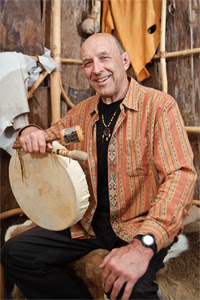
Joseph Bruchac

Joseph Bruchac is a highly acclaimed children’s book author, poet, novelist, and storyteller, as well as a scholar of Native American culture. He is the coauthor of the bestselling Keepers of the Earth series with Michael Caduto. Bruchac’s poems, articles, and stories have appeared in hundreds of publications from Akwesasne Notes and American Poetry Review to National Geographic and Parabola. He has authored many books for adults and children including Code Talker: A Novel about the Navajo Marines of World War Two, Skeleton Man, and The Heart of a Chief.

Bruchac's new novel is Peacemaker.

My Q&A with the author:

How much work does your title do to take readers into the story?

The title Peacemaker was chosen for several reasons. It introduces the central theme of the book —bringing peace at a time of conflict. It also directly relates to the story of the founding centuries ago of the League of the Five Nations (or Iroquois) by a messenger from the Creator who was known as the Peacemaker. Further, the main character of the book is a young man who is himself in need of peace and seeks a way to help bring it.

What’s in a name?

I chose the name Okwaho for my main character not just because it is an Iroquois name that might be given to a boy. (An Iroquois poet friend of mine had that name, though he used the Mohawk spelling of Rokwaho.)

I also chose it because Okwaho means “wolf.” The wolf is deeply respected by Native American people in general. The wolf is regarded as a teacher and a model for good behavior. They have great courage. And wolves work together, they sing together, and every wolf in a wolf pack takes care of all of the cubs.

Also, there are also three main clans among all the different Iroquois nations. Those clans are wolf, turtle, and bear. So his name ties even more into his tribal identity.

How surprised would you were a teenage reader self be by your novel?

As a teenager, my favorite reading was natural history. In fact, when I went to college at Cornell University it was to major in wildlife conservation. I imagined myself as a writer, but not one writing historical fiction or stories about Native American themes. I thought I would be a naturalist.But, bit by bit, as I learned more as a young adult from different Native elders – – such as Ray Tehanetorens Fadden— I realized that writing books such as this one was my true calling.

Also, quite frankly, when I was a teenager in the 1950s there were no books like this one I’ve just written. Most books about Native Americans back then were full of stereotypes and negative images. So they did not interest me.

Writing books that would’ve interested my teenage self, especially books at all the true stories about Native Americans, became my goal—Especially after having children of my own.

Do you find it harder to write beginnings or endings? Which do you change more?

For me, writing a work of fiction is often like a journey on the road without a detailed map. I have an idea where I’m going, but I may not know all the twists and turns or the events that happened along the road. In the case of this novel I knew that I wanted to end it with the arrival of the Peacemaker and the bringing together of the five warring nations.

After all, that is what happened historically and this is a historical novel. However I wasn’t sure what exact role my main character would take and if he would add anything to the events that brought the five nations together. It was sort of a surprise to me that he ended up being the one to provide a crucial piece to the puzzle.

Do you see much of yourself in your characters? Do they have any connection to your personality, or are they a world apart?

I was once told by an American poet named John Logan that (And this is a paraphrase) as we travel through our writing we are always meeting heroes and monsters – – and ourselves. I think there was always a bit of me and my own experiences in my main characters. That includes when they do things that are uncertain or illogical or just plain wrong. Not just when they are awake or intelligent or well balanced. I think the biggest connection to my personality in the case of my main character in Peacemaker is that I, too, believe in reconciliation and the possibility of peace. in fact, I always sign my emails and my letters with the word “Peace.”

What non-literary inspirations have influenced your writing?

I have always been inspired by music and in the case of this book, I often heard the sounds and rhythms of traditional Iroquois music as I was writing it. And, if you could call storytelling non-literary, I certainly was deeply influenced by the oral tradition.
Visit Joseph Bruchac's website.

--Marshal Zeringue

Monday, February 1, 2021

Paul Vidich

Paul Vidich’s fourth novel, The Mercenary, is now out from Pegasus Books. His debut novel, An Honorable Man, was selected by Publishers Weekly as a Top 10 Mystery and Thriller in 2016. It was followed the next year by The Good Assassin. His third novel, The Coldest Warrior, was widely praised in England and America, earning strong reviews from The Wall Street Journal and The Financial Times.

My Q&A with Vidich:

How much work does your title do to take readers into the story?

My latest novel is The Mercenary. A mercenary is a soldier who works for profit – not honor, glory, or in service of his country. I chose this title because it suggests a world in which ethics are set aside and money is all that matters. It suggests a tear in the moral fabric of patriotism and service. My goal with the title is to pique potential readers’ interest so they pick the book up to see what it’s about. The title operates like lighting in a room – it provides atmosphere and shading and invites the visitor in.

What's in a name?

I put great weight on a character’s name. I usually try several before I settle on one that feels right for the story. Names suggest a great deal about a person – origin, language, ethnicity, and readers bring to the name their own assumptions. Aleksander Garin, the novel’s protagonist, is usually referred to just as Garin, a name with deep roots in Russian culture. Erast Garin was one of Russia’s great stage actors. Nikolai Garin-Mikhailovsky wrote popular novels. And the protagonist in Chekhov’s story, ‘Ward 6.’ Dr. Ragin, a perfect anagram of Garin. But Garin is also a name that appears in France, South America, England and elsewhere. The name has an ambiguous provenance, which is what I wanted to achieve with a character who hides who he really is, and works in the shadow world of spies.

How surprised would your teenage reader self be by your new novel?

I was not a big reader as a teenager, but the books I did read were adventure stories. I was drawn to Graham Greene, John Le Carré, some of Rudyard Kipling, and Joseph Conrad. These books bring great writing and empathetic characters into the service of a compelling story – usually in an exotic setting. My teenage self would not be at all surprised by the book I’ve written. I, like many authors, write the type of books that we like to read.

Do you find it harder to write beginnings or endings? Which do you change more?

I research a book for six months before I begin writing. In that time, I develop the characters, establish the setting, and come to know what story I want to tell – and what themes I want to explore. When I first put pen to paper (I write everything long hand in notebooks) I know how the book will end. Sometimes the end will change in later drafts, but I always have the North Star of an ending that guides the writing.

Having said that, there is more at stake in a novel’s ending than in the opening pages. A novel’s opening will draw the reader into the book’s world, and most readers are forgiving of the novel’s first pages as long as the story offers promise. An ending, however, has more at stake. A good ending brings a story together and pays off the patient reader’s eighteen or twenty hours with the book. A bad ending, a trite ending, a tired ending, an ending that doesn’t satisfy, can ruin a good book. So, there is a lot at stake. Although I know how my novel will end when I begin writing, it is a tricky thing to pull it off. I fuss over the final pages until I am satisfied. As I like to say, a book’s last impression is its lasting impression.

Do you see much of yourself in your characters? Do they have any connection to your personality, or are they a world apart?

My character’s biographical details are quite different from my own. I don’t rely on my life to come up with story lines, plots, or characters. I do, however, bring a moral vision to my novels that gets expressed in the opinions of my characters. I write literary spy novels that deal with the nature of justice, honor, betrayal, friendship, and trust. My characters embody different and often contradictory sides of those themes. My characters don’t resemble me, but their opinions and struggles are ones that I ponder. The world of spies is a Petri dish for the deceptions of human relations, where love can be expendable, betrayal a form of honesty, lies a legitimate currency for good, and the crimes of bad men in the service of good causes get excused.

What non-literary inspirations have influenced your writing?

Movies. I spent my college years studying movies and the ones I adored still cast a shadow on my writing: The Third Man, Lawrence of Arabia, It Happened One Night, North By Northwest and Psycho. I began writing novels thinking it was a good path to a career as a screenwriter, which in turn, I thought would be a way to direct movies. Happily, I never got to screenwriting, and stopped with novels, but movies have always fascinated me.
Visit Paul Vidich's website.

--Marshal Zeringue