Thursday, November 30, 2017

Natalka Burian

Natalka Burian's new young adult novel is Welcome to the Slipstream.

From her Q&A with Deborah Kalb:

Q: How did you come up with the idea for Welcome to the Slipstream and for your main character, Van?

A: Van, or at least a proto-Van, was actually a secondary character in another novel I was working on. I wanted to keep writing about her, and realized quickly she needed her own book. That first book never made it out into the world, but I’m glad Van has.

Q: The book is set in Las Vegas and the Southwest. How important is setting to you in your work, and do you think this could have been set elsewhere?

A: For me, the setting is like another character in every story I write. I love the contrast between Las Vegas and the desert, and found it to be kind of an irresistible location for Van’s family to...[read on]
--Marshal Zeringue

Wednesday, November 29, 2017

Dennis Glover

Dennis Glover is the author of The Last Man in Europe, a fictionalized account of George Orwell's life as he wrote 1984.

From the transcript of Glover's interview with NPR's Scott Simon:

SIMON: And that "Last Man In Europe" - that was a working title Orwell had, wasn't it?

GLOVER: Yes, it was the original title of the novel, which he changed at the last minute, I think, at the prodding of his publisher Fred Warburg who thought that "1984" would - was a bit more commercially appropriate. And he's probably right because it gave the book a great renaissance in the actual year 1984.

SIMON: Yeah. And was it also because he was writing in the late '40s? Was it as simple as he wanted to reverse it?

GLOVER: Well, there is a thought that he did it because he simply reversed the four and the eight. I think it's a bit different. If you look at the manuscript and the early typescripts of the novel, what you'll find is it begins April 4, 1980. And then you can see Orwell takes his pen and strikes it over at some later stage and writes '82. And then he strikes it over again and writes '84. I think he was - it took him so long to write the book. He was trying to keep 40 years between the writing of it and the story.

SIMON: By the time we meet Orwell, he is sick and despondent, even though he's become so successful with "Animal Farm."

GLOVER: That's...[read on]
--Marshal Zeringue

Tuesday, November 28, 2017

Deanne Stillman

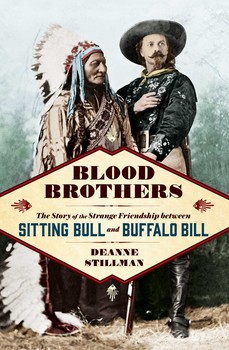
Deanne Stillman's new book is Blood Brothers: The Story of the Strange Friendship between Sitting Bull and Buffalo Bill.

From her Q&A with Deborah Kalb:

Q: You write that this book’s inspiration came from a story about a horse that Buffalo Bill had given to Sitting Bull. Can you say more about that?

A: When Sitting Bull returned to Standing Rock after traveling with Cody for four months in 1885, Cody gave him a horse. That was symbolic because the horse had been stripped from the tribes during the Indian wars. It was not enough to deprive them of the buffalo; they had to be dismounted.

Five years later, while Sitting Bull was being assassinated in his cabin doorway, the horse was outside and started to dance as the bullets were flying. That was because it had been trained to do so at the sound of gunfire in the Wild West show.

Sitting Bull’s murder and the dancing horse that echoed it happened at the height of the ghost dancing frenzy  - an apocalyptic call for a return to the old ways and the resurrection of the buffalo. So here was this horse joining in, a ghost horse really, a representative of the Wild West and all that came with it.

While I was working on my book, I called Chief Arvol Looking-Horse, a prominent Lakota spiritual figure, for his insight into this matter.  What he said stunned me, beyond what I already felt, and I talk about all of this in much greater detail in my book.

By the way, I couldn’t shake the image of the dancing horse for years, and it...[read on]
--Marshal Zeringue

Monday, November 27, 2017

Salman Rushdie

Salman Rushdie's new novel is The Golden House. From the transcript of his interview with Fareed Zakaria:

ZAKARIA: So, this is a novel different from some of the other things you've written. It feels very contemporary. It feels like you're describing the world we're living in.

So, I have to ask you as a social observer, what is, to your mind, the dominant reality of America, of New York, of its big cities today?


RUSHDIE: Well, I think it's - first of all, one of the realities is the incredible division between the big city and the hinterland, the fact that New Yorkers think one way and Middle America thinks in a radically different way.

To the extent there's always been that split, that New York and America have never been completely happy with each other. That's true about Paris in France and London in England as well. So, it's something about the nature of the metropolis.

But, right now, that rift is so exaggerated.

ZAKARIA: It's set in the Obama years, very clearly in the Obama years. You made a conscious decision to do that. It's a thing you're told not to do as a writer, which is to write right up against the present moment, to write the book which is about the moment in which the book is being written, and to react, to be reactive to things that happen.

And as a novelist, what strikes you about the Obama era?


RUSHDIE: What I felt was that there was this movement from incredible optimism to its antithesis.

That's to say, I mean, I remember, I was here on the night of the first Obama election. And I was walking around the city in the middle of the night in places where people gather, like Union Square and Rockefeller Plaza, like that.

And just looking at people's faces, the extraordinary joy and hope in those mainly young faces, I thought, was a remarkable thing to witness.

And now...[read on]
--Marshal Zeringue

Sunday, November 26, 2017

Ian Stewart

Ian Stewart's newest book is Significant Figures: The Lives and Work of Great Mathematicians. From his Q&A with Deborah Kalb:

Q: How did you come up with the idea for this new book, and how did you pick the mathematicians to include?

A: The idea emerged during a lunch with my editor John Davey, who died recently of throat cancer -- the book is dedicated to him. We often used to bat ideas around to see if anything grabbed us.

Selecting whom to include was tricky. The typical length for a popular science book is at most 100,000 words. The publisher set a target of 90,000, later expanded to 95,000.

So I knew I could include at most 25 people. That’s far too small to cover every really important mathematician! I say explicitly early on that the people featured are a selection. I made an initial list of about 50, and then whittled it down.

I decided that someone got in only if their mathematics was top quality and highly influential, if their personal story was interesting in its own right, and if they were dead. I considered it absolutely vital to include...[read on]
See Ian Stewart's top ten popular mathematics books.

The Page 99 Test: Why Beauty Is Truth.

The Page 99 Test: In Pursuit of the Unknown.

The Page 99 Test: Visions of Infinity.

--Marshal Zeringue

Saturday, November 25, 2017

Luke Harding

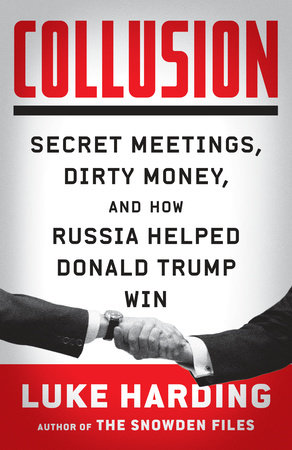
Luke Harding's new book is Collusion: Secret Meetings, Dirty Money, and How Russia Helped Donald Trump Win. From the transcript of his Fresh Air interview with Terry Gross:

Terry Gross: Luke Harding, welcome back to FRESH AIR. So the dossier said that the Russian regime had been cultivating, supporting and assisting Donald Trump for at least five years with the goal of encouraging splits and divisions in the Western alliance. You write that the Russians had their eyes on Donald Trump as early as the 1970s when he married Ivana Trump, who is from Czechoslovakia. Why were they keeping an eye on him in the '70s? What were they looking for?

LUKE HARDING: Well, the KGB really forever has been interested in cultivating people, actually, who might be useful contacts for them, identifying targets for possible recruitments possibly to be agents. That's not saying that Donald Trump is an agent, but the point is that he would have been on their radar certainly by 1977 when he married Ivana, who came from Czechoslovakia, a kind of communist Eastern bloc country. And we know from Czechoslovak spy records de-classified last year that the spy agencies were in contact with Ivana's father, that they kept an eye on the Trumps in Manhattan throughout the 1980s. And we also know, from defectors and other sources, that whatever Prague learned, communist Prague, would have been funneled to the big guys in Moscow, to the KGB. So there would have been a file on Donald Trump.

But I think what's kind of interesting about this story, if you understand the kind of Russian espionage background, is Trump's first visit to Soviet Moscow in 1987. He went with Ivana. He writes about it in "The Art Of The Deal," his best-selling memoir. He talks about getting an invitation from the Soviet government to go over there. And he makes it seem kind of rather casual. But what I discovered from my research is that there was actually a concerted effort by the Soviet government via the ambassador at the time, who was newly arrived, a guy called Yuri Dubinin, to kind of charm Trump, to flatter him, to woo him almost. And Dubinin's daughter, sort of who was part of this process, said that the ambassador rushed up to the top of Trump Tower, basically kind of breezed into Trump's office and he melted. That's the verb she used. He melted.

GROSS: That Trump melted when he was flattered.

HARDING: Yeah. That Trump melted with this kind of flattery. And several months later, he gets an invitation to go on an all-expenses-paid trip behind the Iron Curtain to Soviet Moscow. Now, a couple of things which were important here. One of them is that his trip was arranged by Intourist, which is the Soviet travel agency. Now, I've talked to defectors and others who say - this is actually fairly well-known - that Intourist is basically the KGB. It was the organization which monitored foreigners going into the Soviet Union and kept an eye on them when they were there. So kind of he went with KGB travel. Now, according to "The Art Of The Deal," he met various Soviet officials there. Who they were, we don't know. But what we can say with certainty is that his hotel, just off Red Square, the National Hotel, would have been bugged, that there was already a kind of dossier on Trump. And this would have been supplemented with whatever was picked up from encounters with him, from intercept, from his hotel room.

You know, we can't say that Trump was recruited in 1987. But what we can say with absolute certainty is...[read on]
--Marshal Zeringue

Friday, November 24, 2017

Catherine Reef

Catherine Reef is the author of Victoria: Portrait of a Queen, a new young adult biography of Queen Victoria.

From Reef's Q&A with Deborah Kalb:

Q: Why did you decide to focus on Queen Victoria in your latest biography?

A: I had written two books on subjects from Victorian England, The Brontë Sisters: The Brief Lives of Charlotte, Emily, and Anne and Florence Nightingale: The Courageous Life of the Legendary Nurse. I wanted to write one more biography before leaving that fascinating time and place, and I thought, why not focus on the woman who gave her name to the period, Queen Victoria herself?

Looking into her life, I discovered a terrific tale to tell, one that included family drama, palace intrigue, and a great love story, all involving a woman of singular character.

Sir Henry Ponsonby, who was the queen’s private secretary from 1870 until 1895, said this of her: “Never in her life could she be confused with anyone else, nor will she be in history.” How...[read on]
Visit Catherine Reef's website.

Coffee with a Canine: Catherine Reef & Nandi.

The Page 69 Test: Frida & Diego.

My Book, The Movie: Noah Webster.

The Page 99 Test: Florence Nightingale.

Writers Read: Catherine Reef (January 2017).

--Marshal Zeringue

Thursday, November 23, 2017

Sujatha Gidla

Sujatha Gidla’s new book is Ants Among Elephants: An Untouchable Family and the Making of Modern India.

From the author's conversation with Slate's Isaac Chotiner:

Can you explain why someone’s caste in India is so hard to hide? I think a common American response could be, why do you tell people what your caste is?

Oh, caste is a village social institution. The village social institution persisted for a very long time, and it still does because 80 percent of Indians still live in villages. In villages, castes are very distinct by their occupation, for one thing, and second where they live. Each caste has its own colony. That is where they live. All castes don’t live together mingled. Each has separate colonies.

Because of that, everybody knows who you are and also because of what job you do. When it comes to cities, people who came from villages, they still carry those, “Oh, you are such and such person’s relative,” this and that, so they would know. Apart from that, the way you dress, your surname, what you eat, what gods you’re worshiping, and whether you can wear jewelry or not and how you cut your hair. All of these things show your caste. And because the system is 3,000 years old, even if it scientifically does not have a genetic imprint, it has something very close to it. People’s body language—the way they carry themselves—shows what caste they are.

I’m sure their physical health, too.

Oh yeah, of course.

Why are even left-wing political parties in India so casteist?

The Communist Party of India was dominated by the land-owning Kamma caste, and it’s indistinguishable from a caste-based party. That’s why Communists are all upper-caste. … They bring in their own ideology, instead of...[read on]
--Marshal Zeringue

Wednesday, November 22, 2017

Jonathan Eig

Ken Burns calls Jonathan Eig a "master storyteller." Eig is the author of five books, two of them New York Times best sellers.

His new biography is Ali: A Life.

From Eig's Q&A with Deborah Kalb:

Q: What did the research involve for this book, and what type of cooperation did you receive from his relatives and friends?

A: I interviewed more than 200 people, dug through Ali’s old business records, found court files showing that Ali’s grandfather was a convicted murderer, listened to old audiotaped interviews with Ali from the 1960s, got the FBI to release case files on Ali, did original research counting every punch of Ali’s career, and conducted a study with speech scientists at Arizona State University to measure the effect of all those punches on Ali’s speech rate.

And that’s just the tip of the iceberg. This was more than four years of work. I poured everything I had into this. Ali’s second and third wives sat for multiple long interviews. His fourth and final wife coached me and answered a few questions but declined to do a long session.

Some of his kids cooperated, some didn’t. Almost all...[read on]
Learn more about the book and author at Jonathan Eig's website.

The Page 99 Test: Get Capone.

The Page 99 Test: The Birth of the Pill.

My Book, The Movie: Ali: A Life.

--Marshal Zeringue

Tuesday, November 21, 2017

Ray Dialo

Ray Dalio is the founder and co-chairman of Bridgewater Associates, which, over the last forty years, has become the largest and best performing hedge fund in the world. Dalio has appeared on the Time 100 list of the most influential people in the world as well as the Bloomberg Markets list of the 50 most influential people. His new book is Principles: Life and Work.

From the transcript of Dalio's interview with Fareed Zakaria:

ZAKARIA: You have this fascinating new book out. I don't want to let you go without asking you about one thing that everybody wonders about because you talk about it in the book and you are famous for it, which is that, at your firm there is this idea of radical transparency, which means people have to disagree clearly, publicly with others.

And people always wonder, do you take it to the point where people in your firm, actually, routinely look you in the eye and tell you, Ray Dalio, you're the boss, but you're completely 100 percent wrong?


DALIO: I need that. Yes. And I need that. I do it because I need it. I set up a company. If I don't have that engagement, besides my not hearing things that I need to have, can you imagine what it's like for you to be in the company, being in a position where you have to hold that inside of yourself? And then, you're walking around, thinking I did something stupid around in a company and you can't speak up?

You can't build a culture that way. In order to have independent thinkers around to get at the best ideas and have great collective decision-making, you have to be able to have thoughtful disagreement to rise above it.

I think that there's a challenge a lot of people have emotionally to being able to have disagreements. Shouldn't disagreement be a source of curiosity?

And also, if people are disagreeing, then somebody must be...[read on]
--Marshal Zeringue