Monday, July 13, 2020

C.T. Rwizi

Debut author C. T. Rwizi was born in Zimbabwe, grew up in Swaziland, finished high school in Costa Rica, and got a BA in government at Dartmouth College in the United States. He currently lives in South Africa with his family, and enjoys playing video games, taking long runs, and spending way too much time lurking on Reddit. He is a self-professed lover of synthwave.

Rwizi's new novel is Scarlet Odyssey.

My Q&A with the author:

How much work does your title do to take readers into the story?

My book features a long journey tinged with blood, on a world with a large red moon dominating the skies. I think Scarlet Odyssey does a fairly good job of priming readers to enter this world and travel alongside my characters.

Without reading the blurb, however, they might not know that this is an epic fantasy infused with elements of science fiction, based in an African-inspired setting. I considered a title with the word “savanna” or “plains” so as to be more evocative of the setting, and something magical like “mystic” or “mystical” so it would be immediately apparent that this was fantasy, but I liked Scarlet Odyssey a lot, and so did my editors, so that’s what we stuck with.

What's in a name?

My main character goes by Salo most of the time, but his full name is Musalodi, a fictional name I derived by combining the word “Musa,” which means kindness or mercy in Zulu, Ndebele and a few other Nguni languages, and the word “Naledi” which means “star” in Sesotho. In the fictional language of his tribe, I imagine that his name would mean “the stars are merciful” or “kindness of the stars.”

I gave him such a name because I believe it fits with his general temperament, and I think it’s a rather suitable name for the hero of a world in which celestial events will play an important role in the story.

How surprised would your teenage reader self be by your novel?

He’d probably be surprised that I wrote a book in the first place! But I doubt he’d be too surprised by the content. I have always been a fan of science fiction and fantasy—I grew up on Harry Potter and avidly consumed Dune and The Wheel of Time. But even back then the lack of black and specifically African representation in the genre was always a sore spot for me, so it would probably make sense to teenage me that the first book I wrote would seek to address this problem.

Do you find it harder to write beginnings or endings? Which do you change more?

The endings have thus far been harder to pull off. I knew going into Scarlet Odyssey where the end point would be, but it was not easy to put the idea into practice. I had to go through several iterations before I was satisfied, knowing the whole time that the ending would be the last taste my readers would have of my work, that it would make or break their opinion of it.

But I believe I eventually managed something that weaves the narrative threads into a cohesive whole, bringing the story to a close at a natural point and giving the reader the sense of a complete story while leaving them ready to return for a new instalment.

Do you see much of yourself in your characters? Do they have any connection to your personality, or are they a world apart?

My characters are different from each other and from me personally, but I think it would have been impossible to write them without giving them each a piece of myself. I’d say I gave the biggest piece to my main character, whose struggle against toxic masculinity is something I strongly relate to. I have at times found myself wilting under the pressures of my society’s expectations of manhood, to wit, the pressure to be stoic and self-reliant no matter what, to avoid asking for help, to DIY even when I know I’d be better off asking someone more qualified to do the job simply because I don’t want to look unmanly. The main difference is that, while my character refuses or perhaps fails to warp himself and change who he is in order to fit in, I still give in to the pressure to conform on a regular basis.

What non-literary inspirations have influenced your writing?

Music. I swear it is the key to my most vivid imagination. I almost cannot write without headphones covering my ears. In fact, I’m rarely without my headphones, so you could say music is like a drug for me. From the west African vibes of Fatoumata Diawara, to the classical compositions of Eric Whitacre, to the synths of A.L.I.S.O.N, Memorex Memories and Eagle Eyed Tiger, to the mellow rhythms of Odesza, Droeloe, Illenium and Said the Sky, to the beats of Kendrick Lamar, The Weeknd and Chris Brown; I built the world of Scarlet Odyssey almost entirely under the influence of music.
Learn more about Scarlet Odyssey, and follow C. T. Rwizi on Twitter.

My Book, The Movie: Scarlet Odyssey.

--Marshal Zeringue

Sunday, July 12, 2020

Mary Simses

Mary Simses grew up in Darien, Connecticut and began writing stories as a child. After majoring in journalism in college, she worked for a few years in magazine publishing, but then decided to go back to school to become a lawyer. While working as a corporate attorney, Simses enrolled in an evening fiction writing class at a university in Connecticut and began writing short stories “on the side.” Several of her stories were published in literary magazines. She finally took the advice of a friend and decided to try writing a novel. That manuscript ultimately became The Irresistible Blueberry Bakeshop & CafĂ©, which was published in 2013 and later adapted as a movie called The Irresistible Blueberry Farm for the Hallmark Movies & Mysteries Channel. Simses has since written The Rules of Love & Grammar and the newly released The Wedding Thief.

Simses enjoys photography, old jazz standards, and escaping to Connecticut in the summer. She lives in South Florida.

My Q&A with the author:

How much work does your title do to take readers into the story?

Of my three novels, the only one with a title that really explains the story is The Wedding Thief. To me, the most likely interpretations are that the book is about someone who steals things at weddings or someone who actually tries to hijack the wedding itself. It’s the latter one that’s going on here, of course, as Sara wants to sabotage the wedding of her younger sister, Mariel, and get back the man she’s still in love with.

I don’t remember when I came up with that title, but I know I was pretty far into writing the book. My original title was The Harrington Sisters Come Home. That explained a bit about what was going on. And the idea of coming home is also a metaphor for the sister’ need to find common ground. That was the working title, but I wanted something better, something more catchy, more intriguing. When I thought of The Wedding Thief I knew that was it. Sara is a mischievous girl and the title captures her personality and spirit. It also lets people know there’s a big event in the wings. My editor loved it.

How surprised would your teenage reader self be by your novel?

I think my teenage reader self would be stunned that I’d written a book at all, let alone three. What did I read as a teenager? The big classics come to mind – books like To Kill a Mockingbird, The Great Gatsby, The Catcher in the Rye. I loved them. But I also loved Ian Fleming’s James Bond novels and Agatha Christie’s detective stories. My teenage self would probably have predicted I’d write a spy or mystery novel, but that’s not at all what I’m interested in writing about.

Do you find it harder to write beginnings or endings? Which do you change more?

Endings are much harder for me, no question. Beginnings are easy. I knew I wanted to start The Wedding Thief with a phone call from Sara’s mother, telling Sara she’s very ill and asking her to come home right away. The whole thing is a ruse on the part of the mother – who’s an actress, by the way and is good at making up stories – to bring her daughters home two weeks before the wedding and get them to reconcile, something Sara has no intention of doing.

Sara reminds her mother that Sara is the injured party, the one betrayed by her sister. Reconciliation is not in her vocabulary (although sabotage is!) That phone call was a good way to get things rolling and immediately introduce the three women characters.

The ending of the book was a bit of a challenge. As I was writing, I went back and forth on that. I wasn’t sure who should end up with who or if anyone should end up with anyone, relationship-wise. I’m happy with the ending I chose. It did take more work than the beginning, though.

Do you see much of yourself in your characters? Do they have any connection to your personality or are they a world apart?

There are definitely some connections. Sara, for instance, loves old jazz standards, the music her father loved. A Broadway producer, he enjoyed listening to Frank Sinatra and Ella Fitzgerald sing songs by writers like the Gershwins, Cole Porter, and Jerome Kern. But the real reason why Sara loves that kind of music is because I do, and I enjoy slipping it into my writing when I can.

I’m unlike Sara in many ways, though. She assumes there’s nothing she can’t fix or resolve. As an event planner, she’s used to thinking on her feet and working through whatever emergencies arise. That’s fine, but she has a tendency to assume her way is the only way, a trait that can alienate people. (Now, if my husband were reading this, he might say, Wait a minute, that does sound like you….)

I think I have a bit of Camila, Sara’s mother, in me. She’s an actress and she’s used to creating other personas and letting them tell their stories. That’s what I do in my writing, so we have a lot in common there. And I love her as a character. She’s funny and quirky and so dramatic at times.

What non-literary inspirations have influenced your writing?

Movies, movies, movies! I’m a sucker for a good romantic comedy or a good dramedy. Anything that includes some humor and a love story wins me over pretty easily. It’s that blend of poignancy and wit I adore. It’s so important to be able to laugh, especially these days. The best compliment I get is when a reader tells me they laughed and cried over my book. That’s exactly what I want to happen.
Visit Mary Simses's website and follow her on Facebook.

My Book, The Movie: The Irresistible Blueberry Bakeshop & Cafe.

The Page 69 Test: The Rules of Love & Grammar.

--Marshal Zeringue

Saturday, July 11, 2020

H. G. Parry

H.G. Parry is a fantasy writer based in Wellington, New Zealand. She holds a PhD in English Literature from Victoria University of Wellington, and teaches English Literature, Film, and Media Studies.

Her novels include The Unlikely Escape of Uriah Heep and the newly released A Declaration of the Rights of Magicians.

My Q&A with the author:

How much work does your title do to take readers into the story?

I love the title—I can say that, because it was my agent's idea, and all I can take credit for is jumping on it. A Declaration of the Rights of Magicians is a twist on the 1789 "Declaration of the Rights of Man and the Citizen," so it's highlighting two things: that the story takes place around the French Revolution, and that it's a version of that history with magic. It also highlights that the book centres around people fighting for various rights and freedoms, and that the pages contain a fair amount of politics and pamphlets and parliamentary proceedings.

Basically: history! But magic!

What's in a name?

In this case, most of the characters are alternate-world versions of historical figures (including Maximilien Robespierre, Camille Desmoulins, William Wilberforce, William Pitt the Younger, and Toussaint Louverture), so their names belong to them. They follow their historical counterparts in their essence, but certain things have changed due to the presence of magic in their world—and, in some cases, in their own blood.

How surprised would your teenage reader self be by your new novel?

I love this! Both very and not at all. Very, because even though I loved history at school, my teenage reader self wasn't interested in historical fiction—I mostly devoured science fiction of all kinds, from Ray Bradbury to Anne McCaffrey to Douglas Adams to many Star Trek novels, with fantasy on the side. But also not at all, because I was completely obsessed with social commentary and with intense, complicated, banter-filled friendships, and those things are right at the heart of this book.

Do you find it harder to write beginnings or endings? Which do you change more?

Beginnings, by far. Endings are incredibly satisfying—you get to bring all the story paths together and try to make them feel like this was where they were headed all along. Beginnings are stumbling around in the dark without a torch—which is, of course, very exciting as well as terrifying.

Do you see much of yourself in your characters? Do they have any connection to your personality, or are they a world apart?

The characters' personalities mostly come from history—either from direct biographical research, or just general research about the experience of people living in those times. I didn't intentionally give them any of my personality traits. But having said that, I tried very hard to empathise with all of them, even the ones who made that difficult, so I'm sure there's overlap in unexpected places.

What non-literary inspirations have influenced your writing?

History—which is obvious in this book, but in general I love the eighteenth and nineteenth centuries. Travelling—so far mostly around the UK, but I'd love to broaden that (obviously, that now has to wait a while…). And I'm pretty sure most of what I've done in my life, writing and otherwise, can be traced back to the fact The Fellowship of the Ring came out in theatres when I was twelve.
Visit H.G. Parry's website.

The Page 69 Test: The Unlikely Escape of Uriah Heep.

--Marshal Zeringue

Friday, July 10, 2020

Jessica Barry

Jessica Barry is a pseudonym for an American author who grew up in a small town in Massachusetts and was raised on a steady diet of library books and PBS.

She attended Boston University, where she majored in English and Art History, before moving to London in 2004 to pursue an MA from University College London.

She lives with her husband, Simon, and their two cats, Roger Livesey and BoJack Horseman.

Barry's new novel is Don't Turn Around.

MY Q&A with the author:

How much work does your title do to take readers into the story?

I have to admit that I’m terrible at titles for my books – it was my agent who came up with Don’t Turn Around. I think (hope!) it works well to convey the sense of urgency that propels the story, and also ties in with the overarching theme of pervasive fear that women feel going through their everyday lives. It’s a nod to all the times I’ve heard footsteps behind me on a darkened street and thought Don’t turn around, just keep walking, clutch your keys between your fingers, get your phone ready, pick up the pace. When a pair of headlights appear out of the night and begin relentlessly pursuing Cait and Rebecca, the fear they feel – and the sense that the only way to survive is to keep moving forward – is hopefully encapsulated in the title.

How surprised would your teenage reader self be by your new novel?

Pretty surprised! First of all, I think she’d be shocked that I’ve managed to write a novel in the first place. I grew up worshiping books, and the idea that I could write one myself and see it on the shelf of a bookstore or a library was definitely beyond my comprehension. I think she’d be surprised that I write thrillers, seeing as I’ve always been pretty squeamish about blood. But I hope that she’d be proud of the strong female characters and the story as a whole.

Do you find it harder to write beginnings or endings? Which do you change more?

Endings! I could write the beginnings of books all day long (and often do, only to abandon them) but endings I find really tricky. I think it’s down to two things: wanting to do justice to the story, but also an impatience to see the book finished. And those two things don’t always work well together…

Do you see much of yourself in your characters? Do they have any connection to your personality, or are they a world apart?

There’s probably a bit of me in all of my main characters, but they occupy their own world. In Don’t Turn Around, I can definitely see some of my younger self in Cait – her scrappiness, and her independence – and I can see some of myself in Rebecca, too, particularly her impulse to people-please.

What non-literary inspirations have influenced your writing?

I often get ideas for stories from events that have happened in my own life, or articles I’ve read. Part of the inspiration for Don’t Turn Around came from a particularly unpleasant road-rage incident last year. It reminded me that, even if we might see our cars as safe little bubbles, the act of driving is fraught with danger.
Follow Jessica Barry on Twitter.

--Marshal Zeringue

Thursday, July 9, 2020

Carrie Firestone

Carrie Firestone is the author of the acclaimed young adult novels The Loose Ends List, which Kirkus Reviews called “a poignant and important story about compassion, love, and the decision to live life on your own terms” in a starred review, and The Unlikelies, which Bustle declared “the summer read that’ll remind you how much good there really is in the world.” A former New York City high school teacher, Firestone currently lives in Connecticut with her husband, their two daughters, and their pets.

Firestone's new novel is Dress Coded.

My Q&A with the author:
How much work does your title do to take readers into the story?

I have a feeling anyone who has ever been dress coded will see this title and know exactly what Dress Coded is about. Originally, the working title was Shame Garden. I wanted to send a powerful message about the culture of shame and humiliation that has evolved around unfair school dress code policies. When my editor suggested Dress Coded, however, I knew it was the right title for the book. While the story centers around the fallout from an especially egregious dress coding incident, the ultimate message is one of young people finding their voices and fighting for justice. There's no shame in that!

How surprised would your teenage reader self be by your novel?

I write books for my teenage self. I think teenage me would be surprised to see how little "we've" changed in thirty years. I was always both a writer and an activist and have often found ways to combine those passions. Dress Coded is a book about young people changing their world through activism. Teenage me would probably be a big fan.

Do you find it harder to write beginnings or endings? Which do you change more?

Going into Dress Coded, I knew it would be about an eighth grade girl who, after witnessing her friend being dress coded by two school officials, would start a podcast that would lead to a middle school rebellion. And I knew the outcome of that rebellion. The tricky part was finding an ending that would be both triumphant and plausible. I wanted readers to walk away thinking, "Yeah! I can change the world, too!" So endings, for sure. Also, beginnings are important because you want to pull the reader in, but the endings are what stay (or don't stay) with readers.

Do you see much of yourself in your characters? Do they have any connection to your personality, or are they a world apart?

Dress Coded is my third novel for young people. All of my protagonists include pieces of me. Molly is someone who wouldn't necessary advocate for herself, but when her classmate is the victim of injustice, she finds her voice and speaks out on her friend's behalf. I'd like to think I would do the same. My teenage daughters are reading Dress Coded and they are pointing out countless moments in the book that I admittedly harvested from their middle school experiences. My daughter just said, "It's like reading a creepy alternate reality of my own life."

What non-literary inspirations have influenced your writing?

So many! My books always start with an issue that is important to me and my community work. With The Loose Ends list it was Death With Dignity. With The Unlikelies it was heroin addiction. And with Dress Coded it was both dress coding and vaping. I began writing the novel right around the time vaping was becoming a huge problem in middle schools.

I do a lot of research on the issues and, more specifically, how big-picture issues impact relationships. I also watch a lot of TV and movies and I often watch with pacing and dialogue in mind. And whenever I start a book, I need a playlist to anchor the book vibe. While the other two novels were soulful multi-generational sad songs and straight Beatles, Dress Coded was all about girl-power anthems.
Visit Carrie Firestone's website.

The Page 69 Test: Dress Coded.

--Marshal Zeringue

Wednesday, July 8, 2020

Chris Nickson

Chris Nickson is the author of The Molten City and seven previous Tom Harper mysteries, seven highly acclaimed novels in the Richard Nottingham series, and two Simon Westow mysteries. He is also a well-known music journalist. He lives in his beloved Leeds.

My Q&A with the author:

How much work does your title do to take readers into the story?

I like a title to intrigue and maybe offer a small signpost to the story – enough to make someone want to open the book and start reading. With the Tom Harper series I’ve chosen a theme of metal/precious metals. While a theme can initially be a good idea, it can also end up a bit limiting - as I’ve discovered. So it’s very much a double-edged sword.

What's in a name?

A name can indicate a great deal. In this book I wrote that working-class families would often choose fanciful names for their daughters because it was as close to frivolous luxury as they’d come in their lives. But my main character, Tom Harper, has a deliberately plain name, something that’s no-nonsense, easy to remember, with a little power to it (in my eyes). His wife’s named Annabelle – one of those fanciful names – yet their daughter is Mary. Ordinary, straightforward. And in all three cases, I feel the names reflect the personalities (or is it the other way round?)

How surprised would your teenage reader self be by your new novel?

He’d be aghast that I was writing crime fiction, and historical crime fiction at that, set in the city where he grew up but was eager to leave, and also weaving in tiny strands from his family’s history. But he was a literary, pretentious fellow. His first completed novel, written when he was 20, was in thrall to Brautigan, and he spent his adolescence reading poets like Apollinaire and the novels of Joyce with a sage look on his face. Still, it would be good to give him a shock.

Do you find it harder to write beginnings or endings? Which do you change more?

I think beginnings are harder for me. It had to be the right scene with the right tone for me to feel my way into the book. Once I have the first 5,000 words I can pretty much press on. The knack is getting them right. It’s easier with a series, as I know the characters, where and how they live. Yet life also moves on and they grow older, as in the opening chapter of The Molten City. It’s meant as a jolt, a bit of a dislocation that leaves Tom thinking about his own life a little, and his relationships.

Do you see much of yourself in your characters? Do they have any connection to your personality, or are they a world apart?

I think there’s a bit of me in every character of substance in my books. Dickens said his characters illustrated the good and bad side of him. I think it’s more nuanced than that. There’s certainly some of me in Tom, generally being good and straightforward but also bending the rules at times when it’s in a good cause. But overall I try to make the people on the page – I don’t feel I create them, just write down the movie in which they’re playing – quite independent of me or anyone I know in real life.

What non-literary inspirations have influenced your writing?

There are probably two big influences that have nothing to do with books. There’s Leeds itself, and its history. That’s a constant source of fascination, and the more I research, the more I discover about the place. I want to make it come to life for people, whether it’s Edwardian, as in The Molten City, the Georgian era of the Richard Nottingham books, or the 1950s of the Dan Markham novels. Leeds is an elusive beast and I’m still vainly trying to fully capture it with its varying, changing faces, as well as the essence of the people who live here.

That ties in with my family history, the other large factor. My ancestors arrived here from East Yorkshire (they originated in a tiny little farming village then moved to a country market town) in the 1820s. Until my father, they’d always lived in very working-class areas, neighbourhoods that are often the backdrop to parts of my novels. So in a way, I’m tracing my own family’s footsteps in the books and discovering them.
Learn more about the book and author at Chris Nickson's website.

--Marshal Zeringue

Tuesday, July 7, 2020

Alice Early

After undergraduate studies in creative writing, Alice Early pursued a career spanning academia, commercial real estate, international executive recruiting, and career-transition coaching. She’s come full circle to her first love, writing fiction, and her home by the sea. The Moon Always Rising is her award-winning debut novel.

My Q&A with the author:

How much work does your title do to take readers into the story?

I hope it’s title is intriguing and gives the reader a sense that The Moon Always Rising will be uplifting in some way, but it doesn’t say anything about the story. Choosing a title that captures the novel’s essence was wrenchingly difficult. As it straddles literary and women’s literature and bends genre (a love story but not a romance with elements of mystery and magical realism), the hundreds of titles I considered felt narrow or misleading. My editor and I eventually chose a title inspired by a line in “Fern Hill,” a Dylan Thomas poem that triggers a cathartic exchange between Els and Jack’s jumbie near the end of the book. In that scene, the book’s central theme of the healing power of forgiveness—of oneself and others—comes to the fore and signals that several of the book’s main characters will resolve their dilemmas, at least partially, by the ending.

What's in a name?

Most of my characters’ names landed in my brain as soon as the character began to wriggle and speak to me and refused to be changed. Many characters in The Moon Always Rising use only nicknames. In the Caribbean young men commonly adopt monikers. Elroy James Pemberton might be known to all as “Leggy,” his full name revealed only when he’s cited for an honor or appears in a newspaper police report. Eleanor Gordon’s name hints at her cushy upbringing and powerful family, but she chooses the punchier “Els” that better fits her toughness and eagerness to advance on her own merits. The jumbie was always just Jack to me; I had to concoct his full name (Elliott Jackson Griggs) for the passport Els finds among his possessions. Jack’s friend, the charter captain who gets under Els’s emotional armor, told me he was “Liz,” a name that stuck to him in the Caribbean though it runs counter to his macho vibe. It brings tension, causes questions, sparks fights. Giulietta, Els’s estranged Italian mother, needed a fluid name with dramatic flair. I was also thinking of Juliet and star-crossed lovers, as she and Els both were. Because place is so critical to this story, I adhere to Nevis geography and its evocative place names such as Cotton Ground, Golden Rock, Chicken Stone, Oualie, and Lover’s Beach.

Do you find it harder to write beginnings or endings? Which do you change more?

Beginnings, definitely. I first write individual scenes that are clear in my mind, then try to connect the dots. While I didn’t write the ending in advance, I knew approximately where each of the main characters would end up. The beginning had to be freed from the weeds. I kept chopping through backstory until I discovered where the novel takes off. As the story jumps back and forth in time and location between Nevis and Scotland, the necessary backstory had to be reinserted here and there. After I finished the draft, I rewrote the first chapter countless times in an effort to make that four pages set tone and snag the reader. It was the hardest part of this long project.

Do you see much of yourself in your characters? Do they have any connection to your personality, or are they a world apart?

To make each character human, I had to donate a bit of myself. On the surface, my protagonist Els and I have little in common. She’s tall, red-haired, impetuous, short-tempered, athletic, prickly, and an abandoned only child. I am none of those things. We are both plucky, ambitious, risk-takers, hard workers, and enraged about workplace sexual harassment. We’ve both been burned in love but our responses differ. Els was the hardest character to find. While I loved her from the beginning, some readers initially find her every bit as off-putting as I intended. Most find her sympathetic once the reasons she’s initially so unlikeable are revealed.

What non-literary inspirations have influenced your writing?

Music and film. The Caribbean comes with a vibrant sound track that ran in my head when I was writing this novel. I love to dance, am a singer, and appreciate an eclectic mix of music. I can’t write to music because I disappear into it. It wipes out language. When I’m walking, cooking, or gardening, I count on that silence for problem solving and “aha” moments. But at other times I seek out music to put me into a scene or feeling. I love film for its compressed storytelling and am especially appreciative when the dialogue is snappy and nuanced. When writing, I experience my scenes cinematically, then try to capture them in words, and I choreograph characters’ movements to be sure they are both natural and telling.
Visit Alice C. Early's website.

The Page 69 Test: The Moon Always Rising.

--Marshal Zeringue

Monday, July 6, 2020

Tracy Clark

Tracy Clark is a native Chicagoan who writes mysteries set in her hometown while working as an editor in the newspaper industry. She is a graduate of Mundelein College, where she earned a Bachelor of Arts degree, and the University of Illinois at Chicago, where she earned her MA.

Since reading her first Nancy Drew mystery, Clark has dreamed of crafting mysteries of her own, mysteries that feature strong, intelligent, independent female characters, and those who share their world. Cass Raines, ex-cop turned intrepid PI, is such a character.

Clark's latest novel is What You Don’t See.

My Q&A with the author:

How much work does your title do to take readers into the story?

I’ve been lucky so far in choosing titles that my publisher hasn’t wanted to change. A lot of thought went into each of them and each title hints very clearly at what readers will find inside the book, once they flip back the cover (fingers crossed) and dig in. Broken Places refers directly to the main character’s state of being at the start of that story. When we meet Cass Raines she is battered, broken, at a loss, but not defeated. The title’s from a Hemingway quote: “The world breaks everyone and afterwards many are strong at the broken places.” That’s Cass, strong at the broken places. In Borrowed Time, book two in the series, the title is more about the case she’s investigating, and after readers have finished reading, why I selected it becomes clear. What You Don’t See, book three, well, that title does double duty pinging off, I think artfully, both the main and subplot. I think a book starts at the title and cover. Those are grabs one and two. The first page is grab three. If you make it past those points, you’ve got a good shot at holding your reader to take them along on your journey. At least that’s always my hope.

What's in a name?

Everything.

How surprised would your teenage reader self be by your new novel?

Not a bit surprised. My teenage self always had these twisted little crime stories rattling around in her teenage brain. The pull toward crime fiction, in fact, started way before then. Before I even put pencil to paper to scribble out a story, I worked them out in my head, ran them over and over, or acted them out with my Barbie dolls. Most kids’ Barbies attended tea parties, walked the red carpet or lounged around at the beach. Mine robbed banks, got kidnapped, chased killers, ran from the cops, held up in farm houses and shot their way out, taking it on the lam across three states. I never got that snazzy Barbie Corvette, though it made my Christmas list at least three years straight, so my Barbie peeled out in an old running shoe. Inelegant, but that’s where you really have to use imagination. Never got the Barbie Beach House either, so I built my own, only it had a firehouse pole, a panic room and an escape hatch that led out to the woods in back. Barbie was always the star in these little pre-writing test plays, either as protagonist or antagonist. Ken? Big dud. Way too skittish. A real liability in a shootout. He always took a bullet.

Do you find it harder to write beginnings or endings? Which do you change more?

Beginnings are more difficult. You have to really think about whether you’re starting in the right place to give your story the best start. I spend more time there. But once I have that solid kickoff, I can practically write the ending in my sleep. In fact, for this last book, What You Don’t See, by the time I hit the midway point of draft one, I had the ending, right down to the closing dialog exchange. That was a gift. The end doesn’t always come to me fully formed like that. When I’m working the story out in my head, I have an inkling of how I might end it, but often that shifts and changes as I get closer to the final scene. This time I just got lucky.

Do you see much of yourself in your characters? Do they have any connection to your personality, or are they a world apart?

I think Cass Raines and I share a droll sense of humor, but that’s about it. She’s far too brave for me, too extroverted, too bold, too brash. I’m far quieter, shy. I’m Alistair Cooke in an arm chair. She’s Evel Knievel on a bike. I can go an entire day just thinking up stuff, not uttering a single word, if allowed to, and I’d be just fine with that. Cass could never do that. If she met me, she’d narrow her eyes, stare at me, and wonder what the heck my malfunction was. If I met her in the flesh, I’d give her a very wide berth. So, worlds apart, but oddly connected. But I will admit to some degree of Walter Mitty envy toward some of her exploits, but in the end, it’s a lot safer here in my writing chair.

What non-literary inspirations have influenced your writing?

Strong women doing nonconventional things well have always inspired me. Even as a kid, I looked to those women, black women especially, who rebuffed efforts to hold them back or pigeonhole them into a slot relegated to their sex. Smart women, brave women, rude women, loud women, unstoppable women, they inspire me. Their drive, their persistent forward momentum, their absolute refusal to sit in a box of someone else’s making, breathe life into Cass Raines. I think of them as I write, and I hope with every sentence, paragraph and page some of that moxie rubs off on her.
Visit Tracy Clark's website.

--Marshal Zeringue

Sunday, July 5, 2020

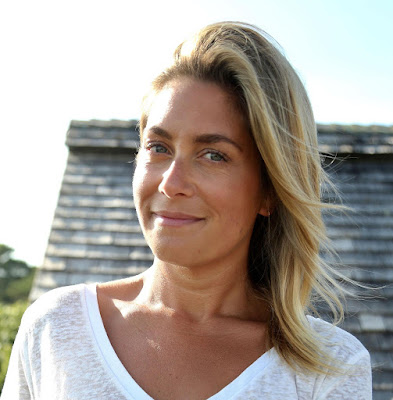
Julia Spiro

A person smiling for the cameraDescription automatically generated
Julia Spiro lives year-round on Martha’s Vineyard, where she enjoys fishing, clamming, scalloping, and anything on the beach. She also teaches spin classes in Edgartown and considers spinning her second passion. She previously worked in the film industry and lived in Los Angeles. She graduated from Harvard College.

Spiro's new novel is Someone Else’s Secret.

My Q&A with the author:
How much work does your title do to take readers into the story?

In my book, the two main characters are both involved in an unthinkable crime, but in different ways. One of them is directly involved in the crime, the other is a witness to it. Both of them silently carry the weight of this crime for ten long years, until they decide that the truth must be revealed. I wanted the title to touch on the difficulty we often face in speaking up when we know there has been an injustice, and the feeling that we are somehow unable to do so if the truth will impact others negatively or perhaps if we don’t feel like the truth is ours to tell. The idea really sprung from my time working in Hollywood, when I was privy to so many whispers about sexual assault and abuses of power, but, like many of my peers, I didn’t do anything about it. There were lots of other titles I considered, but I knew that the title had to have the word “secret” in it, because the story is also very much about how holding onto a single secret can shape the trajectory of our lives, and even ourselves. Someone Else’s Secret as a title also poses a bit of a mystery, which was another reason I chose it. The reader knows right away that the story is about two young women, so the question becomes: who’s secret is it? And who has the right to tell?

How surprised would your teenage reader self be by your novel?

My teenage self wouldn’t be surprised at all by my novel. She’d read it and guess that I was the author, no question. Both Lindsey and Georgie are very much me, in different ways. Many of their insecurities are my own. But my teenage self would be shocked that I actually let anyone read it and didn’t just stuff it under my mattress. I wrote many short stories in high school but I kept most of them to myself, aside from the occasional teacher. I think my teenage self would love my novel but would have wanted more sex scenes!

Do you find it harder to write beginnings or endings? Which do you change more?

Usually, I find the beginning harder to write, because I go back and forth with countless drafts deciding which has the strongest hook. The endings generally come more naturally to me once I know my characters and where they’re going. In this case, however, it was the opposite. I had visualized the opening scene early on and I knew what I wanted it to look and feel like. But I struggled to determine how I wanted the story to end, and I wrote several different versions of it. Without giving away too much, I wanted the characters to have justice, but I also wanted the story to be realistic and not tie up in a too-tidy bow. It was a difficult balance.

What non-literary inspirations have influenced your writing?

Everyday life all around me has really had the biggest influence on my writing. I don’t like writing alone at home or in an enclosed office space. I need to write in a cafĂ©, coffee shop or public library. I put headphones on and listen to classical music, but I silently observe the people around me. I find this crucial to my writing process. At the risk of sounding creepy, whenever I hit a mental block in my writing process, I just cast my gaze around the room and find inspiration wondering about the lives of the people around me – the couple having lunch, the mom with the toddler, the person behind the counter making espressos, the old man eating alone. There’s always an abundance of stories and ideas right in front of me if I just look around. Martha’s Vineyard, where I live and where the story is set, was also a source of inspiration in and of itself. It is a seasonal island that transforms for three months a year from a peaceful community where everyone knows one another into a crowded tourist destination, so the politics and socioeconomic dynamics here are fascinating and layered.
Visit Julia Spiro's website.

The Page 69 Test: Someone Else's Secret.

--Marshal Zeringue

Saturday, July 4, 2020

J. Todd Scott

J. Todd Scott was born in rural Kentucky and attended college and law school in Virginia, where he set aside an early ambition to write to pursue a career as a federal agent. His assignments have taken him all over the U.S and the world, but a badge and gun never replaced his passion for books and writing. He now resides in the American Southwest, and when he’s not hunting down very bad men, he’s hard at work on his next book.

Scott is the author of the Texas/Big Bend trilogy: The Far Empty, High White Sun, and This Side of Night.

His new novel, a stand-alone, is Lost River.

My Q&A with the author:

How much work does your title do to take readers into the story?

Titles are funny things…they tend to come when I least expect them, and I often don’t “title” a book until the end. In fact, I usually use a placeholder title, some word or phrase, and for Lost River, that was “American Vampires” for almost the entire time I was writing it. That was favorite, fictional band of Trey Dorado, one of the book’s viewpoint characters, but I ultimately settled on Lost River, which has significant meaning for one of the other viewpoint characters: Casey Alexander. Lost River is the name of a real cave system she explored with her father while growing up in Kentucky; it also serves to refer obliquely to the (also real) Big Sandy River running near my fictional Angel, KY, and finally, I think it also hints at how all these small towns like Angel have been “lost” or forgotten due to failing economies and the opioid crisis itself.

What's in a name?

Trey Dorado (or Jon Dorado III) is an unusual name. I liked the sound of “Trey,” because it’s simple and sharp, but also ambiguous. I can see someone named that driving a hay truck through a Dairy Queen in Kentucky, just as easily as I can see him listening to his Beats headphones on a New York subway. The “Dorado” part was a play on the myth El Dorado, which over time referred to a man, a city, and then an entire kingdom. El Dorado to me suggests searching for something just out of reach, and the risks you’ll take to find it. It also suggests that oftentimes, attempts to find some new home or new place in some faraway land are just as mythical and futile; home is always with you,

How surprised would your teenage reader self be by your novel?

My teenage self could never imagine the adult me writing a book like Lost River. At that age I was more into sci-fi and fantasy, even horror. Horrific things do happen in this book, but there’s nothing fantastical about any of it. It’s all too real, too visceral, too now. I also couldn’t have imagined writing this story because so much of it reflects my long career as a federal agent, and I wasn’t truly contemplating such a career then.

Do you find it harder to write beginnings or endings? Which do you change more?

Beginnings are hard because you’re trying to set the right tone and tempo and voice, and the beginning of any book needs to do so much “lifting” to get the whole story off the ground. Endings are usually a relief, and by the time I’m in the home stretch, I know exactly what I want to say, how I want to say it, and the final images I want to leave the reader. Lost River has a surprisingly gentle coda for a book that has so much darkness and so many sharp edges, but it was truly a joy to write it, and I knew that ending well before I put the words down on the page.

Do you see much of yourself in your characters? Do they have any connection to your personality, or are they a world apart?

I really don’t see myself in any of the characters in Lost River, although that’s been less true for some of my other novels. I’m not as young as Trey anymore, I’m nowhere near as hot-headed as Casey, and although Paul and Van Dorn are much closer to me in age, our experiences are worlds apart.

What non-literary inspirations have influenced your writing?

Again, for some of my other books, I can point to films or even music that influenced those stories. That’s less true with Lost River. If there was any influence on this book, it’s my job as a federal agent. I thought I had a unique take on the opioid crisis and felt compelled to share some of the things I’d seen and dealt with. I’m hardly a topical writer, but this was a topic I wanted to address.
Visit J. Todd Scott's website.

--Marshal Zeringue