Friday, April 30, 2010

Thomas Kaufman

Sandra Ruttan interviewed Thomas Kaufman about his new novel, Drink the Tea. Part of their dialogue:

Your debut novel, Drink the Tea, has a lot of layers to it. For you, what came first? Plot or character?

It starts with character. In the case of Drink the Tea, at first it was one of the antagonists that most interested me. Then Gidney’s character began to come through. I don’t use an outline, so understanding the characters is crucial. I find that writing successive drafts is like developing a print in a darkroom. You’re under a red light, looking a blank sheet of paper, there’s nothing there, then gradually an image comes to the foreground. Writing about Gidney and company was very much like that.

* * *
Without losing the plot, you manage to throw in some background on the problems with youth homes and even touch a little on the various types of behavior intervention plans used to deal with kids with behavior problems. Did you intend to make a commentary on the issues with youth homes and facilities, and the various philosophies that are tested out on young people? Where does your interest in the topic stem from?

Story comes first. I don’t editorialize. My background in documentary film keeps me from doing that. I present the details of Gidney’s childhood. The readers can draw their own conclusions. Having said that, I think people reading Drink the Tea may come to believe that the system in place is not doing nearly enough to provide protection to the children who most need it.

I grew interested in this subject from a good friend in the film business. She grew up without a father, and when her mother had a nervous breakdown and had to be hospitalized, there was no place for my friend to go but one of these kiddie jails I write about in Drink the Tea. She got tossed in with some hard-core delinquents, drug addicts, and mentally ill children. Her stories were terrifying, but...[read on]
View the trailer for Drink the Tea, and learn more about the book and author at Thomas Kaufman's website and blog.

The Page 69 Test: Drink the Tea.

--Marshal Zeringue

Thursday, April 29, 2010

Robert Whitaker

Robert Whitaker is the award-winning author of The Mapmaker’s Wife, Mad in America, On the Laps of Gods, and the newly released Anatomy of an Epidemic.

From his interview with Jed Lipinski at Salon:

Psychiatric drug use is a notoriously tough subject for writers, because of all the contradictory research. Why wade into it?

In 1998, I was writing a series for the Boston Globe on abuse of psychiatric patients in research settings. I came across the World Health Organization’s outcomes study for schizophrenia patients, and found that outcomes were better for poor countries of the world -- like India, Colombia, Nigeria -- than for the rich countries. And I was startled to find that only a small percentage of patients in those countries were medicated. I also discovered that the number of people on disability for mental illness in this country has tripled over the last 20 years.

If our psychiatric drugs are effective at preventing mental illness, I thought, why are we getting so many people unable to work? I felt we needed to look at long-term outcomes and ask: What does the evidence show? Are we improving long-term outcomes or not?

But you claim in the book that psychiatrists have long known that these drugs can cause harm.

In the late 1970s, Jonathan Cole -- the father of American psychopharmacology -- wrote a paper called "Is the Cure Worse Than the Disease?" that signaled that antipsychotics weren't the lifesaving drugs that people had hoped. In it, he reviewed all of the long-term harm the drugs could cause and observed that studies had shown that at least 50 percent of all schizophrenia patients could fare well without the drugs. He wrote, "Every schizophrenic outpatient maintained on antipsychotic medication should have the benefit of an adequate trial without drugs." This would...[read on]
Read an excerpt from Anatomy of an Epidemic, and learn more about the author and his work at Robert Whitaker's website.

The Page 99 Test: Anatomy of an Epidemic.

--Marshal Zeringue

Wednesday, April 28, 2010

Molly Ringwald

Molly Ringwald lives and works in New York City and Los Angeles. Her new book is Getting the Pretty Back: Friendship, Family, and Finding the Perfect Lipstick.

From her Q & A with The Barnes & Noble Review:

The Barnes & Noble Review: What made you write this book, rather than, say, a straight-up memoir or some other sort of book?

Molly Ringwald: Well, I didn't really want to write a straight-up memoir because I don't feel like I'm ready. I feel like I'm at this halfway point in my life. If I wrote a straight-up memoir, I'd just have to go and write another one later. The book really came about because I was turning 40 and there was kind of this crazy oh my god, how is it possible that I'm turning 40? thing. And I realized there were no books like the one I wanted to read. Anytime that I've gone through anything in my life, I've always felt like I could turn to a book that offers guidance and solace, and I'm not even talking about self-help books necessarily. But there was nothing fun and stylish and inspirational about being a woman, rather than a girl. That's why I wanted to write this particular book -- and why it's in color and illustrated by Ruben [Toledo]. I wanted it to be a colorful, beautiful, fun, sexy little book.

BNR: What was the process of writing the book like? Did you work with anyone else on it?

MR: No. It's all me. It was daunting, to say the least. I've never written a book before. Everything I've ever written has been, you know, a 2,000-word limit. So it was challenging. My husband [Panio Gianopoulos] is a writer and an editor, so he was very helpful in keeping me on track. I had this 500-word-a-day target, or two hours, whichever came first. And as long as I could commit to that, usually once I got myself in the seat, I would usually write, like, 1,500 words or 2,000 words. They add up after a while, if you do it all the time.

BNR: It's just getting over the psychological hurdle.

MR: Yeah. It was just little by little, brick by brick. It took a little longer than I had anticipated because...[read on]
--Marshal Zeringue

Tuesday, April 27, 2010

Ian Johnson

From a Q&A with Ian Johnson, author of A Mosque in Munich:

Q: We're inundated with books on Islam and Europe and so on. Why another?

A: Two reasons. The simplest is because this story is important and hasn't been told before. It starts in World War II with the Nazis deciding they could use Muslims to fight the Soviet Union. Then, after the war, the very same group of Muslims are recruited by the CIA to do the same thing--fight the Soviets by using Islam. This group is then taken over by the Muslim Brotherhood, which uses Munich as a beachhead to spread into the West. This is twenty years before Afghanistan and the muhajadeen; it's the prequel to a lot of what's gone on since. Plus this continues right up to the present. The Muslim Brotherhood still plays a key role in setting a radicalized agenda for Islam in Europe. It's no coincidence that the mosque in Munich is associated with many major terrorist attacks in the West, including the two attacks on the World Trade Center. As our governments try to figure out how to deal with Islam, we need to know our own history first.

Q: So it's important.

A: To be honest, my roots are in journalism and I like colorful stories. This is a really strange one with memorable characters. The people involved are so bizarre that they sound like the start of a joke: you have a brilliant Nazi linguist, a CIA man who's a nudist and a radical Muslim on the lam…

Q: I'm afraid to hear the punch line. You...[read on]
--Marshal Zeringue

Monday, April 26, 2010

Douglas Corleone

Douglas Corleone is the winner of the 2009 Minotaur Books/Mystery Writers of America First Crime Novel Award. A former New York City criminal defense attorney, he now lives in the Hawaiian Islands with his wife and son. His new novel is One Man's Paradise.

From Corleone's Q & A with Julia Bodeeb:

How Did You Get the Idea for the Novel?

The seeds for "One Man's Paradise" were planted with the Natalee Holloway story in Aruba, specifically with the sensational, around-the-clock national news coverage surrounding Natalee's disappearance. The modern media, and one cable commentator in particular, play a role as antagonists in "One Man's Paradise."

The media essentially chased Kevin Corvelli out of New York, and they continue to work against him once he arrives in Hawaii. Fortunately, the events that led to Kevin's move to Hawaii were nothing like the events that led to mine. Still, much of the plot is based on my own experiences as a criminal defense attorney in New York City, and as a newcomer to the Hawaiian Islands.

Is the Protagonist in "One Man's Paradise" like You at all? If So, How?

I'd like to say no, but people who know me would probably disagree. In many ways, Kevin Corvelli is an exaggeration of me. He's more neurotic, more impatient, and more impervious to threats. Like most protagonists, Kevin is larger than life. The thing is, he knows...[read on]
Visit Douglas Corleone's website.

--Marshal Zeringue

Sunday, April 25, 2010

Jehanne Dubrow

Jehanne Dubrow is the author of three poetry collections, most recently Stateside (Northwestern University Press 2010), which describes her experiences as a "milspouse." Her first book, The Hardship Post (2009), won the Three Candles Press Open Book Award, and her second collection From the Fever-World, won the Washington Writers' Publishing House Poetry Competition (2009). Finishing Line Press published her chapbook, The Promised Bride, in 2007.

From her Q & A with Serena Agusto-Cox:

1. How would you introduce yourself to a crowded room eager to hang on your every word? Are you just a poet, what else should people know about you?

I suppose one of the most interesting things about me is my nomadic childhood. I was born in a little town in Northern Italy and grew up in Yugoslavia, Zaire, Poland, Belgium, Austria, and the United States. Oh, and when I twenty years old, I played a gangrenous valley girl in the movie An American Werewolf in Paris (sadly, I ended up on the cutting room floor). I still remember my line: “Claude’s parties are wack!!!”

2. Do you see spoken word, performance, or written poetry as more powerful or powerful in different ways and why? Also, do you believe that writing can be an equalizer to help humanity become more tolerant or collaborative? Why or why not?

For me, written poetry has the emotional force expected of spoken word and performance poetry, while also having a life on the page. I haven’t seen evidence that writing makes us more tolerant or collaborative. Writers tend to be a critical bunch—our craft depends on having a sharp eye and a small sliver of ice in the heart.

3. Do you have any obsessions that you would like to share?

I have an odd mix of obsessions...[read on]
Read "Against War Movies" and sample other poems by Jehanne Dubrow, and visit her website and blog.

Writers Read: Jehanne Dubrow.

--Marshal Zeringue

Saturday, April 24, 2010

Stephanie Cowell

Stephanie Cowell is the author of a new novel, Claude & Camille.

From her Q & A at HistoricalNovels.info:

What do you think made the public dislike Impressionist art so much at first?

The public was much more involved with art then in those days before radio or television. The old Academic School of Art they knew was like a photograph; every blade of grass was painted precisely and the pictures were often of kings, gods and religious scenes. Everything was very still; it did not move. And even though Monet's early works were hardly as loosely painted as his great water lily paintings, the public did not understand. They felt the paintings were unfinished; they weren't interested in quick brush strokes capturing light on everything. Then finally a few began to understand and buy but it took a long time.

Did Auguste Renoir and Claude Monet really take work painting murals on cafe walls?

Renoir...[read on]
Read an excerpt from Claude & Camille, and learn more about the book and author at Stephanie Cowell's website and blog.

The Page 69 Test: Claude & Camille.

--Marshal Zeringue

Friday, April 23, 2010

Mark Terry

Mark Terry is the author of three Derek Stillwater novels, The Devil's Pitchfork, The Serpent's Kiss, and The Fallen, as well as two standalone novels, Dirty Deeds and Dancing in the Dark.

From his Q & A with Julia Buckley:

Your new book, The Fallen, has received much praise, and the Lansing Journal suggests that you write “like Lee Child on steroids.” Is this true? Are your books about action first and foremost?

That was a particularly flattering comment from the Lansing State Journal. Well, “action first and foremost,” I’m not sure. But they are very action-oriented and I really have no problem calling Derek Stillwater, my main character, an action hero. I tend to describe them as action-adventure thrillers, although they’ve been called political thrillers and even espionage thrillers.

This book is your third Derek Stillwater novel. Tell us a bit about this character.

Derek Stillwater, PhD, is a troubleshooter for the Department of Homeland Security. His particular areas of expertise are chemical and biological terrorism. He is a former Special Forces expert in biological and chemical warfare. That’s his resume, but he’s a bit neurotic, something of a hypochondriac, has some superstitious tendencies (he believes in luck, both good and bad, wears ju-ju beads, a St. Sebastian’s medal (patron saint of plagues), and a four-leaf clover). He has panic attacks. His parents...[read on]
Read chapters 1-6 of The Fallen, and learn more about the book and author at Mark Terry's website and blog.

The Page 69 Test: The Fallen.

My Book, the Movie: The Fallen.

--Marshal Zeringue

Thursday, April 22, 2010

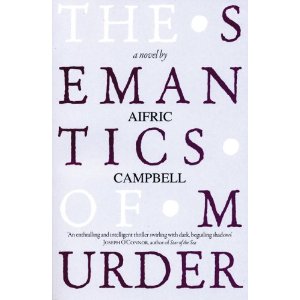
Aifric Campbell

Aifric Campbell is the author of The Semantics of Murder and The Loss Adjustor.

From her Q & A with Boyd Tonkin for the Independent:

Name a favourite author and say why you like her/him

John Updike, especially the Rabbit novels. It's his celebration of the everyday – the grace and humour with which he tells the story of an ordinary man.

* * *
Which fictional character most resembles you?

When I'm talking back at a TV programme, Ignatius Reilly in John Kennedy Toole's A Confederacy of Dunces, shouting "They should all be lashed!" Or else Richard Fords Frank Bascombe (from The Sportswriter), trying to figure out the world while walking the dog.

* * *
Who is your Hero or heroine from outside literature?

I've got a soft spot for Captain Scott [of the Antarctic]. Maybe it's an Irish thing – I've always been fascinated by heroic death.
Read the complete Q & A.

See Campbell's top ten list of favorite jobs in fiction.

--Marshal Zeringue

Wednesday, April 21, 2010

Michael Harvey

Michael Harvey's new novel is The Third Rail.

From his Q & A with Julia Buckley:

Your narrator tells his story in first person, but we get a bad guy’s perspective in third person. Why did you choose a double point of view?

Good question. My first two books, The Chicago Way and The Fifth Floor, were both written in the first person, from Michael Kelly’s point of view. I enjoy writing in Kelly’s voice and wanted to keep him in the first person. My plot for The Third Rail, however, called for multiple crime scenes that unfold almost simultaneously across the city. In order to maintain and feed the dynamics of that story line, I felt it was critical to get into the killer’s head at certain points and allow him to drive the action forward. So I kept Kelly in the first person, and used the third person for my killer.

This decision is not without risk. But I figure nothing ventured, nothing gained. I will be interested in readers’ reaction to the switching. Did it bother them? Did they like it? Did they even notice? We’ll see.
Read the complete interview.

Visit Michael Harvey's website.

--Marshal Zeringue