Monday, May 31, 2010

Aimee Bender

Aimee Bender is the author of four books: The Girl in the Flammable Skirt (1998) which was a NY Times Notable Book, An Invisible Sign of My Own (2000) which was an L.A. Times pick of the year, Willful Creatures (2005) which was nominated by The Believer as one of the best books of the year, and The Particular Sadness of Lemon Cake (2010).

From her Q & A with the Wall Street Journal:

The Wall Street Journal: How did you come up with the premise for "The Particular Sadness of Lemon Cake"?

Aimee Bender: I think it came from a few different places. One source is a friend of mine who talks a lot about feelings as something to be digested. Those words stuck with me in terms of the correlation between feelings and food.

WSJ: Are you a big foodie?

Ms. Bender: I love food. I'm not a great cook, but I love to cook and I like how different it is from writing.

WSJ: What kind of food do you cook?

Ms. Bender: Pretty simple stuff. Pastas, fish or briskets.

WSJ: Do you have an emotional connection to certain foods?

Ms. Bender:...[read on]
Learn more about the author and her work at Aimee Bender's website.

The Page 99 Test: Willful Creatures.

--Marshal Zeringue

Sunday, May 30, 2010

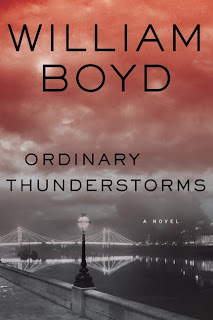
William Boyd

William Boyd's books include A Good Man in Africa, winner of the Whitbread Award and the Somerset Maugham Award; An Ice-Cream War, winner of the John Llewellyn Rhys Prize and shortlisted for the Booker Prize; Brazzaville Beach, winner of the James Tait Black Memorial Prize; Any Human Heart, winner of the Prix Jean Monnet; Restless, winner of the Costa Novel of the Year; and the newly released Ordinary Thunderstorms.

A few questions he asked himself because literary journalists don't:

Are the names of the characters in your novels important?

Extremely. I spend inordinate amounts of time trying to get the names "right" – even for the most minor walk-on characters. If you christen a character correctly, he or she, I believe, already starts to live on the page. You don't have to go the whole Dickensian-Vonneguttian hog, but a little unusualness about the right name works wonders. Characters called perfectly nice and normal names like "Martin Foster" or "Sally Thomas" will always struggle a bit to claim your attention.

What about the titles of your novels?

I couldn't publish a novel if I wasn't happy about the title. The title is a kind of benediction on the whole enterprise. To send a book out into the world with a title I wasn't happy with seems inconceivable to me. Sometimes the right title comes almost immediately; sometimes you're still sweating at it as the 11th hour comes and goes. It's a vitally important omen – for me, the novelist. I don't think...[read on]
--Marshal Zeringue

Saturday, May 29, 2010

Isabel Allende

Isabel Allende's new novel is The Island Beneath the Sea.

From her Q & A with Anna Metcalfe for the Financial Times:

What book changed your life?

The Female Eunuch by Germaine Greer.

* * *
Which literary or historical character most resembles you?

Zorro or Genghis Khan.

* * *
Who are your literary influences?

Probably the great writers of the Latin American boom of literature.
Read the complete Q & A.

--Marshal Zeringue

Friday, May 28, 2010

Sharon Oreck

Sharon Oreck is a film, video, and commercial producer. Between 1984 and 2000 she was the owner-operator of O Pictures. She is an Academy Award nominee and the recipient of a Grammy Award, two Women in Film Awards, and several MTV Awards. Her new memoir is Video Slut: How I Shoved Madonna Off an Olympic High Dive, Got Prince into a Pair of Tiny Purple Woolen Underpants, Ran Away from Michael Jackson's Dad, and Got a Waterfall to Flow Backward So I Could Bring Rock Videos to the Masses.

From her Salon.com Q & A with Amy Benfer:

Looking back, the '80s seem like a golden age of music video. Did that seem true at the time?

People keep telling me over and over that their childhoods were really affected by music videos. I was at a club in Argentina with 25-year-olds and they were all like, "You did Sheila E 'Glamorous Life'! Oh!" We did not have any idea that it was perma-fodder. We just thought, "Oh, it's like newspaper work. You write it, and then the next day, you write something else." But because of the Internet, it will live forever. I think that people look back at it and think of it as a golden age. And the reason for that is it was a free time. You could do anything. Nobody was micro-managing it; no one was paying any attention to it. No one was managing what was being seen; it was not p.c., it was not corporate-approved; it was just what people really wanted to do. MTV is over now, in terms of music programming. That's why it was a golden age; because there is no more music programming. There is no age at all.

Your first work as a producer was on Sheila E's "The Glamorous Life" when you were 29 years old. Was it typical at the time to have a young woman working as a producer?

In the music video world, there was no standard at all. Nothing was typical because there was no industry until 1982. When I entered it, it was still pretty much the Wild West. When I went in and declared that I made 10 percent of the budget, that is not the industry standard, believe me. I would never...[read on]
--Marshal Zeringue

Thursday, May 27, 2010

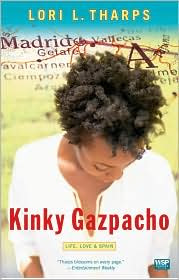
Lori L. Tharps

Lori L. Tharps is an assistant professor of journalism at Temple University, an author, freelance journalist and mom. Her books include Kinky Gazpacho: Life, Love & Spain and Hair Story: Untangling the Roots of Black Hair in America.

From a Q & A at her publisher's website:

Q: Why did you shift away from the field of education into a career in journalism?

LLT: I’ve always wanted to be a writer, but I never considered “writer” a legitimate profession. It seemed like a nice hobby but not something you could tell your parents you wanted to pursue. Once I made the decision to pursue my passion of writing, I elected to go into journalism because journalists have jobs and “writers” just write!

Q: How did the experience of writing this memoir differ from your other nonfiction work as a journalist?

LLT: The hardest part about writing a memoir is that you are the main subject. I was used to dissecting other people’s personalities and researching obscure facts, but for Kinky Gazpacho the spotlight was on me. There were times I didn’t want to write about certain incidents because they were too embarrassing or painful, but the journalist in me knew they were essential parts of the story and had to be told.

Q: You describe a sense of not being “the right kind of Black girl” from your time as an undergraduate at Smith College. To what extent do you think young Black American women in college today share this concern?

LLT: Sadly, I think the same thing still happens when college kids of any ethnic group come to college. Students are forced to immediately align themselves with a group or else risk social stigmatization. College campuses are still great breeding grounds for group-think mentalities.

Q: Why did the discoveries you made in your research on the history of Black slaves in Spain affect you so profoundly?

LLT: I guess...[read on]
Learn more about Lori Tharps at her website and blog.

Writers Read: Lori L. Tharps.

--Marshal Zeringue

Wednesday, May 26, 2010

Hilary Thayer Hamann

Hilary Thayer Hamann is the author of a work of literary fiction, Anthropology of an American Girl, a semi-autobiographical coming-of-age story about a young woman growing up in Reagan era America. The novel was first published by Vernacular Press, an independent publishing company of which Ms. Hamann was founder and co-owner. Anthropology was purchased for publication by Spiegel & Grau, a division of Random House, and releases this month.

From her Q & A with Steven Kurutz at the Wall Street Journal:

WSJ: Why does the novel resonate with young women?

Ms. Hamann: It's a substantial endeavor and takes being a woman in this culture very seriously. If I thought anything, I thought my book wasn't as "light" as other books for women. They look like a pregnancy test: you go to an airport and everything is light blue and pink.

WSJ: How much of the heroine's story is your own?

Ms. Hamann: I wouldn't say it's autobiographical but I attended the same schools, walked on the same streets. I think incoporated into my story are the stories of other women. I tried to make a constellation, not a single star.

WSJ: The book is set partly in the Hamptons in 1979. What was the area like then?

Ms. Hamann: There was a sense that...[read on]
--Marshal Zeringue

Tuesday, May 25, 2010

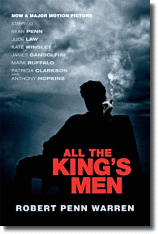
Robert Penn Warren

From Robert Penn Warren's 1957 interview with The Paris Review:

INTERVIEWER
Do you feel that there are certain themes which are basic to the American experience, even though a body of writing in a given period might ignore or evade them?

WARREN
First thing, without being systematic, what comes to mind without running off a week and praying about it, would be that America was based on a big promise—a great big one: the Declaration of Independence. When you have to live with that in the house, that’s quite a problem—particularly when you’ve got to make money and get ahead, open world markets, do all the things you have to, raise your children, and so forth. America is stuck with its self-definition put on paper in 1776, and that was just like putting a burr under the metaphysical saddle of America—you see, that saddle’s going to jump now and then and it pricks.
Read the complete interview.

--Marshal Zeringue

Monday, May 24, 2010

Michael Harvey

Michael Harvey's new novel is The Third Rail.

From his Q & A with Declan Burke:

What crime novel would you most like to have written?

Hmm ... I can think of three and can’t pick between them. THE LONG GOODBYE, THE GREAT GATSBY, THE SUN ALSO RISES.

What fictional character would you most like to have been?

Sam Spade ... is there any other answer?

Who do you read for guilty pleasures?

Clive Cussler, Eric Ambler, Homer.
Read the complete Interview.

Read an excerpt from The Third Rail, and learn more about the book and author at Michael Harvey's website.

The Page 69 Test: The Third Rail.

--Marshal Zeringue

Sunday, May 23, 2010

Jonathan Littell

Jonathan Littell's The Kindly Ones is a brutally graphic novel about the Holocaust narrated by Max Aue, a former Nazi officer.

From Littell's Q & A with the Wall Street Journal:

WSJ: Why pick this topic?

Mr. Littell: It evolved slowly. I wanted to write about the war initially and then the emphasis focused on the genocide. I knew I wanted to do it first person. I didn't have any hesitation. I've been in dark places a good part of my life.

What was the process?

I started on this full time in 2001, but I'd been thinking about it for a dozen years. The research was done very systematically. I drew up a long reading list. I then divided it thematically and read chunk after chunk. Along the way you find out about new books and one topic leads to another. I also fit in trips along the way, including Jewish communities in the Caucasus.

How difficult was it to focus on the death squads in the Ukraine and various concentration camps? When you write, you don't think about the content, you think about the sentences, the grammar, the syntax, the rhythm. It's like a painter. Hieronymus Bosch was able to paint Hell by thinking...[read on]
The Kindly Ones is one of writer/director John Waters' six favorite books.

--Marshal Zeringue

Saturday, May 22, 2010

Bernd Heinrich

Bernd Heinrich is a renowned naturalist and emeritus professor of biology at the University of Vermont. His new book is The Nesting Season: Cuckoos, Cuckolds, and the Invention of Monogamy.

From his Q & A with Jed Lipinski at The Barnes & Noble Review:

Can penguins really feel love?

When I talk about penguins experiencing love, I'm talking about mechanisms that we have for attachment, for reproduction. And I don’t think that’s anthropomorphizing at all. It's not any more of a generalization than saying the muscles of a bird act the same way in moving a limb as they do for us. Of course, attachment is going to be very different between species, just as it is between individual humans.

But when I wrote as much in my Op-Ed on March of the Penguins for the New York Times, many readers rejected the idea of love as a chemically induced state of mind that many animals share. One reader seemed threatened by the idea that humans might not be special, that they might be just another animal. He felt love was an exalted feeling that only humans can have. Yet most biologists simply look at a trait’s functional aspects: what it does, what it's for, why it evolved. We're interested in the differences, of course, but also in the things we all have in common.

Why do you think "March of the Penguins" was such a hit?

Because people recognized aspects of our own behavior in them, for one. But I think it's a mistake to see them as archetypes of virtue, as many viewers did, because by that measure you'd have to hold up others as archetypes of evil. The male bird of paradise, for example, will mate with anything that comes along every few minutes. So if you hold up a penguin as something to emulate, then why not a bird of paradise? It's not that penguins are nicer or better than birds of paradise—they're just penguins. As humans, we tend to impose a moral framework on animal behavior, as we do on our own. We value that which doesn’t put a burden on society. But birds don’t have morals in the sense of emotional pressures to act in a certain way. They are what they do, and do what they are.

We have this idea that many birds, like swans, for example, are these ideals of monogamy. Is this true?

Monogamy among birds...[read on]
--Marshal Zeringue