Thursday, February 28, 2013

Rebecca Miller

Writer and filmmaker Rebecca Miller’s most recent book is Jacob’s Folly.

From her Q & A with Annasue McCleave Wilson at Publishers Weekly:

Is your writing influenced by the work of your father, Arthur Miller?

You can’t escape being influenced by your parents, whoever they are. I don’t know if he’s my literary father as much as my biological father, but I do think his natural economy... There’s a kind of moral inquiry in my work that isn’t completely foreign to what he was doing.

How much do you collaborate with your husband [actor Daniel Day-Lewis]?

He’s not my very first reader because I want a story to be finished enough that I know it’s something I can stand behind. He’s a wonderful reader, very honest, wonderful in terms of [understanding] humanity—what people would really do.

Will you make Jacob’s Folly into a movie?

No, I don’t think I’ll be making it into a film anytime soon, or maybe ever. It was a very hard book to...[read on]
--Marshal Zeringue

Wednesday, February 27, 2013

Megan Abbott

Megan Abbott's latest novel is Dare Me.

From her Q & A at BOLO Books:

BOLO Books: Your two most recent novels, The End of Everything and Dare Me, feature more contemporary settings, smaller towns, and younger protagonists and yet I would be very hesitant to call them Young Adult novels. What is it about the girls in these stories that make them suitable characters for your brand of story, which is geared more towards adult readers? What is it about the threshold to adulthood that is so ripe with dramatic potential?

Megan Abbott: The passage from innocence into experience is probably the constant across all my books and we see it most strikingly in adolescence. It’s the age at which we truly “make” ourselves or let ourselves be made by others. Our friendships, rivalries, crushes, humiliations—they all create us, and with a fervor you never get at any other age. Everything seems to matter so much. Also, I think many of us are still pretty uncomfortable with acknowledging some of the darker feelings of girls at that age—desire, aggression, jealousy. But I find that such ripe terrain.

And better to write about it than to live it—I think it’s the hardest age of all and I’d...[read on]
Visit Megan Abbott's website.

The Page 69 Test: Bury Me Deep.

The Page 69 Test: The End of Everything.

--Marshal Zeringue

Tuesday, February 26, 2013

Emily Bazelon

Emily Bazelon's new book is Sticks and Stones: Defeating the Culture of Bullying and Rediscovering the Power of Character and Empathy.

From her Q & A with Emily Yoffe at Slate:

Emily Yoffe: What was the most surprising thing your reporting turned up?

Emily Bazelon: One piece of research in particular helped me understand why kids bully—how that can be a rational, if unfortunate, choice. Robert Faris at U.C. Davis mapped social networks in a few different high schools, and he showed that kids behaving aggressively—not physically, but socially—use gossip, exclusion, and attacks on other kids’ reputations to help themselves move up the social ladder. It turned out that for most kids, it didn’t work, in terms of increasing status, to attack someone much weaker. But if you picked on someone near you in the social hierarchy who was a possible rival, that often had a social benefit. It is sort of depressing but important to understand, I think. People ask: Why do kids act this way? But kids are doing what anyone would do: maximizing their social influence. So then the question is: How do we upend this?

Yoffe: Is it even realistic to think you can upend it? Aren’t you talking about a pervasive part of human nature?

Bazelon: Aggression is endemic to human nature, and we wouldn’t want to stamp it out. Kids are not always going to be nice to one another. But bullying is a certain kind of harmful aggression. The agreed-upon definition is that it’s verbal or physical aggression that is repeated over time and involves a power differential. It’s one kid lording it over another, and because it persists, the victim can find it particularly devastating. We can help kids realize this kind of aggression is not the norm, and in the end, it’s not the best way to advance socially, either.

One school I write about did a survey, and the results showed that 90 percent of students there did not exclude other kids at the lunch table. So they put this information on posters around the school, and the incidence of exclusion dropped even further. There’s an analogy here to the campaign against drunk driving. When I was in high school, I felt it was a tiny bit cool to drink and drive. There wasn’t a strong message about how dangerous and wrong it was. But parents, schools, and the media have succeeded in impressing that on kids, and now they are less likely to do it—and the death rate from drunk driving among young people has gone down significantly. There are social problems that seem intractable, but...[read on]
Writers Read: Emily Bazelon (September 2007).

--Marshal Zeringue

Monday, February 25, 2013

Andrew Solomon

Andrew Solomon is the author of The Irony Tower: Soviet Artists in a Time of Glasnost, A Stone Boat, The Noonday Demon: An Atlas of Depression, winner of fourteen national awards, including the 2001 National Book Award, and Far From the Tree: Parents, Children and the Search for Identity.

From his Q & A with Jeremy Adam Smith of the Greater Good Science Center:

Jeremy Adam Smith: Why did you write this book?

Andrew Solomon: Twenty years ago my editors at the New York Times asked me to write about the deaf on the grounds that I had done a lot of reporting about foreign cultures and this was a foreign culture in our midst.

I immediately saw parallels between the experiences of deaf people, with their claim on culture that was questioned by the outside world, and gay people, who had made a similar claim. And I found that most deaf children are born to hearing parents, and that most gay children are of course born to straight parents. I wrote a lot about the ways in which in exploring the deaf experience I found this resonance with my own experience as a gay man.

Then a few years later a friend of a friend of mine had a daughter who was a dwarf, and I heard her asking all the same kinds of questions that hearing parents of deaf children asked themselves: “Do I bring her up to be friends with other dwarfs? Do I tell her she just like everyone else, only she’s shorter? What is the approach supposed to be here?”

As I listened to that experience, I suddenly saw this recurring theme: this idea of parents who perceive themselves to be normal and children who perceive themselves to be different—and parents who don’t know how to deal with these children who are different. If it’s true...[read on]
See Andrew Solomon's five top books about family love.

--Marshal Zeringue

Sunday, February 24, 2013

Glenn Frankel

Glenn Frankel is director of the School of Journalism and G.B. Dealey Regents Professor in Journalism at the University of Texas at Austin.

His new book is The Searchers: The Making of an American Legend.

From the author's Q & A at DirectedByJohnFord.com:

DxJF: What prompted you to write the book?

GF: I’d loved The Searchers since I first saw it as a child and for perhaps 20 years I thought I’d love to write about it. Eventually, I started thinking about a coffee table book for the 50th anniversary in 2006, but then I got sidetracked by another foreign assignment for The Washington Post. When I got back from overseas, I wanted to write an American book, and nothing seemed more American than The Searchers. What I didn’t realize was that what began as a simple book about the making of a movie in 1955 would expand into a multi-generational epic spanning 150 years and the entire Southwest.

DxJF: What are the significant differences between the Alan LeMay fictional presentation of the Cynthia Parker story vs. the Ford’s film version of The Searchers? And how does Cynthia Ann’s real story compare to each?

GF: Alan LeMay took the original story, changed the date from 1836 to 1868, combined Cynthia Ann’s tale with that of several other abductees from other times and places, and then shifted the focus from the victim to the relatives who searched to find her. Ford faithfully uses the spirit of LeMay’s novel but shifts some significant parts to fit his needs. The uncle who heads the search becomes the central figure, most notably because he’s played by John Wayne and Wayne dominated every movie he was in. The novel is a powerful piece of work but it’s unrelentingly dark and grim, and Ford leavens it with a tablespoon of cornball humor. Finally, and perhaps most important, Ford raises to the surface all of the racial and sexual tensions that underlie the book. He gives Martin some Indian blood, thus making one of the heroes a “half breed.” And he makes clear that Ethan [played by John Wayne] is searching for Debbie not to restore her to the family but to kill her because she has grown into a young woman and, willingly or not, has had sex with a Comanches.

In both the novel and the film...[read on]
Visit Glenn Frankel's website.

--Marshal Zeringue

Saturday, February 23, 2013

Camille Paglia

Camille Paglia's latest book is Glittering Images: A Journey Through Art from Egypt to Star Wars.

From her Q & A at Powell's Book Blog:

Who are your favorite characters in history?

I was obsessed with Napoleon during my childhood in the suffocatingly chirpy Doris Day 1950s. I was entranced by Napoleon's fabulous form-fitting military uniforms, which I saw in paintings vividly reproduced in Courvoisier cognac ads in magazines. For Halloween when I was eight, I wore a splendid black, white, and red Napoleon costume and two-cornered hat made by my ingenious parents. (Transgender personae were definitely not the norm back then.) However, as the decades passed and I learned more about Napoleon, disillusion set in. Sometimes war is necessary, but not for vanity and imperialism.

An even bigger craze of mine was Amelia Earhart, whom I spent three years researching in high school in the early 1960s. It was through her that I discovered the thrilling first phase of feminism, when women strove to achieve at the high level of men and didn't get bogged down in resentment and self-pity. In the bowels of the Syracuse public library, I plowed through sooty newspapers and magazines from the 1920s and '30s (not yet on microfilm), wrote hundreds of letters of inquiry, and visited all sorts of Earhart-related places on side trips from family vacations — including the white frame house that was her birthplace in Atchison, Kansas. I briefly met her elderly sister near Boston and had a private appointment with a Smithsonian official to examine Earhart's medals, stored in a vault at the National Air Museum in Washington, D.C.

A record of my Earhart period is my letter to the editor of Newsweek (July 8, 1963) protesting the absence of women in the U.S. space program and demanding "equal opportunity for American women," as Earhart had fought for. Next to my letter (which was the lead item), the magazine published a strong photo of Earhart in her leather flying jacket. I was in high school at the time. It must be noted that this letter appeared the same year as...[read on]
--Marshal Zeringue

Friday, February 22, 2013

A.J. Jacobs

A.J. Jacobs is the author of four New York Times bestsellers, including The Year of Living Biblically (about his quest to follow all the rules of the Bible); The Know-It-All (about his adventure reading the encyclopedia); and Drop Dead Healthy (about his attempt to become the healthiest person alive).

From his Q & A with Alicia Oltuski for Beyond The Margins:

AO: You’ve posed nude for Esquire, where you’re an editor, you’ve stolen and replaced eggs from a pigeon’s nest to fulfill a biblical commandment, you’ve chewed blueberries an exhausting number of times before swallowing them to more properly glean nutrients and taste, and you’ve let a stranger watch you sleep even though your doctor didn’t make you. My point is that you don’t spare yourself as a subject. How does this approach shape you as a writer?

AJ: For me, the best way to research a topic is to dive in and immerse myself in it. If I were writing about France, I would read maps and census data and history books. But I’d also want to go to France and taste the almond croissants. So that’s the way I try to write about every topic. If I’m writing about the Bible, I want to live the Bible — grow a beard, wear sandals and turn the other cheek (or take an eye for an eye, whichever seems more appropriate).

AO: Which one of your projects so far has most enduringly changed your life?

AJ: Probably ‘The Year of Living Biblically.’ Just to give one example: It taught me the importance of gratitude. I am now much more aware of the hundreds of things that go right every day, and I try not to focus on the four or five that go wrong.

AO: The Ed Helms resemblance–that’s a thing, right?

AJ: Ha! I’ve never heard that. But I’ll take it. I do get mistaken for McLovin in...[read on]
The Page 69 Test: The Year of Living Biblically.

--Marshal Zeringue

Thursday, February 21, 2013

Julianna Baggott

Julianna Baggott's new novel is Fuse, the sequel to Pure.

From her Q & A at Powell's Books Blog:

If someone were to write your biography, what would be the title and subtitle?

Oh, poor biographer, weedy and pale. I wish you'd latched onto someone greater, who heaved around more literary weight, drank too much, caused scenes in restaurants, and slept with movie stars. Alas, sweetheart, lowest-ranking PhD candidate in your tidal pool, you've chosen me. Or maybe some sympathetic professor said, "Go with Baggott. No one's talked about her work at all, that I know of." And so you rummage my books for meaning. You access my old emails — oh, the coughing kids, the parent-teacher conference sign-ups, the dog groomer appointments — my God, that collie had a sensitive digestive system — and, sure, a few quips — some even with the writers you wish you'd chosen. But you're in too deep now. You've finally read all the books (why did I have to be so prolific?), and you've jotted notes about my codependent relationship with my husband: "They seem to love each other…" You stare out a window. Here, let me help. Baggott: A Study in Daily Dithering Mess. Buckshot: A Career That Makes No Sense. Julianna Baggott: A Cautionary Tale of a Wannabe Hermit. Don't work too hard on this. In fact, abandon the cause. Take a walk and keep walking. Join a commune. Take up acupuncture. Go get some sun. I'm okay with becoming dust.

What fictional character would you like to date, and why?

I've always loved T. S. Garp. I loved him from the start — from when he was in high school, that is, in his singlet in the dank, fungal stink of the gym's wrestling pads. I loved his mother — her asexual candor, her lack of all pretense. I'd have married him, you know, even though we were both writers. And I'd have never slept with the "gradual" student. I don't like...[read on]
Visit Julianna Baggott's website and blog.

The Page 69 Test: Pure.

Writer Read: Julianna Baggott.

--Marshal Zeringue

Wednesday, February 20, 2013

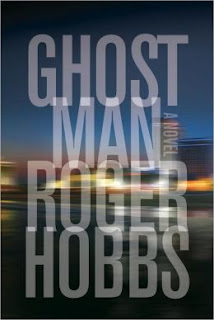
Roger Hobbs

From Sam Coggeshall's Portland Monthly Q & A with Roger Hobbs, author of Ghostman:

What was your inspiration for this novel? Why crime fiction?

I got the idea for Ghostman the summer after my sophomore year at Reed. I was walking home late after a movie when I came across an armored car depot. It was a plain white unmarked building with rows and rows of armored cars parked out front. I sneaked up and touched a few, and my mind started whirling—what do you think I would need to rob one of these? That night I went home and wrote the first chapter of what would become Ghostman.

Portland is such a writers’ town. Does anything about the city contribute to your style of writing or your choice of subject material? The long winters or the rain, say?

The thing that I love most about Portland isn't the rain, but the darkness. Even when the sun comes out, it's never bright here. Nobody wears sunglasses. During the winter months, Portland is submerged in a perpetual twilight—and that's a fantastic atmosphere for a crime writer like me. I like to work at night to avoid distractions, and Portland's quiet, dark, industrial silence definitely helps me set the mood. I love listening to the...[read on]
Visit Roger Hobbs's website.

--Marshal Zeringue

Tuesday, February 19, 2013

Melanie Benjamin

Melanie Benjamin is the author of Alice I Have Been (2010), The Autobiography of Mrs. Tom Thumb (2011), and the newly released The Aviator's Wife.

From her Q & A with Molly Driscoll at the Christian Science Monitor:

Q: What about historical figures makes you want to focus a novel around them?

A: Now that I've got three under my belt, I can sense a pattern. The first one, "Alice I Have Been," was just kind of blindly stumbling across what I thought was an interesting story. But I think I am looking for women who were well-known in their time, or for a short period of time, and have kind of fallen off the public's collective consciousness.

And I also am looking for women who I suspect are not entirely truthful with the historical record or even to themselves – not intentionally, maybe. I think I'm attracted to those stories where I suspect there are a lot of locked doors and hidden closets that we haven't explored.

Q: What have readers or people you know been most surprised by about Anne [Morrow Lindbergh, wife of aviator Charles Lindbergh, and the protagonist of The Aviator's Wife]?

A: I think a lot of people were surprised primarily to hear of her aviation exploits. During the height of their fame in the early '30s, they were Lindy and Anne together, one breath, and she was certainly admired for her aviation and her exploits at that time. Though I think even at the time, everyone assumed it was Lindy doing everything and Anne was tagging along. Certainly female reporters would not ask her about her skills as a pilot, they would ask her how she was going to set up housekeeping in the plane.

I think that what happened was the kidnapping [of the Lindbergh's baby] so...[read on]
Learn more about the book and author at Melanie Benjamin's website.

The Page 69 Test: Alice I Have Been.

The Page 69 Test: The Autobiography of Mrs. Tom Thumb.

My Book, The Movie: The Autobiography of Mrs. Tom Thumb.

Writers Read: Melanie Benjamin (August 2011).

The Page 69 Test: The Aviator's Wife.

Writers Read: Melanie Benjamin.

--Marshal Zeringue