Sunday, June 30, 2013

Lori Nelson Spielman

Lori Nelson Spielman's new, debut novel is The Life List.

From her Q & A with Caroline Leavitt:

CL: I read that the idea for your novel came from a life list you’d written at age 14. Can you tell us some of the things on your life list?

LNS: I wish I could say my list was comprised of noble pursuits and daring adventures. Truth is, most of my wishes were humble and conventional, like having babies and going to college and getting married. Like my protagonist, I wanted a horse and a dog (neither of which I have). And some goals were embarrassingly shallow, like Have lots of clothes. Apparently a nice wardrobe is key to a happy life. Who knew?

CL: Most people think of a bucket list when they see your title. Is there a difference between a life list and a bucket list?

LNS: I think of a life list as a blueprint for crafting your life. The goals are broader, farther-reaching and longer-term than those on a bucket list. In the book, Brett’s life list included things like having children and maintaining old friendships. A bucket list, on the other hand, is a list of one-time items that can be checked off in an instant, like a visit to the Grand Canyon or skydiving. But this is just my take on it. People seem to use the phrases interchangeably. And I recently heard about a third type of list, a list of...[read on]
Visit Lori Nelson Spielman's website.

--Marshal Zeringue

Saturday, June 29, 2013

Rebecca Lee

Rebecca Lee's new book is Bobcat and Other Stories.

From her Q & A with Matthew McAlister for Publishers Weekly:

Many of these stories focus on the ways we settle our lives into the expectations of others. What is it about settling that interests you?

I love that question. I love even the word “settle.” I used the word “settlers” as the title for the last story in my collection because the word connotes something so obviously trail-blazing and intrepid, as in the early settlers, but then it also implies something that we all desperately want to avoid—settling, compromising. There’s just a lot of life and philosophy bound up in that word. I’ve been rereading Henrik Ibsen lately—"A Doll’s House"—and I’ve been very taken with his idea that we are all acting out the parts assigned for us, often by the people who surround and love us—we’re all dolls in a doll’s house. That’s such a striking idea for me, and I think fiction in general likes to think about the interrelationships between people, the ways others might provide a sort of net for the identity but can also of course threaten it.

A few of these stories focus on characters in college, which is a transformative time, both intellectually and emotionally, but what else is it about the experience that you find ripe for narrative?

I love college campuses. In a way I grew up on one, as my dad was a chemistry professor, and I’ve spent the last 16 years at a state university in North Carolina. I find it interesting to be in the midst of ideas all the time, and there are arguments and discussions every day. Also, as in any business, there’s just a lot of things I find funny. Committees are funny, and we have a committee for everything. We have a committee called the “Adverse Weather Committee” and every time I hear that I laugh. We also, actually, have a committee to figure out how to have less committees. We....[read on]
--Marshal Zeringue

Friday, June 28, 2013

Lisa-ann Gershwin

From a Q & A at The Daily Beast with Lisa-ann Gershwin, author of Stung!:

What's your big idea?

Jellyfish, of all strange things, are turning out to be the unexpected and unwanted consequences of human impacts on our oceans. Jellyfish form large populations (called blooms) as a normal part of their life cycle, but our actions in the name of progress are giving them the perfect conditions to do more of it than probably ever before.

Who would have thought that the lowly jellyfish could cause so many problems, materializing almost completely out of left field as a major contender in changing ecosystems? Almost all of the things we are doing to intentionally or accidentally manipulate our ocean either directly favor jellyfish or put so much stress on other species that jellyfish are often the last man standing.

Fishing takes out the predators and competitors of jellies. Warmer water stimulates them to grow faster and breed more. Coastal construction gives them more places for their polyp stages to colonize. Reduced coastal oxygen gives them the competitive advantage compared to heavy breathers like fish and crustaceans. Pollution hurts fish and other species, but rarely affects jellyfish. And ships’ ballast water gives them a free ride to anywhere they haven’t been before.

While most people are aware of our impacts on the ocean—and indeed, on nature in general—most of us still see conservation as a moral issue or a conscience issue. “If I could afford to be more conscientious, I would be,” we might say. “But frankly, we were put on this earth to have dominion over nature, and it’s not my fault for being born human.” But the truth is...[read on]
Learn more about Stung! at the University of Chicago Press website, the Stinger Advisor webpage, and the Stung! Facebook page.

The Page 99 Test: Stung!.

--Marshal Zeringue

Thursday, June 27, 2013

Ted Kosmatka

Ted Kosmatka is the author of the novels The Games and the recently released Prophet of Bones.

From Kosmatka's Q & A with Dave Truesdale for The SF Site:

Paul Carlsson [the protagonist in Prophet of Bones] is using science as a benign tool to reveal Truth. On the other hand, there is the wealthy but brilliant scientist Martial Johansson who figures darkly in the story in several ways I don't want to reveal here -- in too much detail, at least. But through Martial you pose another ages-old question, that being: How do ethics and morality define how far science should go? Martial's experiments deal with attempts to interbreed humans with apes via genetic manipulation. Some of these attempts turn out horrifically, creating sentient monsters. In the creationist worldview of the novel, Martial would pose just as big a threat as Paul, wouldn't he, if he showed that God had created something so close to a human that, with a bit of tinkering, they could interbreed? Do Martial Johansson's "Dr. Moreau-ish" experiments justify his claim that science has a right to go where it will for the ultimate advancement of mankind, and why is Johansson one of those trying to thwart Paul's revelation about the bones of Flores, when one might think, at least superficially and if for no other reason, they would take the heat off of himself and his clandestine scientific laboratory complex? Why did you decide, when plotting the book, to add a character like Johansson; what role did you envision him playing and why?

Martial does pose his own substantial threat to the status quo, and his experiments have made things very complicated and dangerous for the political interests that fund him. But to some extent, he's the devil you know. Part of the reason he still has so much power is because it would be so difficult to get rid of him. What do you do with a mad dog on a leash? You can't let him off the leash, but you sure don't want him close to you. Martial is deeply ensconced in the socio-political intrigues, so there is no easy solution to the problem he presents. Paul, however, is much more easily dealt with.

The whole situation is balanced on a knife edge, and these new fossils could be just the push that will take things past the tipping point. Martial's motivation for going after Paul lies in his own desire to maintain his safe little bubble of autonomy. By silencing Paul, Martial keeps his political benefactors happy, and by keeping them happy he's able to ensure they turn a blind eye on the questionable experiments he's been running. In a lot of ways, Martial is meant to be a counterpoint to Paul. They are opposites, and yet they are searching for an answer to the same question: how do you decide what...[read on]
Learn more about the book and author at Ted Kosmatka's website.

Writers Read: Ted Kosmatka (March 2012).

The Page 69 Test: The Games.

My Book, the Movie: The Games.

My Book, the Movie: Prophet of Bones.

Writers Read: Ted Kosmatka (April 2013).

The Page 69 Test: Prophet of Bones.

--Marshal Zeringue

Wednesday, June 26, 2013

Jennifer Zobair

Jennifer Zobair grew up in Iowa and attended Smith College and Georgetown Law School. She has practiced corporate and immigration law and as a convert to Islam, has been a strong advocate for Muslim women's rights. Zobair lives with her husband and three children outside of Boston, Massachusetts.

Her new novel is Painted Hands.

From the author's Q & A at Drey's Library:

drey: Tell us about Painted Hands.

ZA: Painted Hands is a novel about smart, successful, career-oriented Muslim women in Boston, and the difficult choices they face when relationships with unlikely men shatter their friendship, and the current political climate threatens their careers.

I knew I wanted to write about the kind of Muslim women I know personally but who are not often portrayed in the media. The actual idea for the novel came from this image I had of a Muslim feminist and a right-wing politico finding themselves attracted to one another despite their philosophical differences. I was curious if they could find love, and I wanted to explore it.

drey: What do you hope your readers walk away with after reading Painted Hands?

ZA: First and foremost, I hope they enjoy it, that it’s a good story. But I also hope it...[read on]
Learn more about the book and author at Jennifer Zobair's website, Facebook page, and Twitter perch.

The Page 69 Test: Painted Hands.

My Book, The Movie: Painted Hands.

Writers Read: Jennifer Zobair.

--Marshal Zeringue

Tuesday, June 25, 2013

Alafair Burke

Alafair Burke's novels include “two power house series” (Sun-Sentinel) that have earned her a reputation for creating strong, believable, and eminently likable female characters, such as NYPD Detective Ellie Hatcher and Portland Deputy District Attorney Samantha Kincaid.

Burke's new novel If You Were Here features former prosecutor turned journalist McKenna Jordan.

From the author's Q & A with Cat Acree for BookPage:

What do you think readers will most like about McKenna Jordan? How is she different from your past heroines?

Is it fair to say that a character will be liked for becoming more likable? Most of my past books feature series characters who evolve slowly. They grow, like most of us, in increments and with subtlety. McKenna, in contrast, endures more trauma and drama than most people experience in a lifetime, which allows her to make enormous discoveries about herself in one little book. She's also incredibly tenacious, for better or for worse. I think knowledgable crime fiction readers might also recognize that I've borrowed some familiar tropes of the genre and turned them upside down (or at least I hope so).

How has your law career most influenced your career as a writer?

I've been teaching criminal law for 12 years and, before that, was absolutely blessed to work as a prosecutor for five years. As luck would have it, I happened to work for a prosecutor who believed in taking lawyers out of the courtroom into the community, so I spent about half that time working out of a police precinct. Without that window of time, I wouldn't be the same kind of writer. Criminal investigations don't look...[read on]
Learn more about the book and author at Alafair Burke's website and blog.

The Page 69 Test: If You Were Here.

--Marshal Zeringue

Monday, June 24, 2013

Cheryl Strayed

Cheryl Strayed is the author of the critically acclaimed novel Torch and the memoir, Wild: From Lost to Found on the Pacific Crest Trail.

From Strayed's Q & A with Marjorie Kehe at the Christian Science Monitor:

What was the best gift the trail gave you?

The greatest gift was a sense of my own resilience. By that I mean something deeper than what confidence is. When we feel confident I think that a lot of times we think that that means that we’re going to be able to succeed at something and dominate something and master something. You know, it’s all those kind of winning and on-top things. The kind of confidence that I got on the PCT was more like, "Whatever it is that happens I’ll be OK." To carry everything that I needed on my back ... to say “Here’s what I actually need to survive” and it’s stuff that I can carry on my back. That’s really powerful. And to do it while carrying it over this difficult terrain and in difficult weather. It just gave me this sense of my own strength and resilience.

What was your worst moment?

There were times all along the way when the physical circumstances would meet the negative thought patterns. I would just get so angry at myself. I would say why do I have to be out here? You know, think of all the other things a 26-year-old woman could be doing right now. And I’m just out there in the wilderness and so when it would be really searingly hot and my feet would be absolutely killing me I would be hungry and just thinking about all the things I did not have. I would get into one of those negative thought patterns and that was so hard. I just wanted...[read on]
Author Pam Houston on Wild: "I read it on a long airplane flight, and by the time I was done the people all around me were seriously afraid of me. I was laughing so hard I was shaking the whole row of seats, and when I wasn’t laughing I was crying."

--Marshal Zeringue

Sunday, June 23, 2013

Steven Pinker

Steven Pinker's 2011 book is The Better Angels of Our Nature: Why Violence Has Declined.

From his Q & A with Clint Witchalls at the Independent:

Clint Witchalls: You say that, over the centuries, violence has been declining, yet most people would view the last century, with its pogroms, death camps and nuclear bombs, as the most violent century. Why was it not?

Steven Pinker: You can't say that a particular century was the most violent one in history unless you compare it with other centuries.

The supposedly peaceful 19th century had one of the most destructive conflicts in European history (the Napoleonic Wars, with 4 million deaths), the most destructive civil war in history (the Taiping Rebellion in China, with 20 million), the most destructive war in American history (the Civil War, with 650,000), the conquests of Shaka Zulu in southern Africa (1-2 million), the most proportionally destructive interstate war in history (the war of the Triple Alliance in Paraguay, which killed perhaps 60 per cent of the population), slave-raiding wars in Africa (part of a slave trade that killed 37 million people), and imperial and colonial wars in Africa, Asia and the Americas whose death tolls are impossible to estimate. Also, while the Second World War was the most destructive event in human history if you count the absolute number of deaths, if instead you count the proportion of the world's population that was killed, it only comes in at ninth place among history's worst atrocities.

I think few people would disagree that the medieval times were tortuous and bloody, yet most imagine primitive tribes living in Edenic bliss. But you claim that these tribes are far from the noble savages portrayed by Rousseau. How homicidal were they?

Steven Pinker: Tribal groups show a lot of variation, but on average around 15 per cent of people in nonstate societies die from violence. This is the average I got from signs of violent trauma in skeletons from 21 prehistoric archaeological sites, and from eight vital statistics from eight hunter-gatherer tribes.

Hunter-horticulturalists and other tribal people have...[read on]
See Steven Pinker's list of five books on the decline of violence.

The Better Angels of Our Nature is one of Fareed Zakaria's six favorite books.

--Marshal Zeringue

Saturday, June 22, 2013

Ru Freeman

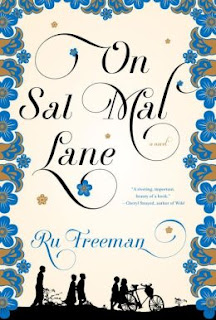
Ru Freeman's new novel is On Sal Mal Lane.

From her Q & A with Tania James at Fiction Writers Review:

Tania James: I suspect your family was a literary one. Was writing encouraged by your parents? What books were you drawn to in your youth?

Ru Freeman: I grew up with the idea that words—read, written, uttered aloud—were important. They were the meat, muscles, bones of persuasion. Everything revolved around how well we could handle words. My mother taught English literature and Greek and Roman classics (history and literature in translation), and my father—a civil servant—also wrote poetry. My older brothers and I, therefore, took to language and writing the way the children of mountain homesteaders take to running about in tall grass without fear of ticks and rattlesnakes.

As a child I read whatever I could find. We weren’t wealthy enough (in financial terms, anyway) to buy new books easily, so most of what I read was borrowed or gifted to us through, oddly enough, an American initiative (the Asia Foundation), or bought for a song from a Soviet initiative (The People’s Publishing House). There’s more on my childhood and books here in the Fall/Winter 2010 issue of Pebble Lake Review.

Did you dabble in music as well, like Suren, the eldest child of the Herath family?

Yes, I played the piano—as did my brothers. They also played the violin and my oldest brother—much like Suren—was a gifted musician who could play any instrument he picked up. For me it was mostly the piano, a little guitar (that my oldest brother taught me), and....[read on]
Visit Ru Freeman's website and blog.

Writers Read: Ru Freeman (August 2009).

--Marshal Zeringue

Friday, June 21, 2013

Nan Marino

Nan Marino is the author of Neil Armstrong Is My Uncle & Other Lies Muscle Man McGinty Told Me, which received a SCBWI Golden Kite Honor and was featured on the Bank Street Best Books and the New York Public Library 100 Titles for Reading and Sharing.

Her latest book is Hiding Out at the Pancake Palace.

From Marino's Q & A with Brittney Breakey at Author Turf:

How did you choose the genre you write in?

I’m not sure I write in any one genre. My first book was historical fiction. [Hiding Out at the Pancake Palace] is contemporary with a fantasy element. No matter what I write, my audience is always middle graders. I never intentionally set out to write children’s books, but every main character I think of happens to be between the ages of ten and fourteen. When I was in library school, I came across a table filled with children’s books. I picked up the book, Sarah Plain and Tall by Patricia MacLachlan and that hooked me forever on middle grade literature.

* * *

Is any material in your books based on real life experiences or purely imagination?

My first book Neil Armstrong is My Uncle and Other Lies Muscle Man McGinty Told Me took place in the town where I grew up. There were things in that book that I took straight from my childhood–a neighbor who sings, the family who had extravagant parties, the feeling of closeness in a neighborhood. My...[read on]
Learn more about the book and author at Nan Marino's website and blog.

See--Coffee with a Canine: Nan Marino & Tai Chi Marino.

My Book, The Movie: Neil Armstrong Is My Uncle & Other Lies Muscle Man McGinty Told Me.

--Marshal Zeringue