Friday, October 30, 2015

Jay Atkinson

Jay Atkinson, called “the bard of New England toughness” by Men’s Health magazine, is the author of eight books. Caveman Politics was a Barnes & Noble Discover Great New Writers Program selection and a finalist for the Discover Great New Writers Award; Ice Time was a Publishers Weekly Notable Book of the Year and a New England Bookseller’s Association bestseller; and Legends of Winter Hill spent seven weeks on the Boston Globe hardcover bestseller list. He has written for the New York Times, Boston Globe, Newsday, Portland Oregonian, Men’s Health, Boston Sunday Herald, and Boston Globe magazine, among other publications. Atkinson teaches writing at Boston University and has been nominated for the Pushcart Prize three times. He grew up hearing Hannah Duston's story in his hometown of Methuen, Massachusetts, which was part of Haverhill until 1726. He lives in Methuen, Massachusetts.

Atkinson's new book, Massacre on the Merrimack: Hannah Duston's Captivity and Revenge in Colonial America, focuses on a series of events in late 17th century New England between English settlers and members of the Abenaki tribe.

From the author's Q & A with Deborah Kalb:

Q: The book includes so many details of Hannah Duston’s story. How did you recreate them?

A: The book’s research took about two years and six months, and the research had a bifurcated way that it developed. The first 18 months, all my research was indoors, reading all the accounts written about her, some contemporaneous with her actions—those were pretty short.

And because I’m from the same area, I was able to go to the special collections room in Haverhill where she lived. They had old deeds, and ephemera relating to the Duston family. For the first year, I tried to get my head around Abenaki warrior tactics, the English colonial government’s agrarian society taking over the wilderness.

And then there was her story—a homesteading wife with [many] children, a 39-year-old woman who had delivered a baby a week earlier, before the Indians attacked. I had all these facts, and I had stick figures performing these actions, and I had ...[read on]
Visit Jay Atkinson's website.

My Book, The Movie: Massacre on the Merrimack.

Writers Read: Jay Atkinson.

The Page 99 Test: Massacre on the Merrimack.

--Marshal Zeringue

Thursday, October 29, 2015

Carrie Brownstein

Carrie Brownstein co-founded the band Sleater-Kinney and is the co-creator and co-star of the IFC TV comedy series Portlandia. Her new memoir is Hunger Makes Me A Modern Girl.

From Brownstein's Fresh Air interview with Terry Gross:

GROSS: You didn't know it at the time, but your father was gay. He didn't come out until he was 55, and you were probably in your 20s by then. Do you think he knew at the time, when you were in your teens and living at home with your parents? You think he knew he was gay?

BROWNSTEIN: Wow, that - that's sort of the million dollar question in our family. I think deep down he did. I think he would say that now. He does sort of say that now. But it was very buried. It was subconscious and unconscious. He really did not know. I think he and I and anyone in our family can look back and see signs or see hints, but only in retrospect. At the time, no, I would have to just say no.

GROSS: When he came out at the age of 55, you say you were thankful that he was happy. And you say now there's someone to know. Did you feel like there was no one present when you were growing up, that your father was - that he didn't know who he was, therefore you didn't know who he was?

BROWNSTEIN: Definitely. My dad, as I describe in the book, he was sort of this series of signifiers - a generic office building in the suburbs, a three-piece suit, a soccer coach, a clean-cut, you know, haircut and clean-shaven. And he interacted with my sister and I through activities and much less so with emotions. And he really only ever had one story from his childhood. There was just this blankness that was very difficult to penetrate. I always felt very close to him but just almost this sort of - by default. And I really just didn't know him. I think none of us did. So, yeah, when he came out, it was like...[read on]
--Marshal Zeringue

Wednesday, October 28, 2015

Nicholas Stargardt

Nicholas Stargardt is Professor of Modern European History at Magdalen College, Oxford. His new book is The German War: A Nation Under Arms, 1939-1945.

From his Q & A with Deborah Kalb:

Q: Why did you decide to write this book, and how does your analysis differ from that of some other historians?

A: There hasn’t been a history of German society in the Second World War. There are whole libraries on military strategy, the Nazi leadership and the Holocaust, but we simply have not known what the German people thought they were fighting for. And this was a war the regime could not have fought without mobilizing everyone.

So, this book does something quite different from what historians have explored till now. I wanted to know what people experienced but also how completely the war overturned and transformed their lives and perspectives.

Individual voices have a special place here, because one of the key questions which interested me was...[read on]
--Marshal Zeringue

Tuesday, October 27, 2015

Steve Knopper

Steve Knopper is a Rolling Stone contributing editor and author of MJ: The Genius of Michael Jackson (2015).

From his Q & A with John Wenzel for The Denver Post:

Q: Why Michael Jackson? Why now?

A: A few reasons: One, it’s a book I could sell. I wrote this book about the music business and I was super happy with it and it got a lot of press. But in the end, it was a pretty limited audience (of) people who are interested in the music business. And so I wanted another book, but as I was pitching idea after idea it kept not going anywhere. Then Michael passes away…

Which was not too long ago, in the scheme of things.

June 25, 2009, which is burned in my brain. But immediately after that I pitched my previous agent, and it just all kind of crystallized.

A lot of people might assume there’s not much new information, given the dozens of books already out there about him.

There are, but there hasn’t really been a book that’s credible. Not a salacious tell-all, but a narrative, music-business book. I kind of pitched it as the Peter Guralnick version of Michael Jackson’s story. He’s the guy that did the Elvis Presley biographies (“Last Train to Memphis”), and those books are great because there’s a lot of dirt in there, a lot of sexy stuff. But in addition to that, it’s high-level criticism and analysis, and you don’t come away from that going, “Wow, Peter Guralnick is really a cheap celebrity biographer.” That’s what I aspired to. My agent liked the idea but at the time he said, “Can you finish it in six months?” and almost immediately after Michael’s death. And I said, “No, I really think it needs a lot more depth than that. I don’t think we should rush-release something into the market just because he died.” His death reminded me and so many other people how much we loved him and his music and I really wanted to...[read on
Visit Steve Knopper's website.

Writers Read: Steve Knopper.

--Marshal Zeringue

Monday, October 26, 2015

David O. Stewart

David O. Stewart is the author of several works of history, including Madison’s Gift: Five Partnerships That Built America, which have been awarded the Washington Writing Award and the Society of the Cincinnati History Prize.

His latest new novel is The Wilson Deception.

From Stewart's Q & A with Deborah Kalb:

Q: What are some of the most common perceptions and misperceptions about Woodrow Wilson?

A: Wilson was a highly idealistic and moralistic person, the son of a Presbyterian preacher who loved to sing hymns. Surviving photographs tend to emphasize the grim, somewhat constipated side of his character.

But he also was a vigorous fellow who liked women a lot and relished telling bad jokes and reciting limericks. I tried to convey a more complex picture of him.

Q: When you mix historical figures and fictional creations, how much do you stick to the actual facts?

A: The basic events of history, the basic traits of historical figures – I respect all of those. In The Wilson Deception, the sequence of the peace negotiations provides the timeframe for the story and I follow it very closely.

The assassination attempt on French Premier Georges Clemenceau, the death of British diplomat Mark Sykes (architect of the Sykes-Picot agreement carving up the Middle East), and President Wilson’s health crises are...[read on]
Learn more about the book and author at David O. Stewart's website and blog.

My Book, The Movie: The Wilson Deception.

Writers Read: David O. Stewart.

The Page 69 Test: The Wilson Deception.

--Marshal Zeringue

Sunday, October 25, 2015

Diane Roberts

Diane Roberts is an English professor and a football fan at Florida State. Her new book is Tribal: College Football and the Secret Heart of America.

From her Q & A with Steve Almond at Salon:

Early on in “Tribal” you talk about how fandom “takes the edge off this painful self-examination, offering a kind of energetic clarity.” But the book complicates the experience of fandom, by suggesting all the toxic attitudes and outcomes football fosters. Does the game still provide you with that clarity?

I can still disappear into the hold-your-breath moment of the game. I holler. I cheer. I sing. I clap. If I’m home watching on television, I coach. I’m really good at calling plays when nobody can hear me. It’s so comfortable and fine to belong, to be part of the tribe, to know that the people around you in the stadium — people who don’t see the world as you do, who might hate your politics — will share the general triumph when your guys score. For a moment, you’re all one family.

It’s why people join churches, political parties, sororities, fraternities, gangs, book clubs. Most of us live tangled in paradox. Loving a college football team is simple and comforting — even when that team loses. When I’m praying that FSU’s quarterback can actually get the ball to that open receiver, I forget all about climate change, Syria and the NRA. When the ball lands in the boy’s waiting hands, the world falls away. Joy takes over.

As a devout fan for many years, I get it. But can I just ask why you decided to open this particular can of worms?

Because it’s my can of worms. I’m trying to figure out how and why this absurd (and gorgeous and thrilling and destructive) game has such a hold on me and other people. I’m particularly interested in the way we often love things that aren’t good for us: chocolate, booze, narcissists, football.

I’m also a product of my culture — a culture I...[read on]
--Marshal Zeringue

Saturday, October 24, 2015

Robert C. Holub

Robert C. Holub's latest book is Nietzsche’s Jewish Problem: Between Anti-Semitism and Anti-Judaism.

From his Q & A at the Princeton University Press website:

Should Nietzsche be regarded as a forerunner of National Socialism and its racist ideology?

There are strong arguments against considering Nietzsche as a precursor of National Socialism. Perhaps the two ideological pillars of Nazism were ardent nationalism and virulent anti-Semitism, and Nietzsche evidences neither of them. He was nationalistic and Judeophobic during his Wagnerian period, but he never embraced these tenets passionately and without reservation. On the other hand, Nietzsche did admire strong and dictatorial leaders, such as Napoleon; he detested democracy, parliamentary rule, and equal rights. And he flirted with eugenics in his later years, although it was never a racially based eugenics. So arguments can be made for and against this proposition. Of course Nietzsche was established as a precursor of National Socialism by Nazi philosophers and ideologues, but we should remember that some party members found it difficult to integrate him into their outlook. We should also recall that Nietzsche in his own time was vehemently opposed to any collective undertaking, whether it was on the right or the left of the political spectrum. It is difficult to know how he would have reacted to the rise of fascism in Germany several decades after his death. One of the main points of my book is that speculation of this sort is...[read on]
--Marshal Zeringue

Friday, October 23, 2015

Emily Holleman

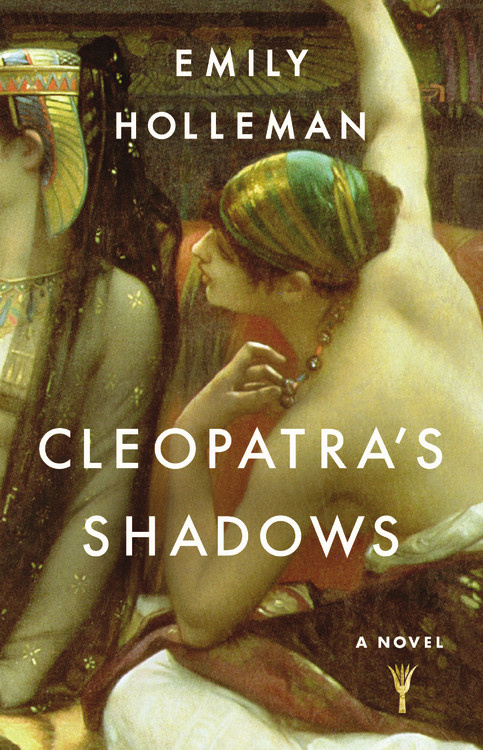
Emily Holleman is a Brooklyn-based writer. After a two-year editing stint at Salon.com where she had to worry a lot about politics, celebrities and memes, she returned to her true passion: fiction. She's currently working on a set of historical novels that reimagines the saga of Cleopatra from the perspective of her younger sister, Arsinoe. The first of these, Cleopatra's Shadows, is currently available from Little, Brown.

From the author's Q & A with Alexandra Schwartz at Salon:

Tell me how you got interested in this: Were you interested in trying to find a different way of approaching Cleopatra or did you start at a point of interest with her sisters?

I started at a point of interest with her sisters. I was reading Stacey Schiff’s book about Cleopatra right before going to Egypt with my family. Toward the beginning, there’s this mention of Arsinoe, and Stacey Schiff describes her literally in a footnote, something like, “Very little is known about Arsinoe’s motivations but that hasn’t stopped even the most illustrious historians from trying to figure them out,” and then quotes something from [a] French guy who’s like, “If Arsinoe hadn’t been jealous of Cleopatra, she wouldn’t have been a woman, let alone a Ptolemy.” [A] very pre-World War II French historian thing to say about her motives.

That really caught my eye: this idea that all women must be by default jealous of any sort of sexual successes [of their peers]. He, of course, was talking about Cleopatra’s relationship with Caesar, which is much later than what we cover in this book. That was what really intrigued me: the idea of taking this woman whom we see always from the perspective of her lovers, from the perspective of Rome, and flipping that on its head and looking at it through the eyes of her sisters whom we now have completely...[read on]
Visit Emily Holleman's website.

Writers Read: Emily Holleman.

The Page 69 Test: Cleopatra's Shadows.

--Marshal Zeringue

Thursday, October 22, 2015

Joseph S. Wilson & Olivia Messinger Carol

Joseph S. Wilson and Olivia Messinger Carol are co-authors of comprehensive new bee guide, The Bees in Your Backyard: A Guide to North America’s Bees. From their Q & A at the Princeton University Press blog:

In the introduction to your book, you discuss the many misconceptions surrounding bees–what ‘myth’ do you find yourself most often dispelling?

OC & JW: It used to be that every time we told folks what it is that we studied, they would try to find common ground with us by relating a story about that one time that they had been stung by a bee (the truth is, only female bees are even capable of stinging, and they are not very aggressive. In all the many years of collecting bees and handling them–sometimes hundreds in a day, we’ve been stung less than two dozen times). Anymore, though, people skip telling us about being stung and ask: “So how bad off are the bees?”

How bad is the bee decline, really?

OC: The truth is that 1) we don’t really know because 2) its complicated. Its complicated because there are so many species of bees. If one kind is in decline, we really can’t assume that all 30,000 kinds around the world are. Or because some are in decline in the eastern United States doesn’t mean that western populations of that same species are too. We can guess that many of the landscape alterations we’ve made in the U.S. are not beneficial (replacing midwestern prairies with monocultures of corn and soy, fragmenting desert areas with parking lots and strip malls, perhaps even our unchecked use of insecticides), but the actual impact is largely unknown. Systematic bee surveys were seldom conducted 100 years ago, so we don’t have solid baseline data against which to compare current population levels. And at least some bee species seem to naturally vary 10 to 100-fold from year to year based in part on floral bloom and weather.

We do know for certain that for several years honey bee populations appeared to be dropping dramatically and the reasons for that are...[read on]
--Marshal Zeringue

Wednesday, October 21, 2015

Amy Ellis Nutt

Amy Ellis Nutt is the author of Becoming Nicole: The Transformation of an American Family. From her Q & A with David Ebershoff:

David Ebershoff: What first drew you to the story of Nicole Maines and her family? Tell me about the first time you met them?

Amy Ellis Nutt: There were several aspects to the story and the Maines family that hooked me right away. First of all, Nicole and her brother Jonas were still young teenagers and, in many ways, the family’s journey was still unfolding. As a journalist, that was exciting. Because the science of gender identity is still being learned, I also felt that Nicole and Jonas being identical twins gave me a perfect opportunity to explore the importance of this intermediate territory between nature and nurture called epigenetics: how our environment (even the environment of the womb), contributes to who we are, even when our DNA is identical, as it is in the case of Nicole and Jonas. What cinched the deal for me was meeting the family for the first time. They were all warm and generous, funny, honest, and articulate, and they welcomed me into their home. On her laptop, Nicole showed me videos she was making for school, Jonas told me about writing songs on the guitar. They were clearly creative kids, with their own personalities, but with an obvious love for each other as well as their parents.

This is Nicole’s story, of course, but it’s also her family’s story. I think of it as the biography of a family. What was it like to write a book with four central characters? How did you research their lives?

It’s true, Becoming Nicole is about a family, about four people, not just one, and I felt that this kind of story had not yet really been told. I think Wayne and Kelly were also keenly aware of this, and the importance for the wider world in sharing the lessons of their lives in raising a transgender child and her identical twin brother. At the same time, they were—are—extremely...[read on]
Visit Amy Ellis Nutt's website.

The Page 99 Test: Shadows Bright as Glass.

Writers Read: Amy Ellis Nutt (April 2011).

--Marshal Zeringue