Monday, November 9, 2020

Bennett R. Coles

Bennett R. Coles served as an officer in the Royal Canadian Navy for fifteen years, where he saw many adventures and also had many boring times to think about writing. As his career shifted to one of international business development he continued to explore all corners of the Earth, but now had thirteen-hour flights across the Pacific where he could churn out chapter after chapter of military space adventures. He is a recipient of the Cygnus Award for military science fiction and the Cygnus Grand Prize for science fiction. He attends SF cons across North America whenever he can, but is far more likely to be spotted at cons closer to his home in Victoria, Canada.

Coles's new novel is Dark Star Rising.

My Q&A with the author:

How surprised would your teenage reader self be by your novel?

I’ve been a science fiction fan since, like, forever and I never really grew out of my childhood fascination with dinosaurs. By high school I’d realized that sailing ships were pretty cool and I’d mostly made up my mind that I was going to join the Navy.

So if you said, “Hey, Teenage Ben, in 2020 you’re going to publish a novel with a swashbuckling star frigate hunting down space pirates… with dinosaurs,” Teenage Ben would probably nod thoughtfully and say, “Yeah, that sounds like me.”

Do you find it harder to write beginnings or endings? Which do you change more?

Interesting question. With Dark Star Rising I knew the ending before anything else and it never really changed (except for the ongoing debate of exactly how I was going to get my heroes to actually swing on a rope in space… spoiler alert: they don’t). The beginning of the book took quite a few tries, though, as I had to walk back from my ending and figure out exactly what the moment was that started my heroes on their inevitable path to the climax.

It’s interesting because this is my sixth published novel but it’s the only one where I knew the ending first. With all the others, it was the beginning that came naturally and the ending which I had to labor over. Literary growth?

What non-literary inspirations have influenced your writing?

I was four years old when Star Wars launched and it forever shaped my literary worldview. Basically, my mind works like this: “that’s pretty cool, but it’d be even cooler if it was in space!” It’s why I write science fiction. My career as a Navy officer also had a big impact on my writing. I like stories of well-disciplined, hard-working teams who struggle together against powerful (and sometimes anonymous) foes, where loyalty is a strength and competence (not luck or brash, self-centered “heroism”) carries the day.

What's in a name?

I’m glad you asked, because I actually put a fair bit of thought into the naming conventions in the Blackwood and Virtue series. My intent was to make the names as culturally neutral as possible, while still using real names. I didn’t want to invent all new names – to me that just creates an obstacle for the reader. Instead I wanted to use familiar names to make it easy to grasp each character while avoiding any obvious connection to our contemporary culture. But I used two different approaches for surnames and given names

These stories are based in a far-off galactic cluster with no connection to Earth as we know it, so I wanted to completely avoid surnames that carry any cultural background (like
MacBeth, Hernandez, Wu, Sakiyama, Mehta, al-Assad, etc.). Instead, I developed two simple rules for all my characters’ surnames:
  1.  if the character is a commoner, their surname is a simple trade or concept (like Butcher or Swift);
  2.  if the character is a noble, their surname is a description of a place or a symbol (like Highcastle or Silverhawk).
My editor initially commented that my names all sounded very English, so was I not just assigning a single nationality to everyone? No. The names are simply descriptions, and they only sound English because we’re reading them in English.

For example, our hero Liam Blackwood would be Liam Boisnoir in French or Liam Schwarzwälder in German. His loyal enforcer Harper Sky would be Harper Ciel in French or Harper Himmel in German. (I kinda like Harper Himmel – nice ring to it…)

For first names, I didn’t want to create any barriers between the reader and the characters, so I chose a different tack. I went to the 100 Top Names for Baby lists and chose my favorites. I figured this way all the characters would have names that most readers would be so familiar with that no-one would trip over them. Liam, Amelia, Mason, Sophia… As a reader you can just grab these names and run with them, focusing your attention on the characters rather than puzzling over where their names came from or how to pronounce them.
Visit Bennett R. Coles's website.

The Page 69 Test: Dark Star Rising.

My Book, The Movie: Dark Star Rising.

--Marshal Zeringue

Saturday, November 7, 2020

Kristin Bair

Kristin Bair is the author of the novel Agatha Arch Is Afraid of Everything. Under the name Kristin Bair O’Keeffe, she has published two novels, The Art of Floating and Thirsty, as well as numerous essays about China, bears, adoption, off-the-plot expats, and more. Her work has appeared in The Gettysburg ReviewThe Baltimore ReviewThe Manifest-StationFlying: Journal of Writing and EnvironmentThe Christian Science MonitorPoets & Writers MagazineWriter’s Digest, and other publications. 

Bair has an MFA from Columbia College Chicago and a BA in English and journalism from Indiana University, Bloomington. 

My Q&A with the author:
How much work does your title do to take readers into the story?

The original title of this book was Agatha Arch’s Fothermucking Heart. Throughout the story, Agatha uses the made-up word “fothermucking” when she’s really mad or upset (instead of the alternative). I loved and still love the original, but my editorial team at Alcove Press was understandably worried that it might put off some readers. Not everyone appreciates a good potty-mouth like I do. After some back and forth, we agreed that Agatha Arch is Afraid of Everything was an equally powerful title. It introduces the reader to the fact that Agatha is on a journey and hints at the question, “Will she find her courage?”

What's in a name?

The name Agatha means good or honorable. Despite the fact that Agatha doesn’t seem to possess either of these qualities at the beginning of the story, I wanted her name to reflect the true Agatha—the one hidden behind all the fears. Arch, as a verb, is quite physical. You arch your eyebrows. You arch your back. As a noun, an arch is a structure that forms a passageway. Both definitions serve Agatha’s journey quite well.

How surprised would your teenage reader self be by your novel?

My tender teenage reader self would be so excited that I’ve stayed true to my quirky storytelling instincts and been published. (She’d also be like, “Oh, my god! So much sex! So many penises! You’re embarrassing me!”)

Do you find it harder to write beginnings or endings? Which do you change more?

I’m tortured by endings. I always write well beyond the natural stopping place in a story and have to be reined in by my agent or another early reader. The last 50 to 100 pages of first drafts always get chopped off.

What non-literary inspirations have influenced your writing?

Place is always a big one for me. Animals, too. In this book, I was particularly inspired by group dynamics. I’m fascinated by how group dynamics govern every damn thing in some communities (like Agatha Arch’s Facebook mom group): friendships, alliances, parenting strategies, car purchases, holiday projects, etc. Who is included and who is excluded changes by the day (sometimes the hour). It’s bewildering, but powerful. I tend to steer clear myself, but I study it all from a safe distance.
Visit Kristin Bair's website.

My Book, The Movie: Agatha Arch is Afraid of Everything.

--Marshal Zeringue

Thursday, November 5, 2020

Matthew Hart

Matthew Hart is a veteran writer and journalist, and author of seven books, including the award-winning Diamond. His work has appeared in The Atlantic Monthly, Granta, the London Times, and Vanity Fair, and he has appeared on 60 Minutes, CNN, and the National Geographic Channel. He lives in New York City.

Hart's first novel is The Russian Pink.

My Q&A with the author:

How much work does your title do to take readers into the story?

The title evokes a world both glamorous and dark, and in that way plunges the reader immediately into the matter of the book. The plot revolves around a colossally huge pink diamond. Pinks, as they’re called in the jewel trade, are among the most valuable objects on Earth, and this one is almost immeasurably valuable and rare. The reader witnesses the discovery of the diamond in the opening lines, and a few pages later, understand that Russians are involved. The action is set during a presidential election, so in that context the word “Russian” carries a special whiff of subterfuge and crime.

What's in a name?

Characters name themselves. That’s one of the truths I grasped quickly. You can’t just fasten any name you like onto a character. You find they just won’t live with it. They put their foot down! I learned to think very carefully before trying out a name. If it doesn’t work for the character, you’ll find out soon. It will sound absurd. You have to give him/her another and see how (s)he takes to it. Hercule might suit a dapper Belgian, but I don’t think it would sit too well on the shoulders of a forty-something American who grew up rough in his father’s diamond camps in Africa!

How surprised would your teenage reader self be by your new novel?

My teenage self loved every kind of chicanery. What teenager doesn’t? I devoured books with exotic settings. I remember especially Lawrence Durrell’s suite of four novels known as the Alexandria quartet, saturated with the outlandish and bohemian lives of young expatriates in the decadent world of the ancient Egyptian port city. So I think my teenage self would pat me on the back. He didn’t like the suburbs any better than I did. I just wish he’d get rid of that yellow V-neck and stop trying to look cool with that ridiculous cigarette holder.

Do you find it harder to write beginnings or endings? Which do you change more?

For me the opening is the easiest. That’s the part you can really make up by yourself. By the time you get to the end, the characters have developed enough to figure it out for themselves. You’re just there to write it down.

Do you see much of yourself in your characters? Do they have any connection to your personality, or are they a world apart?

There's nothing autobiographical in The Russian Pink, but for sure there’s a strong personal connection. I know the diamond world intimately from the years I traveled in it and wrote about it as a reporter. I made sure my hero, the Treasury agent Alex Turner, and his lover, the Russian diamond thief known as Slav Lily, were true diamond people, so that I could recapture, through them, that enchanting, duplicitous, dangerous and sparkling world. So it’s my own world that I’m writing about, and the act of writing fiction allows me to re-enter it. But the characters have their own lives to live!
The Page 69 Test: The Russian Pink.

--Marshal Zeringue

Tuesday, November 3, 2020

Sarah Tolmie

Sarah Tolmie is a poet, speculative fiction writer, finalist for the Crawford Award and professor of English at the University of Waterloo. Her books of poetry, Trio in 2015 and The Art of Dying in 2018, were shortlisted for the Pat Lowther Award and the Griffin Prize, respectively. Her fiction includes the novels The Little Animals (2019) and The Stone Boatmen (2014), the dual novella collection Two Travelers (2016), and the short fiction collection NoFood (2014). 

Tolmie's new novella is The Fourth Island.

My Q& A with the author:
How much work does your title do to take readers into the story?

If your book is set on an island — and explores what has been called “island knowledge” — you need the word island in the title. This book is set in the Aran islands, off the west coast of Ireland. There are three of them. This story imagines a fourth one: The Fourth Island. The title came to me early on. Various people suggested adding in “Aran” but I resisted. It seemed to me more evocative without it.

What's in a name?

Names are critical. They are critical in verisimilar or historical fiction (and there’s a lot of that in this book) and differently critical in fantastic fiction (and there’s a lot of that, too). In the first case you need plausibility and accuracy; in the second you need good sound. As a poet I am always fussy about how words and names sound. Names in this book are regional and historical and as such they do a lot of work differentiating cultures and periods. For example, much of the timeline of The Fourth Island runs through Inis Mor (a real Aran isle) and Inis Caillte (the lost island that I invented) in 1840 and the names there are Irish (Mairin, Aoife, Jim Conneely) where in an intersecting timeline set during Cromwell’s campaigns in the seventeenth century the significant names are English (Meg, Richard).

How surprised would your teenage reader self be by your new novel?

My teenage self would have liked this particular book. I would have loved to have written it at 18, though I could not have done so. A lot has come together over a decade of fiction writing for me and I think this novella finally achieves a kind of assuredness and repose that I associate with Ursula Le Guin, who has always been a touchstone.

Do you find it harder to write beginnings or endings? Which do you change more?

Endings. As a rule, endings. Certainly with this book, difficult to draw to a close. I had the text of the ending written into the first draft but transposed it several times. On the other hand, in my 2019 novel The Little Animals I wrote the last page very early on — possibly as an incentive to keep working on a long book that was very tough to write. The Aran isles book, on the other hand, flowed out seamlessly and was complete, end to end, in three months. Only sorting out the ending took time.

Do you see much of yourself in your characters? Do they have any connection to your personality, or are they a world apart?

I see some of me in my characters. Other readers who know me personally might see more. Many of my central characters are contemplatives: artists or scientists. The biggest stakes are about ideas. I have written one or two action heroes here and there but they rarely hold my attention.

What non-literary inspirations have influenced your writing?

I’m a medievalist by training so almost all historical phenomena interest me. I am highly interested in the history and practice of dance, and of natural philosophy and early science.
Visit Sarah Tolmie's website.

The Page 69 Test: The Fourth Island.

My Book, The Movie: The Fourth Island.

--Marshal Zeringue

Monday, November 2, 2020

Cathy Marie Buchanan

Cathy Marie Buchanan is the New York Times bestselling author of The Painted Girls.

Her latest novel is Daughter of Black Lake.

My Q&A with the author:

How much work does your title do to take readers into the story?

The title Daughter of Black Lake works on a few levels. Hobble is daughter to Black Lake’s healer, Devout. The pair of them narrate the story and their relationship is central to the book. And with that old adage about it taking a village to raise a child, Hobble can be thought of as daughter to the entire community of bog dwellers at Black Lake. Lastly, in a way that readers will not appreciate until the final pages of the book, Hobble can be thought of as, quite literally, the daughter of Black Lake.

What's in a name?

We’ve all met people with the surname Carpenter or Hunter, or perhaps with the first name Grace or Charity. We know many modern-day names are rooted in our forefathers’ occupations and character traits. I fully embrace the old naming scheme in Daughter of Black Lake, and on the pages of the novel, you will meet Smith, Tanner, Hunter, Carpenter—each who practices the occupation his name implies—and also Devout, who is devoted to Mother Earth, and Hobble, who walks with a limp, and a druid called Fox, who is cunning and whose hair flames red.

How surprised would your teenage reader self be by your new novel?

Floored. I hold a BSc (Honours Biochemistry) and an MBA. I spent the first decade of my work life in high tech. I put pen to paper for the first time at thirty-five and had my first novel published at forty-
five. As a gal who came to writing in midlife, my teenage self would have scoffed. No way had she written a novel (never mind that her nose was always stuck in a book).

Do you find it harder to write beginnings or endings? Which do you change more?

Beginnings. It was particularly tough for Daughter of Black Lake. The book is set 2000 years ago and to bring readers into the pagan world while introducing the characters and launching the tension proved to be the toughest writing challenge I have faced. I changed the opening scene a dozen times. I changed the point of view. In desperation, I rewrote the entire novel—the narration shifts back and forth in time by seventeen years—so that it moved chronologically through time, and then I changed it back to the way it was. The opening chapters did not come together until I moved the arrival of a druid priest at Black Lake from a hundred pages into the story to chapter three.

What non-literary inspirations have influenced your writing?

Travel. There’s nothing I like better than stepping off an airplane into a world that scarcely resembles my own. It looks, smells, sounds and tastes new, and that’s exhilarating. I think it’s related to why I write historical fiction; my love of diving deep into a time and place utterly different from my own.
Learn more about the book and author at Cathy Marie Buchanan's website.

My Book, The Movie: Daughter of Black Lake.

--Marshal Zeringue

Sunday, November 1, 2020

K. Eason

K. Eason is a lecturer at the University of California, Irvine, where she and her composition students tackle important topics such as the zombie apocalypse, the humanity of cyborgs, and whether or not Beowulf is a good guy.

Eason's books include How Rory Thorne Destroyed the Multiverse and the newly released How the Multiverse Got Its Revenge.

My Q&A with the author:

How much work does your title do to take readers into the story?

I do not enjoy coming up with titles. Sometimes they just...happen. Most of the time they do not, and my working titles don't survive. My agent and I collaborated to get How the Multiverse Got Its Revenge when the publisher rightfully nixed the working version. As a title, it does a lot of work--it links to How Rory Thorne Destroyed the Multiverse in obvious structural ways, but it also describes the flavor and trajectory of the story inside. This is a story of consequences, and what happens after you break things. This is about what happens when happily ever after isn't.

What's in a name?

Personal names in the Thorne Chronicles are pretty random. I'm typing along, I realize I have a character, I realize I need to name them, and I want to get that done fast so I don't break the writing flow (or open the web browser and get sucked into social media or the news or animal videos). Sometimes I co-opt the names of former students (Zhang!). Sometimes, as with Grytt, I wanted to indicate something about her personality, and I trust the readers to get the association despite the creative spelling.

How surprised would your teenage reader self be by your novel?

Not too much. In high school I was reading C.J. Cherryh's Alliance novels, anything William Gibson, the Dragonlance series, Heinlein, and pretty much whatever I could find on the Science Fiction and Fantasy shelves at the bookstore (because yes, that was before Amazon). She might be surprised at the genre mixing, because she definitely liked brighter lines between science fiction and fantasy, and I think she'd be surprised at the idea of arithmancy and math-magic (high school me did not mind math, but she did not find it magical, either).

Do you find it harder to write beginnings or endings? Which do you change more?

Revenge had a beginning from, well, the beginning. I knew that Thorsdottir would be boarding a derelict ship in an out-of-the-way system, and that the ship was not what it appeared to be, and that there are few things as creepy as an empty, dark ship that turns out not to be so empty. But the ending, now. That was a lot harder, and required a lot of not so much rewriting as fleshing out. I tend to end things abruptly, to the consternation of my agent and my editor.

What non-literary inspirations have influenced your writing?

Film, be it television or movies, helps me visualize a scene: imagining camera angles or jump cuts or close-ups, and then trying to replicate that in the prose. Also, of course, history and politics, and science as a way of thinking and figuring out the world (rather than a collection of facts), because although it is not concerned with "real" science, Revenge focuses a lot on characters trying to make sense of new technology and how that can possibly fit into the scientific paradigms they do understand.
Visit K. Eason's website.

The Page 69 Test: How Rory Thorne Destroyed the Multiverse.

--Marshal Zeringue

Friday, October 30, 2020

Emily Carpenter

Emily Carpenter is the bestselling author of Until the Day I Die, Every Single Secret, The Weight of Lies, and Burying the Honeysuckle Girls. A graduate of Auburn University,
Carpenter has worked as an actor, producer, screenwriter, and behind-the-scenes soap opera assistant for CBS television. Raised in Birmingham, Alabama, she moved to New York City before returning to the South, where she now lives in Atlanta, Georgia, with her family.

Carpenter's new novel is Reviving the Hawthorn Sisters

My Q&A with the author:

How much work does your title do to take readers into the story?

I love my title so much! I was on a writing retreat with a couple of writing friends and they actually came up with the title for me. Because this novel is a follow-up, I wanted it to echo the title of the first book Burying the Honeysuckle Girls. And I love the word "reviving" - it conjures up miracles and also death. It's so dramatic.

What's in a name?

Dove, the main character in the 1930s timeline and Eve's grandmother, has many names. Her birth name is Ruth Lurie, a simple name given to a little girl born in a state hospital or asylum for the insane in the 1920s. When she runs away and joins up with a gang of street children, she decides to call herself Annie, after Little Orphan Annie from the radio show because she's plucky and has red hair. Then when she takes a job she calls herself Ruth Davidson, using the last name of her best childhood friend at the asylum. Then, when she runs away with Charles Jarrod to become a tent preacher with him, she gives herself another name Dove!

How surprised would your teenage reader self be by your new novel?

I think teenage Emily would read this book, nod knowingly, and say, "Exactly what I expected." I loved books like this when I was growing up - Southern Gothic mysteries, with lots of spooky elements and some romance thrown in.

Do you find it harder to write beginnings or endings? Which do you change more?

Beginnings are incredibly difficult for me. It's always so hard to know exactly how to get into the story. I don't like to jump in too fast like a thriller - I mean, I'm not writing Jack Reacher, you know? But if I take it too slow or start too early in the story, the pace can lag. That first chapter is a really tricky beast. I usually rewrite that one the most.

Do you see much of yourself in your characters? Do they have any connection to your personality, or are they a world apart?

All of my characters are part of me, even the villains. Because I have to find something I identify with or can empathize with in all of them in order to make them feel human and complex and accurately drawn. On the other hand, none of them are "me." They all come from backgrounds that are wildly different than mine, and have had experiences that I've never had, so in that way, they're nothing like me. I identify with Eve's feeling of protectiveness over her family because of their mental health and the need they have to believe in Dove's legacy. I identify with Dove's determination to take care of herself no matter what, even if she has to fudge a little to keep herself safe.

What non-literary inspirations have influenced your writing?

Movies and TV have had a huge influence on me. I see things visually - cinematically - when I write so every time I see a great movie that's visually so immersive, I'm inspired. Also, there's nothing like movies and TV to teach you how to write great dialogue. Also, music really inspires me. I love it when I stumble on a great, moody, emotional song that really inspires me for a scene or a character. Sometimes, I can get entire ideas for a scene just by listening to a song!
Visit Emily Carpenter's website.

My Book, The Movie: Reviving the Hawthorn Sisters.

The Page 69 Test: Reviving the Hawthorn Sisters.

--Marshal Zeringue

Wednesday, October 28, 2020

Anna Ellory

Anna Ellory is the author of two novels, The Rabbit Girls (2019) translated into 14 languages and The Puzzle Women (2020).

She has always been an avid reader and after becoming a mum she started writing too. Prior to this she worked as a nurse. In 2018 she completed an MA in Creative Writing at Bath Spa University. The Puzzle Women was written, in part, on this course.

Ellory lives with her family, including a dog called Seth, and writes in pockets of borrowed time. She is currently working on her third novel. 

My Q&A with the author:

How much work does your title do to take readers into the story?

I think The Puzzle Women has a dual meaning as a title. It’s actually what the men and women piecing together the Stasi’s archived and shredded documents are called. But it’s also a metaphor for all the women in the book, all missing pieces of themselves.

Lotte is desperate to know her Mama.

The women they encounter in the refuge Rune recognizes are all broken in some way.

The role of Nanya and Isolde to help women to find themselves again.

How even The Puzzle Women themselves have lives that are fractured.

How Berlin was broken and divided, then united, but the differences between living on either side are still very present.

This book looks at breaking and mending, scars and trauma, puzzle is a great word to embody these themes.

What's in a name?

Everything.

Rune means keeper of secrets. When he first started talking to me, it must have been back in 2016 he came ready made with his name. It hasn’t changed.

Lotte means light and life and she is both to the reader, I hope, but also to the narrative and everyone she meets.

As a side note – when you cannot type a name and have a character have that name and feel so attached you cannot possibly change that name, your manuscript mark-up is peppered with Isodle, Isdle, Isode, Isodde – you name it I have typed every single alteration to Isolde there is, even now, still seems to be a very tricky name to type!

Do you find it harder to write beginnings or endings? Which do you change more?

Beginnings are the hardest thing about writing. The beginning of this book as it stands now was written almost at the very end of the process, on the second round of edits with my editor. We first meet Rune and Lotte at home, Lotte is looking at some of Rune’s drawings and passing comment. This opening allows the reader to see just how dedicated Rune is to Lotte and how much he is struggling under the surface. This was the last scene I wrote.

Endings however, are great. I know them before I start, I write them when I struggle to see an end point to the draft (around half-way), I tinker with them when I’m having a hard day and then when I get to them there’s always something else, just that tiny touch that I missed that needs adding, like the bow. I love endings, maybe one day I’ll write a novel in reverse, but then I may never get to the end, because the beginning … is always so elusive to me.

Do you see much of yourself in your characters? Do they have any connection to your personality, or are they a world apart?

I think all my characters are me in some way, some closely linked and others far removed. They have to come from a truth within me somewhere so that they land fully formed on the page. My favourite character in The Puzzle Women is Lotte, she balances the light and dark of the book perfectly. I finished writing The Puzzle Women in April and I miss writing her already, she was utterly joyful.

What non-literary inspirations have influenced your writing?

While writing The Puzzle Women I discovered Kathe Kollwitz and I absolutely love her prints, I have a copy of her self-portrait beside my desk – she’s looking hard at me telling me to do better, go darker, push harder. She was an incredible artist who spoke to masses, never shying away from exploring the suffering of others, you can see pain in her work, it makes many turn away, but there is such tenderness and fear in her prints that I am absorbed in them.

I also, very rarely, watch movies, but when I do I tend to re-watch them a lot. I like to see how things come together, how different visuals work to form the whole. Recent movies I have watched were German ones, Nina Hoss is a wonderful actress, I may have watched all her English subtitled movies. Barbara is one I have watched many times over. I also enjoyed The Lives of Others.

I like being outside, so taking the dog for a walk always helps unknot a problem in my writing. I like being around nature and its infinite inspirations.
Visit Anna Ellory's website.

The Page 69 Test: The Puzzle Women.

My Book, The Movie: The Puzzle Women.

--Marshal Zeringue

Tuesday, October 27, 2020

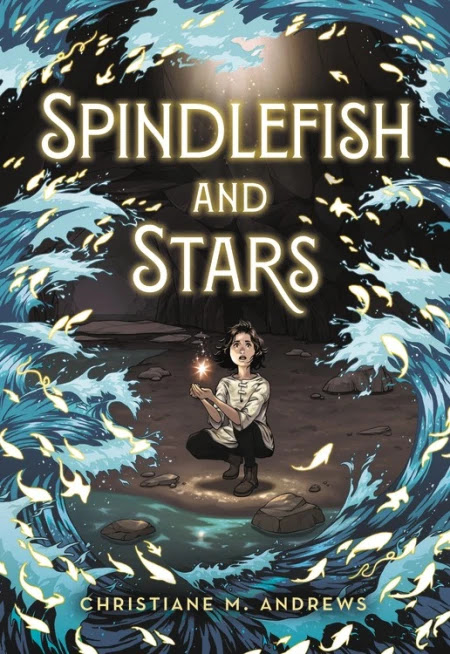
Christiane M. Andrews

Christiane M. Andrews grew up in rural New Hampshire, Vermont, and Maine, on the edges of mountains and woods and fields and sometimes even the sea. A writing and literature instructor, she lives with her husband and son and a small clutch of animals on an old New Hampshire hilltop farm.

Spindlefish and Stars is Andrews's first novel.

My Q&A with the author:

How much work does your title do to take readers into the story?

Because the entire story was inspired by a picture of a stargazy pie (a Cornish fish pie, sometimes decorated with pastry stars, where the fish heads are left poking through the crust and “gazing” at the sky), the working title for this novel was “Stargazy.” However, while the fish and the stars became the center of the story, the pie itself never made it into the draft, and my editor and I worked together to find a new title.

Though Spindlefish and Stars suggests the direction of the story, it deliberately does not take readers too far into it; in fact, it was a bit of a struggle to find a title that did not reveal too much! So many of the ones we brainstormed would have given away significant parts of the plot—Why did Clo’s father send her to this desperately gray island?—or identified aspects of the characters—Who is this old woman who locks Clo away? Why is Clo given such repulsive chores with the fish?—not meant to be understood until later in the text. Though the word “spindlefish” does not appear anywhere in the novel, I think readers will come to see how it fits… and I have actually seen readers using it to identify something left otherwise unnamed in the book.

What's in a name?

As is the case in fairytales where characters are identified only by some element of their identity (the woodsman, the witch, the prince, etc.), many of the characters in Spindlefish and Stars also remain unnamed: Clo’s father, the swineherd, the parchment-skin man, the bosun, the old apple-faced woman (though there is, in fact, a passing reference to her actual name slipped into the text!). Only a few characters—and the piggish cat—have names, and here, I tried to reference (but not reveal) the myths from which I lift them: Clothilde (Clo), the main character; Cary, the boy she meets and befriends on the island; and Haros, a man Clo must journey to find by the sea.

Locations, too, are left unlabeled, with the goal of not limiting Clo’s place in the world. Though her story is inspired by Greek myth, variations of this myth appear in many different legends and tales, and because Clo and her sometimes-thieving father travel from village to village to village always seeking out new homes, she really could be from anywhere.

How surprised would your teenage reader self be by your novel?

I think my teenage self would be moderately surprised. I was reading a good deal of Russian literature then—so not, I would say, particularly close to Spindlefish and Stars—but I remember also being very taken with myths and retellings, so teenage-me would likely not find it unexpected that the novel re-imagines several Greek myths. Teenage-me probably would be surprised by a middle grade novel, though, as I had not thought seriously of writing for children until I had my own son and began re-discovering the beauty of children’s literature with him. However, now that I think about it, I did have to write a children’s picture book for senior English in high school, and I remember absolutely loving this project, so perhaps I wouldn’t be surprised after all!

Do you find it harder to write beginnings or endings? Which do you change more?

Endings! Endings are definitely more challenging for me, and this is absolutely my own fault. I spend a lot of time thinking about a story before I even begin writing it, so I usually have a good idea of where I’m starting and where I’m going… but only up to about the middle of the book. When I wrote Spindlefish and Stars, I knew how Clo would arrive on the island, I knew what she would discover about the old woman and herself when she was there, I knew the image and scene I was writing toward (which is now the chapter “In Which Our Hero Dies”), but I did not really know how I would help her off this island where I had trapped her. Because I had left her in a rather bleak place with only a few personal possessions, I had, in a sense, also trapped myself: I had to reconsider all the details I had seeded in the earlier parts of the story to see how they could be used to resolve the plot. This was a good exercise—and one that fortunately worked out well!—but in current projects, I have been trying to keep at least a vague idea of the ending in mind, even if it’s constantly shifting as I write.

What non-literary inspirations have influenced your writing?

In Spindlefish and Stars, there are a few non-literary inspirations. Brueghel’s paintings—especially his Landscape with the Fall of Icarus—shaped not only the portrayal of Clo’s father and his work with art, but also the development of the book’s plot and themes. The pre-Raphaelite painters, too, with their re-imaginings of myths and legends and tales (particularly the different renderings of the Lady of Shalott by Waterhouse, Rossetti, and Hunt) probably also had some influence here.

Place was likely an inspiration as well: I lived in Downeast Maine in high school and grew up vacationing with my family on various islands (and even now take summer camping trips with my own family to quiet sections of Atlantic Canada), so I’m certain I drew from these experiences when writing about Clo’s ocean journey. Clo is desperate to escape the perpetually gray island she travels to, but I’ve always loved the coast more when it’s foggy and silent and gray.

And lastly, though I wasn’t necessarily thinking of them as I was writing, I’m sure my mother and grandmother, who spun and sewed and wove and knitted, inspired the portrayal of the old apple-faced woman—at least her dedication to her craft, if not her (rather chilly) personality! I was always struck by how much time and care and artistry went into my mother and grandmother’s projects: I wanted to honor that in the old woman’s weaving and show her work as art, and not, as it has often been dismissed, just “women’s work.” Because women who are engaged in fiber crafts are often making household objects or items of clothing for others, I also wanted to honor the generosity of this art, and to explore how both the crafting skills and the objects themselves are passed from generation to generation.
Visit Christiane M. Andrews's website.

My Book, The Movie: Spindlefish and Stars.

The Page 69 Test: Spindlefish and Stars.

--Marshal Zeringue

Monday, October 26, 2020

Yoon Ha Lee

Yoon Ha Lee's novel Ninefox Gambit came out from Solaris in 2016 and quickly garnered massive critical acclaim and was short-listed for the Arthur C. Clarke, Hugo and Nebula Awards. It won the Best First Novel Award in the Locus Awards and the Reddit Fantasy Award. Revenant Gun, the third novel in the Machineries of Empire series, was nominated for a 2019 Hugo Award.

Lee's new novel is Phoenix Extravagant.

My Q&A with the author:

How much work does your title do to take readers into the story?

I've always thought a title should intrigue the reader and, if possible, just sound cool. It might be weird to have a story about a mecha dragon (featured on the cover!) called Phoenix Extravagant, but that was the title that came to me when I conceived this novel. It refers to a magical paint pigment with fiery and destructive power, and I picked the phoenix reference because it's based on a real-world watercolor pigment, PO49 (Quinacridone Gold), that has a glowing golden tone. The secret behind the creation of these magical pigments is at the heart of the story's exploration of themes of colonialism and assimilation.

What's in a name?

My setting, Hwaguk, is loosely based on Korea during the Japanese occupation; the Japan-analogue is called Razan. My protagonist's name is Jebi, which means "swallow" (as in the bird); their sister is Bongsunga, or "balsam." These aren't typical names, but I wanted to avoid colliding with the names of well-known people and frankly, there's not a huge amount of variation in Korean names. Many Koreans love nature so names derived from the natural world seemed like a good choice. I made the perhaps unusual decision to use a constructed naming language for the people of Razan rather than actual Japanese names, again to avoid colliding with the names of historical figures.

How surprised would your teenage reader self be by your new novel?

My teenage self wouldn't be surprised by the fact that it's a fantasy, as my original ambition was to write fantasy, not the science fiction I'm better known for. But all the stories I produced as a teenager were about Western characters. It literally hadn't occurred to me that I could write a story drawing upon my Korean heritage and the years I lived in that country. The other thing that would startle teenage-me is that I spent middle school complaining loudly to my best friend that dragons were cliché. Obviously I've changed my mind since then!

Do you find it harder to write beginnings or endings? Which do you change more?

Beginnings for sure. I don't even start writing until I know the ending; I learned in college that writing without a goal in mind is a great way to end up with unfinished story-corpses all over my hard drive. In this case, I goofed on a colossal scale. Not only was my opening wrong, my first 40,000 words (not a typo) were wrong. The first draft of Phoenix Extravagant was set in a fake fantasy Renaissance Europe, and several months into it I realized it wasn't working, tossed out all those words, and started over, this time with a setting I could connect to--Korea.

Do you see much of yourself in your characters? Do they have any connection to your personality, or are they a world apart?

The only way I can write is to find some point of connection between myself and my characters, even the most despicable villains. In the case of my protagonist Jebi, they're a painter. The arts figure prominently in the novel, and I picked painting instead of pottery (although Korean celadon is arguably better known) because I'm a watercolorist, albeit in the Western rather than the Eastern style. Jebi is an ordinary person caught up in politics and intrigue and war, and they're rather poorly equipped for it. All they want to do is paint! I identify a lot with Jebi; I have no martial skills worth mentioning, and I'm not notably brave. Like Jebi, my basic desire in life is to make beautiful things. Of course, Jebi will find that they may have to take a stand.

What non-literary inspirations have influenced your writing?

For this novel specifically, I did a lot of reading up on Korean art history. In general I get most of my worldbuilding ideas from nonfiction, especially history, or games (both computer games and tabletop games). The really ironic influence is anime, which is of course Japanese. My then-boyfriend now-husband Joe introduced me to it in college, and I still enjoy it to this day, from the outlandish mecha robots to romantic comedies or sf/f shows. My mecha dragon, Arazi, was directly inspired by watching anime like Visions of Escaflowne.
Visit Yoon Ha Lee's website.

The Page 69 Test: Revenant Gun.

Writers Read: Yoon Ha Lee (June 2018).

My Book, The Movie: Ninefox Gambit.

--Marshal Zeringue